

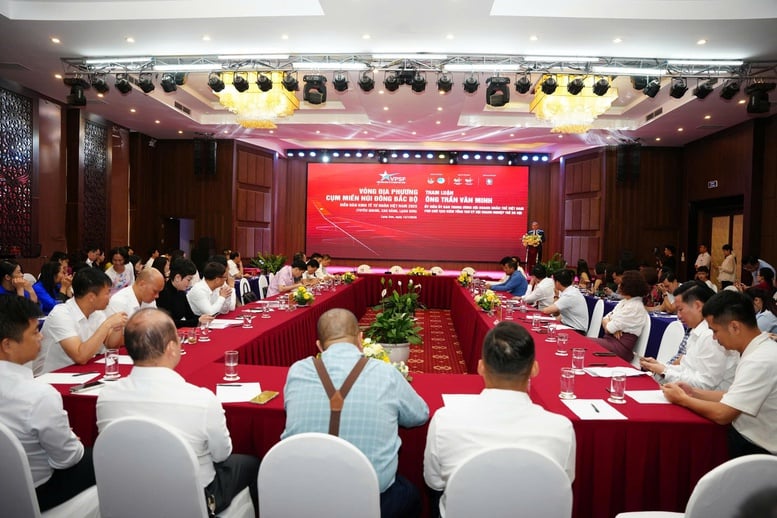
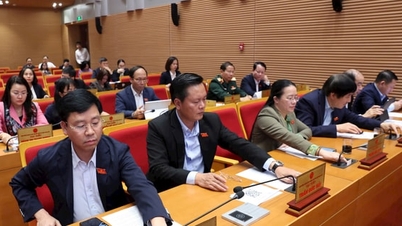
The Northeast Mountainous Region Private Economic Forum, local dialogue round - Photo: VGP/HT
Private sector economy - the foundation for growth in border regions.
At the Northeast Mountainous Region Private Economic Forum, the local dialogue round on July 13th was lively, bringing together more than 100 young entrepreneurs from the Northeast provinces and across the country.
The Young Entrepreneurs Associations of the provinces have presented a comprehensive picture of the aspirations for innovation and development of the private economic sector in mountainous areas. Particularly noteworthy is the leading role of the "Four Resolutions" comprising Resolution 57 (on science, technology and innovation), Resolution 59 (international integration), Resolution 66 (legal reform), and Resolution 68 (private economic development).
Mr. Nguyen Van Nam, a member of the Presidium of the Central Committee of the Vietnam Young Entrepreneurs Association and Chairman of the Bac Kan (formerly) Young Entrepreneurs Association, affirmed that digital transformation is the "shortest path" for localities to narrow the development gap. Resolution 57 has been concretized through the application of technology to trace the origin of local products such as cassava vermicelli and green pumpkin tea, or by bringing agricultural products onto e-commerce platforms.
Resolution 59 on international integration also helps local businesses gradually access global value chains. Regional investment promotion activities and specialized trade fairs are considered effective bridges for small businesses to keep pace with larger markets.
However, the key point remains Resolution 68 - the "heart" of the Quad. The Bac Kan Young Entrepreneurs Association emphasized the need to concretize support policies with action plans and clear resource allocation, avoiding policies being "buried" under layers of bureaucracy.
Meanwhile, Mr. Dam Van Tien, Vice Chairman of the Cao Bang Young Entrepreneurs Association, shared: Due to its geographical characteristics as a mountainous border region, Cao Bang has a large proportion of small and micro-enterprises, facing many difficulties in accessing credit, land, and technology. The representative of the Cao Bang Young Entrepreneurs Association frankly pointed out that a major bottleneck is the lack of leading enterprises, preventing small businesses from integrating into the value chain.
Meanwhile, the logistics system and digital infrastructure at border gates still have many shortcomings, reducing competitiveness. Resolution 68 is expected to boost confidence in the private sector, but without concrete action, the advantages from this resolution will not be realized.
The association proposed five pillars to improve the situation: perfecting the legal framework, investing in digital infrastructure, providing specific financial support, attracting leading enterprises, and developing human resources according to local needs.
The private sector must go hand in hand with business ethics.
Mr. Do Van Dinh, Vice Chairman of the Tuyen Quang Provincial Young Entrepreneurs Association, raised the issue: To develop startups in mountainous areas, fairness in policy implementation needs to be restored. Accordingly, local startups are being "encroached upon" by large corporations – entities that are supposed to lead national innovation.
Resolution 57 sets ambitious goals, but reality shows that less than 5% of startups operate in the midland and mountainous regions. Therefore, a favorable development environment, more testing grounds, financial support, and market access opportunities are urgently needed.
Representatives of the Tuyen Quang Young Entrepreneurs Association emphasized that, in addition to policies for developing the private economy, it is necessary to build a sustainable business culture. The business ecosystem cannot develop if there are "ghost" businesses, businesses that exploit policies, circumvent laws, or produce substandard goods.
With approximately 3,000 small and micro-enterprises, Tuyen Quang believes that three factors (appropriate policies, sufficient infrastructure, and confidence in the business environment) are key to promoting growth. The association proposed five specific groups of solutions ranging from institutions, credit, land, to human resource training and innovation.
From the perspective of a locality that has gone through many stages of development, Mr. Tran Van Minh, Vice Chairman and General Secretary of the Hanoi Young Entrepreneurs Association, commented: Resolution 68 is a historical turning point, setting specific targets for the proportion of private sector contribution to GDP, budget, and employment.
However, the biggest challenge lies not in mindset or written documents, but in implementation. The association pointed out three obstacles: inconsistent institutions between the central and local levels; the domestic market being dominated by large distribution chains; and small businesses lacking the capacity to participate in supply chains.
One notable point is the requirement for "compliance." If small businesses lack financial transparency and fail to upgrade their governance, they will be excluded from the mainstream when the policy is implemented comprehensively.
The association proposed three groups of solutions: inter-sectoral monitoring, prioritizing trade promotion, and shifting policy thinking from "support" to "trust".
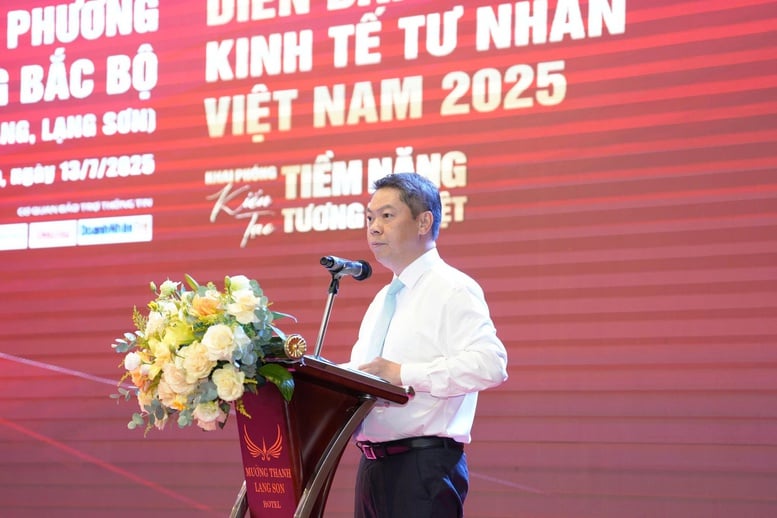
Mr. Doan Thanh Son, Vice Chairman of the People's Committee of Lang Son province, giving a speech - Photo: VGP/HT
Representing the government, Mr. Doan Thanh Son, Vice Chairman of the People's Committee of Lang Son province, stated: The provincial government always stands alongside businesses, considering their development as an important driving force to accelerate the transformation of the growth model, the application of technology, and the exploitation of the potential of the border region.
The dialogue program is part of a three-round series of connections within the Vietnam Private Economic Forum, encompassing local, ministerial/sectoral, and high-level levels. It serves as a direct bridge between business practices and policy-making, allowing the business community to reflect on challenges and propose practical policies.
The leaders of the Lang Son Provincial People's Committee emphasized the importance of the four major resolutions of the Central Government, which not only provide national strategic direction but also open up opportunities for comprehensive changes in the development methods of localities like Lang Son.
Mr. Doan Thanh Son highly appreciated the contributions from businesses, considering them as a basis for the locality to refine policies and improve the investment environment. Mr. Son hoped that young entrepreneurs in the province would boldly share their proposals, while also strengthening their capacity for digital transformation, innovating business models, and aiming for sustainable development.
Over the past years, Lang Son's economy has experienced positive growth. GRDP in 2024 reached 7.8%, and in the first six months of 2025 alone, it increased by 8.37% – exceeding the central government's target. Total budget revenue in the first six months reached over 80% of the plan, while import and export turnover through the province is estimated at over 40.5 billion USD, an increase of 48.3% compared to the same period last year.
Notably, the private sector plays a very significant role. Each year, it contributes approximately 63% of the province's GRDP and 15% of its budget revenue.
Notably, Lang Son was also recognized as a UNESCO Global Geopark in April 2025, opening up prospects for the development of ecotourism and cultural tourism. With its mild climate, unique topography, and long-standing cultural traditions, the province possesses ample potential for developing specialty agriculture, community tourism, and processing industries.
Regarding industrial planning, the province has approved two large industrial parks: Dong Banh (162 ha) and VSIP Lang Son (599 ha), along with nine industrial clusters with a total area of 373 ha. The goal by 2030 is to establish seven industrial parks (2,055 ha) and 24 industrial clusters (1,158 ha).
The provincial government is accelerating the implementation of the Smart Border Gate Project, following the government's direction, considering it a breakthrough in reforming procedures and increasing customs clearance capacity. Efforts to improve the Provincial Competitiveness Index (PCI) have also yielded positive results: Lang Son has consistently maintained a position in the Top 30 out of 63 provinces and cities, ranking 13th, 15th, and 16th in the last three years.
Alongside infrastructure development, the province is committed to supporting businesses in accessing land, credit, technology, and markets. The provincial People's Committee leaders stated that listening to the voices of businesses, especially those in the private sector, will be a crucial criterion for adjusting policies, ensuring they are relevant to reality and meet needs.
At the Forum, the leaders of Lang Son province also put forward three specific recommendations to promote the role of the private sector. Firstly, the business community, especially young entrepreneurs, need to proactively innovate business models, actively embrace digital transformation, and enhance competitiveness in the context of deep integration; secondly, the Provincial Young Entrepreneurs Association needs to play a core role in connecting and supporting its members, promoting entrepreneurship and innovation among young people; and thirdly, relevant agencies need to work alongside businesses in resolving difficulties, reforming administrative procedures, and promoting investment. The government committed to using business satisfaction as a measure of reform.
The leaders of Lang Son province have demonstrated a strong commitment to building a friendly, transparent, and dynamic investment ecosystem. This affirms that Lang Son is not only a destination but also a strategic partner for the business community in the process of national sustainable development.
Mr. Minh
Source: https://baochinhphu.vn/kinh-te-tu-nhan-vung-cao-ky-vong-but-pha-tu-bo-tu-nghi-quyet-102250713191457531.htm


![[Photo] Prime Minister Pham Minh Chinh attends the Conference summarizing and implementing tasks of the judicial sector.](/_next/image?url=https%3A%2F%2Fvphoto.vietnam.vn%2Fthumb%2F1200x675%2Fvietnam%2Fresource%2FIMAGE%2F2025%2F12%2F13%2F1765616082148_dsc-5565-jpg.webp&w=3840&q=75)













































































Comment (0)