

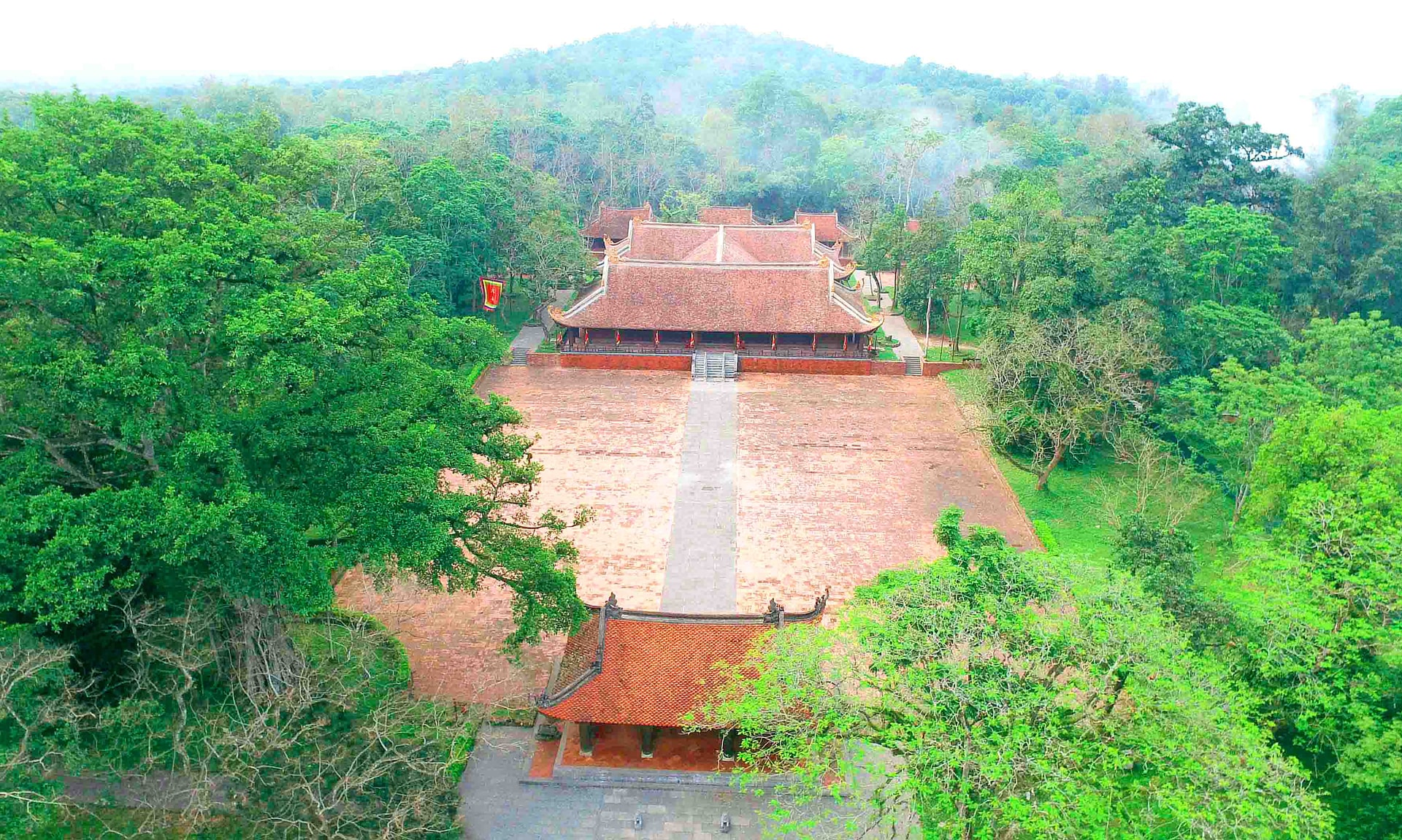
Walking slowly with history
Every time I return to my hometown, Lam Kinh is always a place I want to visit. Without making any plans, without rushing, it's simply a habit of a Thanh Hoa native who has left, wanting to rediscover the source of memories, wanting to walk slowly in a space where history still lingers. The road leading to the Lam Kinh National Special Historical Site remains the same, winding through peaceful villages, but each time I set foot there, the feeling within me is different.
Once, I arrived at Lam Kinh early in the morning, with a thin layer of mist still clinging to the ancient trees. Lam Kinh didn't overwhelm me at first. Stepping across the Bach Bridge (formerly called Tien Loan Bridge), and looking at the Ngoc River flowing silently beneath my feet, I always felt as if I had just crossed an invisible boundary, a boundary between the present and the past.
I often linger for quite a while in that space before moving on. Lam Kinh is not a place to rush. Here, one is forced to slow down, lest all the values be merely glanced at like a hastily viewed painting. Only when one delves deeper does the space gradually unfold, and then the grandeur of Lam Kinh becomes apparent. The architectural structures, bearing the distinct mark of East Asia and having survived for hundreds of years, are arranged within a cohesive and deliberate whole. I realize I am walking in a space built according to the ancient principle of "sitting on the mountain, facing the water": its back against the mountain, its face towards the river, and its surroundings enveloped in lush green forests. This very topography creates a unique atmosphere—cool, refreshing, and tranquil.
As we walked further, the layout of the palace complex, the imperial citadel, and the royal temple became clearer, like a neatly arranged chessboard amidst nature. The straight pathways and interconnected courtyards left first-time visitors in awe. I once stood for a long time in the dragon courtyard, not to admire the architecture, but to imagine. Imagining the ancient court sessions, the processions of officials in their formal attire, the ceremonies taking place under this sky. Then I wondered, what remains after several hundred years? Is it the foundations, the reconstructed wooden pillars, or some spirit that still silently lingers?
After many visits, the Lam Kinh Palace is no longer just a purely architectural structure to me. Each time I step into that space, I always feel like I'm standing before an extension of time. The carved patterns, the towering columns, tell not only stories of engineering or art, but also of humanity's efforts to preserve historical memory. I like sitting on the steps in front of the palace, where I can see the entire courtyard. There, one can more easily feel the insignificance of the individual before the vastness of history. A once glorious dynasty, one that created golden pages for the nation, is now encapsulated in this tranquil space.
.jpg)
On other occasions, I chose to go to the mausoleum. The road leading to Vinh Lang is not long, but each step feels very different. The mausoleum of King Le Thai To is not massive or elaborate. Everything is just right, simple yet solemn.
Connecting the past and the present
I remember the first time I heard about the guava tree that "laughs." At the time, I just smiled, considering it an interesting anecdote. But then, on a visit, I tried placing my hand on the trunk. The gentle vibration that spread through the branches and leaves surprised me. Not because of its strangeness, but because that moment compelled me to believe that in Lam Kinh, there are things that cannot be explained by ordinary reason.
Similarly, there's the story of the ancient ironwood tree known as the "self-sacrificing ironwood tree." I stood for a long time in front of the plot where it once stood. A tree over 600 years old, it fell at precisely the right time, its size strangely fitting for the reconstruction of the main hall. Believe it or not, that story makes Lam Kinh feel closer, as if this land always has its own way of connecting the past with the present.
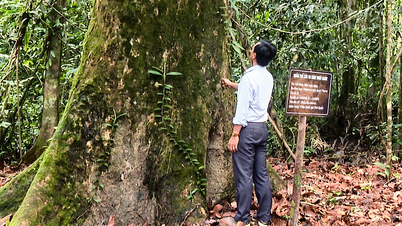
There were times I visited Lam Kinh on crowded days. Tourists swarmed the area, their laughter and chatter filling the air. But as soon as I turned onto a small path, venturing deeper into the forest, all sounds seemed to fade away. In that space, ancient trees like the green lim, banyan, and oak have stood there for hundreds of years, silently witnessing countless changes. Occasionally, I would hear squirrels scurrying through the branches, a bird darting through the foliage, or the faint sound of the forest breathing. Lam Kinh is not just about rocks, wood, and inscriptions; it's also about life continuing day by day. People say there are nearly twenty ancient trees here, some between three and seven hundred years old. But for me, that number isn't as important as the feeling of walking through a primeval forest, where nature and history seem to have chosen to coexist.
.jpg)
I realized that what keeps me returning to Lam Kinh isn't the novelty of each visit. On the contrary, Lam Kinh remains almost unchanged. But it is precisely this unchanging quality that gives people a sense of security. In a world of constant change, having a place where time slows down and memories are carefully preserved is truly precious.
From a historical site once nestled quietly amidst the green forest, Lam Kinh is now gradually becoming a familiar destination for tourists from all over – people who come not only to visit, but also to experience, to listen, and to connect with history through emotion. According to the Lam Kinh Historical Site Management Board, since the site was restored and renovated, the landscape has become increasingly spacious, clean, and beautiful; the number of visitors has steadily increased, especially during traditional festivals. This not only contributes to preserving and spreading the historical and cultural values of the locality and the nation, but also creates momentum for the development of the service economy , gradually improving the lives of the people in the region.
The Lam Kinh historical site holds profound cultural and sacred value not only for the people of Thanh Hoa but for the entire nation. In 1962, the Lam Kinh site was classified as a national historical site. In 1994, the Prime Minister issued Decision No. 609/QD-TTg approving the overall project for the restoration, rehabilitation, and preservation of the Lam Kinh historical site. Notably, on September 27, 2012, the Prime Minister issued Decision No. 1419/QD-TTg recognizing the Lam Kinh historical site as a special national historical site.
Source: https://baolamdong.vn/lam-kinh-diem-dung-cho-nhung-nguoi-thich-lang-nghe-lich-su-414061.html

![[Photo] Solemn bathing ceremony and Buddha procession in Hue](https://vphoto.vietnam.vn/thumb/1200x675/vietnam/resource/IMAGE/2026/05/31/1780228263543_1-jpg.webp)
![[Photo] The General Secretary, President and his wife begin their state visit to the Philippines.](https://vphoto.vietnam.vn/thumb/1200x675/vietnam/resource/IMAGE/2026/05/31/1780230559452_anh-man-hinh-2026-05-31-luc-19-28-11.png)
![[Image] Hanoi Police officially crowned champions of V-League 2025/2026](https://vphoto.vietnam.vn/thumb/1200x675/vietnam/resource/IMAGE/2026/05/31/1780244769054_ndo_br_039d561b692be875b13a-jpg.webp)
![[Photo] Admire the coral "masterpiece" amidst the million-year-old heritage of Dak Lak province.](https://vphoto.vietnam.vn/thumb/1200x675/vietnam/resource/IMAGE/2026/05/31/1780221235105_anh-man-hinh-2026-05-31-luc-16-53-27.png)




















![[Video] Sunset at Lap An Lagoon – Where the sun sets over the fishing nets](https://vphoto.vietnam.vn/thumb/340x192/vietnam/resource/IMAGE/2026/05/31/1780192137701_beach-landscape-sea-water-nature-grass-745871-pxhere-com.jpeg)


































































Comment (0)