


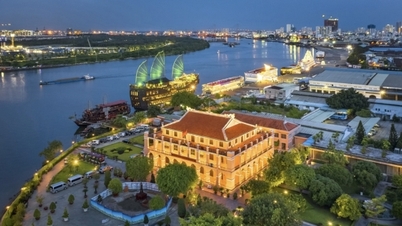
The Ho Chi Minh City History Museum regularly organizes thematic exhibitions that attract visitors - Photo: Provided by the Museum
The discussions revolved around the current state of museum operations; research, collection, inventory, preservation, and documentation of artifacts; data digitization and the application of technology in museum activities; promoting the value of cultural heritage; and proposing solutions for developing the museum system in Ho Chi Minh City.
Museums must be connected to the pulse of life.
Dr. Nguyen Thi Hau assessed that Ho Chi Minh City's museum system currently has many limitations. While there are many museums with diverse themes, they are not truly attractive, often featuring overlapping types of artifacts, and exhibiting rather monotonous displays lacking connectivity.
"Museums still operate on a traditional, 'closed' model, focusing more on displaying artifacts than on storytelling and interpreting them, leading to a disconnect in the way history is recreated. Most museums are not closely connected to community life; the lack of connection between events, figures, and artifacts displayed in museums and their historical context and contemporary life diminishes the 'vibrancy' of cultural heritage and the sense that heritage belongs to the community," Ms. Hau said.

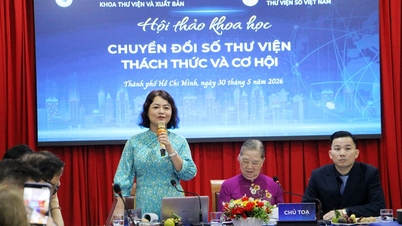
Dr. Nguyen Thi Hau giving her opinion - Photo: Hoai Phuong
Ms. Hau proposed that the museum system be organized into four main components: " The central museum acts as the 'brain' of the system, tasked with telling the overall story of the city's formation, development, and characteristics. Specialized museums are organized along distinct content axes such as art, war, migration, or urban economics ... Each museum should focus on a central question, avoiding duplication and creating depth in interpretation."
Community heritage spaces encompass markets, residential areas, alleys, and craft villages, where heritage exists as "living heritage." Integrating these spaces into museum systems will help expand the scope of interpretation beyond formal institutions. Digital museums play a connecting role across the entire ecosystem through heritage maps, augmented reality/virtual reality (AR/VR) technology, and open databases.

Former Director of the Ho Chi Minh City Museum of Fine Arts, Ma Thanh Cao, proposed solutions at the conference - Photo: HOAI PHUONG
Ms. Ma Thanh Cao, former Director of the Ho Chi Minh City Museum of Fine Arts, suggested that efforts should be intensified in information gathering and research, as this would provide more new materials to introduce to tourists. Technology and techniques are merely tools for tourists to access this information.
Ms. Nguyen Thi Tham, former Director of the Southern Vietnam Women's Museum, shared that it's necessary to avoid the mindset that museums must be outdated, and instead focus on museums that are connected to the pulse of life and attract young people. This is because museums also carry an educational mission. Ms. Tham also emphasized the importance of maximizing the use of social media to promote museums.

Delegates present their opinions at the conference - Photo: HOAI PHUONG
Building a modern, highly interactive model.
According to Tran The Thuan, Director of the Ho Chi Minh City Department of Culture and Sports, during the period 2026-2030, the city's museum system will improve the quality of its professional activities; focus on scientific research, collecting original artifacts, and purchasing exceptionally rare artifacts to propose for recognition as national treasures; and concentrate on inventorying and managing artifacts using software, aiming for synchronized artifact management.
Innovating the content and methods of modern exhibitions, using artifacts to tell stories, and educating and communicating about cultural heritage aims to better serve the needs of people who wish to visit, learn, and experience.
The development of highly skilled human resources in management and scientific research, with proficiency in information technology, and the strengthening of connections, exchanges, cooperation, and sharing of experiences between museums in Ho Chi Minh City and the national and international museum systems need to be given greater attention.
"The goal is to build the museum into a place that preserves urban memories, a community education space, a cultural creativity space, and an attractive tourist destination for Ho Chi Minh City," Mr. Tran The Thuan shared.
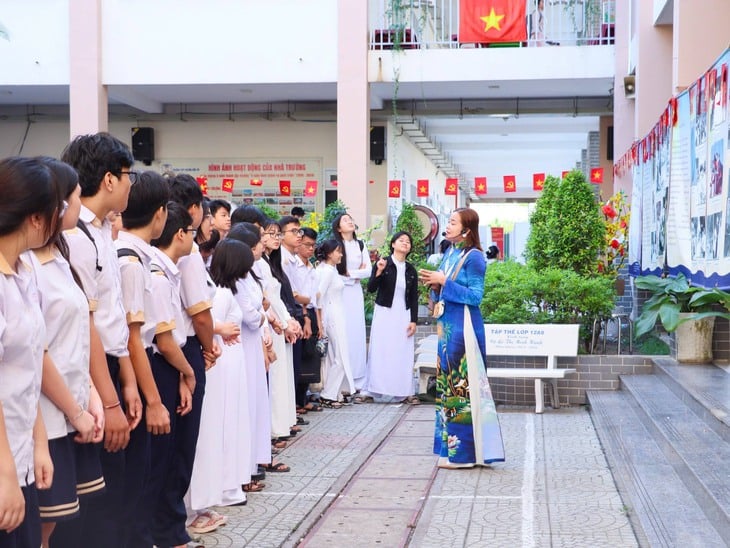
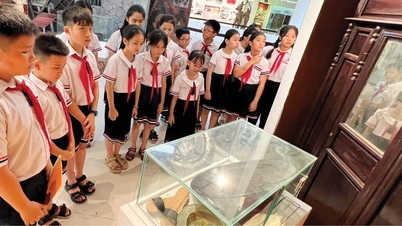
The War Remnants Museum organizes traveling exhibitions at schools in Ho Chi Minh City - Photo: Organizing Committee.
Summarizing museum activities in Ho Chi Minh City during the 2021-2025 period, Mr. Hoang Nghi - Head of the Cultural Heritage Department, Ho Chi Minh City Department of Culture and Sports - said that during this period, museums welcomed more than 13.4 million visitors, including nearly 4 million foreign visitors.
The Department is promoting the introduction of heritage to schools and encouraging students to visit museums. To date, museums have digitized 249,319 artifacts and image documents in 2D, and 2,176 artifacts and documents in 3D.
Mr. Pham Dinh Phong, Deputy Director of the Department of Cultural Heritage (Ministry of Culture, Sports and Tourism), suggested that Ho Chi Minh City's museum system should focus on building interactive experiential spaces, applying digital technology, and improving the quality of exhibition design. He also recommended strengthening the development of museum databases and artifacts; completing 3D digitization of national treasures and rare artifacts; and gradually forming a cultural heritage data ecosystem in Ho Chi Minh City connected to the national data system.
According to Mr. Phong, museum development must be linked to the cultural industry and creative tourism. Museums need to develop distinctive cultural products, enhance nighttime activities, offer experiential programs, educational services, and cultural services to improve their ability to attract tourists and create sustainable revenue streams.
Ho Chi Minh City currently has 25 museums, including 13 public museums (9 under the Department of Culture and Sports, and 5 under the management of central ministries and agencies) and 11 private museums.
The museums house 692,626 artifacts and documents (including 296,665 original artifacts) and 25 national treasures (22 national treasures held in public museums and 3 national treasures held in non-public museums and private collections).
Source: https://tuoitre.vn/lam-sao-de-bao-tang-hap-dan-20260530094027233.htm
![[Image] Nearly 125,000 Hanoi students completed the Literature exam for the 10th grade entrance exam.](https://vphoto.vietnam.vn/thumb/1200x675/vietnam/resource/IMAGE/2026/05/30/1780117233041_ndo_br_thiet-ke-chua-co-ten-2-png.webp)




































































Comment (0)