|
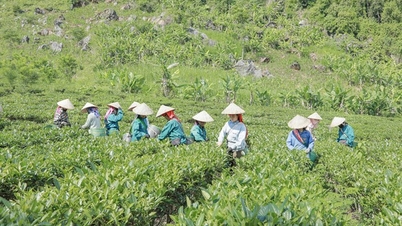
| Tea harvesting. Photo: Ngoc Hai |
When I returned to Minh Ly, I stayed at Mr. Dam's house. He was about 5 or 6 years older than me, honest but somewhat patriarchal. Mr. Dam's father had passed away early, leaving only his elderly mother, who was 80 years old at the time but still seemed sharp and agile.
Mr. and Mrs. Đảm have five children, both boys and girls, like chickens and ducks. Their eldest son, Bảo, is only 16. The children's names are quite amusing. Besides Mr. Đảm, they have two sons named Bảo and Thành. Their three daughters are named Hoàn, Kế, and Hoạch.
The order of names in the family is Dam - Bao - Hoan - Thanh - Ke - Hoach. After our agency returned to the city, we heard that the couple had another son. Having run out of names, the father named him Them. All nine members of the family, as well as the people in the village, depend on tea cultivation for their livelihood.
I rested on the double bed next to the altar, while the central room, furnished with a table and chairs, served as a reception area. The two side rooms were for my siblings, my grandmother, and the rest of the family. The house wasn't large, but it was well-designed; banana trees were planted in the back, and tea plants grew on the front plot.
My family also owned a hillside where they grew tea, but it was about a hundred meters away from the house. It was only after moving here that I started drinking tea daily. And I can say that it was here that I first gained some understanding of tea and learned to drink it.
I first learned about Thai Nguyen tea in 1958, when I had business in Thai Nguyen from Hanoi . At lunchtime, I went to the Thai Nguyen Food and Beverage Trading Store to find something to eat. It was called a food store, but every day they only offered one item: pho, and it was "meatless" pho – just noodles and broth, no meat at all. Occasionally, they would include pork, but only sometimes. Not only was there no meat, but there weren't even a few sprigs of green onions or a slice of lime or chili. Life seemed to revolve around simply getting enough to eat.
I don't know when it started, but the shop added another item to its menu: tea in a teapot. It wasn't pre-brewed tea; instead, customers were provided with a teapot and cups, a small packet of tea wrapped in newspaper, and a 2.5-liter Rạng Đông thermos when they wanted to drink tea. Customers could brew it themselves, adjusting the strength to their liking. They could sit for a few minutes or for a long time.
We used to spend entire evenings sitting with a pot of tea. Drinking tea was also an excuse to sit and chat for a long time. But when I returned in 1960, this "specialty" had somehow disappeared. Perhaps the tea-selling business wasn't profitable. The saying, "One pot of tea, three thermoses of water," did it originate in Thai Nguyen ? The tea was good, but one thermos of boiling water wasn't enough, so many customers always asked for more, which was inconvenient, and the price wasn't high.
That was my first time drinking Thai Nguyen tea, but honestly, I didn't really know how to appreciate tea until I returned to Minh Ly.
I remember the day the village headman took me to his family to introduce me. Mr. Dam brewed tea for his guests. When he opened the banana leaf stopper of the bamboo tube containing the tea, a gentle aroma wafted out, spreading throughout the house. Inhaling it made me feel refreshed. Mr. Dam explained that dried tea leaves easily lose their aroma and are very sensitive, so they must be kept away from other things with strong smells. Therefore, after carefully pouring the tea from the tube into the teapot, he immediately closed the lid and put it in the attic.
Looking at the cup of tea, with its pale green tint mixed with yellow and its delicate aroma, I was about to drink it immediately, but Mr. Dam advised me not to rush, saying that to truly appreciate the taste of tea, one must take their time. He suggested I lift the cup to my nose for a few minutes to savor the fragrant aroma.
I followed the instructions. The first sips of tea revealed a slightly bitter taste, followed by a hint of sweetness that lingered in my throat for a long time. The rich flavor permeated my teeth. Drinking tea was like smoking tobacco; it became an addiction. Waking up without a cup of tea for breakfast felt like being lost, my mouth feeling bland. Enjoying tea is definitely not for impatient people.
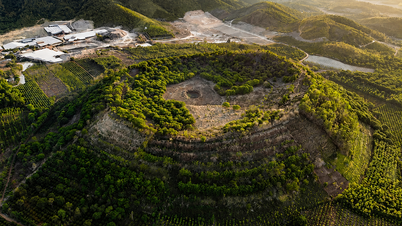
Usually, when I woke up, the whole family had already gone up the hill to pick tea leaves. Only Mr. Dam's mother, his children, and the little one were left at home. Everyone would get up and go picking tea leaves while it was still misty. I also went with the family up the hill once to watch them pick tea leaves and try it myself. The family's tea plantation was as vast as a forest.
It seems easy, but picking tea leaves isn't simple. I picked them all day but only managed to get a few handfuls. Observing everyone else, I noticed that everyone's fingers seemed to have eyes, moving as fast as a dance, and each tea leaf was plucked at the perfect time.
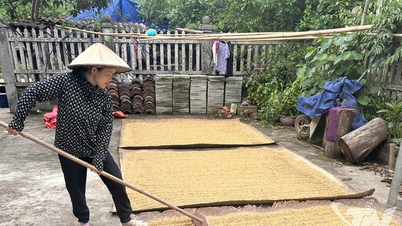
The harvested tea leaves are brought back and spread out on a brick courtyard to drain excess water. However, they shouldn't be dried for too long, so that the leaves remain fresh when processed. It's said that to speed things up, some families even wear boots and stomp on the piles of tea to let the water drain out. While this might speed things up, the tea will spoil, and the resulting brew will be cloudy. Only tea makers know the exact drying time.


However, the process of roasting and drying tea leaves is not simple.
In the evening, after dinner, Mrs. Dam cleaned a rather large pan and placed it on the stove to light the fire. She also arranged several sieves and baskets next to the stove. After Mrs. Dam finished preparing, Mr. Dam came and sat by the pan to begin his work, and I only saw Mrs. Dam sitting there.
Grandpa Dam assured that roasting tea requires meticulousness, patience, dexterity, and quick eyesight. Young people lack patience and often do auxiliary tasks. The pan is filled with fresh tea leaves, then the roasting begins, with one hand stirring continuously from the moment the tea is added until the batch is finished. This is called continuous roasting. Before adding the fresh tea leaves to the pan, Grandpa Dam must test the temperature with his hand, waiting until the pan is evenly heated to the right temperature before pouring the tea in. The flame must always burn evenly, neither too strong nor too weak. Roasting a batch of tea takes up the entire evening.
From the moment she sat by the stove, Mrs. Dam continuously stirred the tea leaves with her hands, sometimes using a wooden ladle to stir from the bottom of the pan to ensure even cooking, then stirring again. Every now and then, she would lift the pan, pour the tea leaves into a basket nearby, and sift and winnow them. She explained that this was to filter out any burnt or broken tea leaves, otherwise they would burn if not sifted and winnowed quickly enough.
Sitting beside the tea pan, Mr. Dam was as silent as a shadow. The way he roasted the tea by hand was different from today; people use machines much faster, but the quality can't compare. Only for home use do people meticulously roast and dry the tea by hand. No one in the market can do that. That's why drinking tea at a tea-growing family's home is different from drinking tea at a tea shop. Later, I also realized that good tea isn't necessarily only found in Tan Cang.
Having the opportunity to drink tea in many tea-growing regions of Thai Nguyen province such as Dai Tu, Trai Cai, Phu Luong, Dinh Hoa, or even Quan Chu, Pho Yen, Song Cong… if the cultivation, irrigation, and drying are done carefully, the quality of the tea is in no way inferior.
I also have a memory related to tea. About 50 or 60 years ago, that is, in the 1970s, carrying goods with you was forbidden because the government did not allow people to trade... The prohibited goods included all sorts of things, including dried tea.
People were not allowed to carry dried tea leaves with them, and the rules were even stricter for officials. During that Tet holiday, while still in an evacuation area, I was allowed to return to Hanoi for the festivities. I heard that my father-in-law was a heavy tea drinker, so before I left, Mr. Dam's family packed me a few hundred grams of tea as a gift for him to enjoy during Tet.
Of course, I liked it very much, but I was also a little worried about its safety on the road. Mr. Dam said, "With 2 or 3 ounces of tea as a New Year's gift, no one will arrest you." He added cautiously, "Don't worry, I've wrapped it carefully; no one will know."
 |
| Thai green tea. Photo: Ngoc Hai |
The train from Dong Quang station to Hanoi during Tet was extremely crowded. There were no seats available; passengers had to squeeze together, practically sardines, with only one foot on the floor, making it almost impossible to move around. But I felt lucky, thinking that with such a large train, there probably wouldn't be any inspectors, and I was fortunate that the tea package Mr. Dam gave me as a gift would be spared.
I was getting impatient watching the train slowly crawl along the tracks. But unexpectedly, when the train stopped at Trung Giã station, a tax official suddenly appeared and boarded the carriage. Of course, he had to struggle to squeeze through the crowd, but he seemed used to it. He walked past.
I breathed a sigh of relief when I saw him pass. I thought I was safe, but before I could even celebrate, after only a few steps, the tax officer suddenly turned back to where I was standing, his eyes scrutinizing the bags passengers were carrying, and then he spoke in a commanding tone:
"Any passenger who has tea with them, please report it immediately."
He said it a third time, but no one said anything. After observing for a moment, he suddenly pointed at me.
- Please open the bag so we can inspect it.


Knowing there was no denying it, and being unaccustomed to lying, all I could say was:
"My landlord at the evacuation site gave me a few ounces of tea to take back to Hanoi as a Tet gift."
I thought he would be understanding and let it go, but despite my pleas, the tax officer's face remained expressionless:
- Please follow me to the captain's cabin so we can get to work.
In the ship's captain's cabin, the few ounces of fine tea that Mr. Dam had given me were immediately confiscated, despite my pleas. Back then, being accused of smuggling was troublesome, like being a criminal; the only way to get it back at the agency was disciplinary action, or even dismissal. So, despite my resentment, I reluctantly complied.
I was very sorry, but secretly very impressed. How did that tax officer know I was carrying tea? I asked. After receiving the tea package, the tax officer didn't hide anything: "When I passed by, I smelled the aroma, so I knew for sure someone was carrying tea. I saw your expression change, so I figured it out quickly."
Even the most delicious tea can sometimes have its drawbacks.
Source: https://baothainguyen.vn/xa-hoi/202603/lan-man-nho-tra-minh-ly-f8c1272/

![[Photo] General Secretary and President To Lam working with the Technical and Professional Center, Ministry of Public Security](https://vphoto.vietnam.vn/thumb/1200x675/vietnam/resource/IMAGE/2026/07/06/1783318005842_a1-bnd-1129-2263-jpg.webp)