

Ho Chi Minh City: The community food garden model at the Ho Chi Minh City University of Agriculture and Forestry uses organic and sustainable farming methods and aims to protect the environment.
In Vietnam, the model of community-based organic food gardens is attracting a lot of attention. Community food gardens are suitable not only for development in large cities but also in rural areas. These vegetable gardens will be managed by the community and shared with those in need, such as disadvantaged people and areas affected by natural disasters.
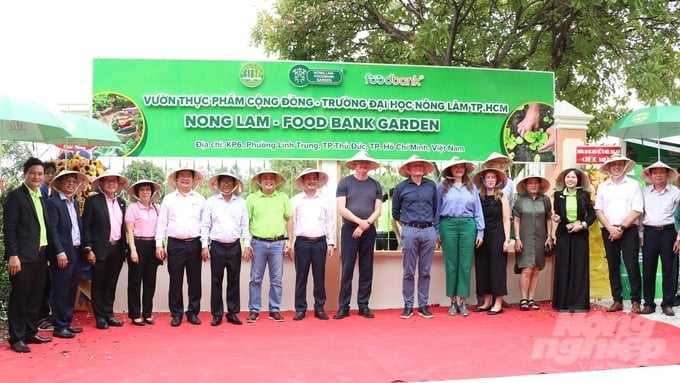
The non-profit organization Food Bank Vietnam, in collaboration with the University of Agriculture and Forestry of Ho Chi Minh City, inaugurated the Nong Lam Foodbank Garden community food model in Ho Chi Minh City. Photo: Tran Phi.
To promote and support this model, the non-profit organization Food Bank Vietnam, in collaboration with the Ho Chi Minh City University of Agriculture and Forestry, recently inaugurated the Nong Lam Community Food Garden (Foodbank Garden) in Thu Duc City. This model utilizes organic and sustainable farming methods, helping to minimize negative impacts on the environment.
This model also incorporates education on sustainable agriculture and nutrition, helping to raise community awareness and knowledge about organic production and its environmental benefits.
According to Associate Professor Dr. Nguyen Tat Toan, Rector of Ho Chi Minh City University of Agriculture and Forestry, the cooperation with Food Bank Vietnam in implementing the community food garden model not only contributes to improving the quality of life but also demonstrates the university's social responsibility.
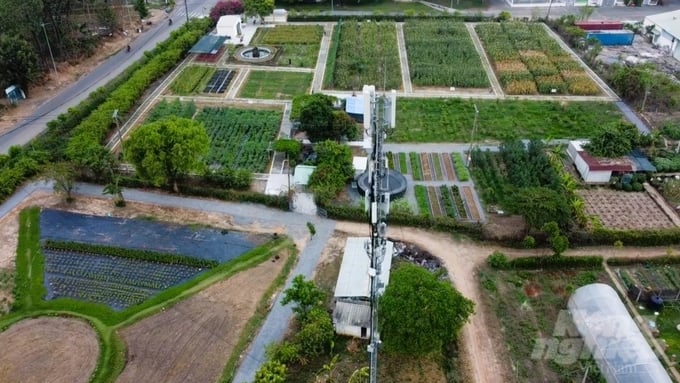
Nong Lam Foodbank Garden, a community food garden, initially covers an area of 1 hectare and focuses on growing a variety of organic crops. Photo: Tran Phi.
On its initial 1-hectare area, the garden focuses on growing a variety of crops to enhance nutritional diversity and store sufficient food to be delivered to areas in need in case of emergency. The community food garden at the Ho Chi Minh City University of Agriculture and Forestry utilizes readily available water, land, and energy resources as an ecosystem to reduce waste and protect the environment.
"The school will simultaneously implement training courses, workshops, and experiential learning programs to help people transition from traditional agriculture to sustainable organic agriculture," Associate Professor Dr. Nguyen Tat Toan emphasized.
Nong Lam Foodbank Garden is a non-profit project. This model supports and provides a transparent process for production, organic waste treatment, care, harvesting, and finally transportation to consumption.
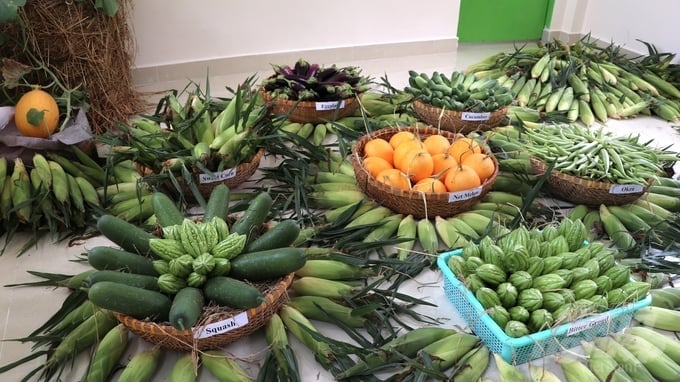
The community food garden model uses organic and sustainable farming methods and shares food resources with areas in need. Photo: Tran Phi.
Mr. Nguyen Tuan Khoi, Chairman of Food Bank Vietnam, stated that the Community Food Garden model aims for sustainable development and food balance in Vietnam. The model applies scientific methods to agriculture, helping to reduce the use of harmful chemicals. Specifically, Food Bank Vietnam collaborates with major coffee shop chains in Ho Chi Minh City to collect tea leaves, coffee grounds, and other organic food products to provide additional nutrients for plants and animals.
“Applying scientific methods to organic farming helps reduce the use of harmful chemicals, which is not only a trend in Vietnam but also a global trend. Based on these models, we will collaborate with the Ho Chi Minh City University of Agriculture and Forestry to apply and put them into practice. Once successful, we will seek support from relevant agencies to disseminate this knowledge to farmers, thereby promoting green, clean, organic, and sustainable production,” Mr. Khoi emphasized.
Mr. Khoi added that Starbucks Vietnam is currently a pioneer in participating in the activity of donating used tea leaves, coffee grounds, and unusable pastries from their chain of stores for this purpose.
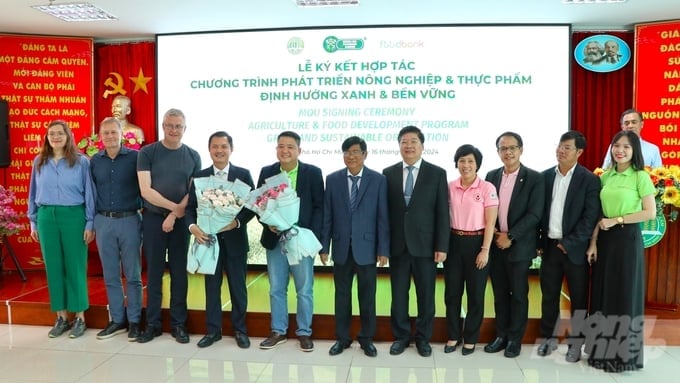
Food Bank Vietnam and Ho Chi Minh City University of Agriculture and Forestry have signed a cooperation agreement for a program to develop agriculture and food with a green and sustainable orientation. Photo: Tran Phi.
The Community Food Garden model is one of the outstanding activities in green transformation. Products cultivated and harvested from the model will be sorted by the project team to raise funds for community support activities within the Food Bank Vietnam network.
In addition to inaugurating the Foodbank Garden, Ho Chi Minh City University of Agriculture and Forestry and Food Bank Vietnam also signed a cooperation agreement on a program to develop agriculture and food with a green and sustainable orientation. The cooperation agreement includes components such as: Research and application of solutions to improve technology in agriculture; cooperation in training and education to promote green and sustainable initiatives; incubation and development of green agricultural products; and development of green models within the University and community green gardens.
Source: https://nongsanviet.nongnghiep.vn/lan-toa-san-xuat-huu-co-tu-mo-hinh-vuon-thuc-pham-cong-dong-d386508.html

![[Photo] General Secretary and President To Lam presides over a meeting with the Central Organizing Committee.](https://vphoto.vietnam.vn/thumb/1200x675/vietnam/resource/IMAGE/2026/06/03/1780482764658_a1-bnd-4741-3342-jpg.webp)

![[Photo] First session of the 14th Congress of the Vietnam Trade Union](https://vphoto.vietnam.vn/thumb/1200x675/vietnam/resource/IMAGE/2026/06/03/1780465947883_ndo_br_img-3852-jpg.webp)

![[Photo] Secretary of the National Assembly Party Committee, Chairman of the National Assembly presides over the meeting of the Standing Committee and Executive Committee of the National Assembly Party Committee.](https://vphoto.vietnam.vn/thumb/1200x675/vietnam/resource/IMAGE/2026/06/03/1780480353201_ndo_br_bnd-2585-jpg.webp)
















![The Essence of Viet Bac Villages: [Part 3] The Precious Fragrance of Nghinh Tuong](https://vphoto.vietnam.vn/thumb/402x226/vietnam/resource/IMAGE/2026/05/29/1780020600366_5237-tinh-tuy-ban-lang-viet-bac-bai-3-chuyen-o-nghinh-tuong-050626_700.jpeg)
![The Quintessence of Northern Vietnam's Villages: [Part 2] The Famous Cassava Noodles of Kunming](https://vphoto.vietnam.vn/thumb/402x226/vietnam/resource/IMAGE/2026/05/28/1779937455892_3929-3144-mien-dong-15-nongnghiep-023138.jpeg)
![The Essence of the Village: [Part 1] Wine on the mountain, tea in the clouds - Bang Phuc](https://vphoto.vietnam.vn/thumb/402x226/vietnam/resource/IMAGE/2026/05/27/1779841729178_3821-1jpg-nongnghiep-103814.jpeg)
























![[Video] Sunset at Lap An Lagoon – Where the sun sets over the fishing nets](https://vphoto.vietnam.vn/thumb/1200x675/vietnam/resource/IMAGE/2026/05/31/1780192137701_beach-landscape-sea-water-nature-grass-745871-pxhere-com.jpeg)

































Comment (0)