

As we drove along the winding roads of National Highway 20 towards the outskirts of Da Lat, my colleague, a long-time journalist in Lam Dong, steered the car into the side of a misty mountain and turned to me, saying, "With this cool weather, let me take you to a place in the past for a moment to let your soul find peace!"
"The 'space of the past,' as he put it, is the row of houses nestled against the side of a lush valley, with patches of forest evoking a sense of nostalgia. The houses themselves are also planned and arranged in a distinctly nostalgic style. As soon as we got out of the car, my friend called out, "Minh! Minh!" Ahead on the small road leading down into the valley, a thin man stepped forward, cheerfully saying, "It's been raining in Da Lat these past few days, and I was feeling down, but now we have a visitor. How wonderful!"
Cao Van Minh, the owner of this nostalgic space, is from Mo Duc, Quang Ngai , born in 1962. At the age of two, he was moved to Da Lat by his parents, so his personality, from his appearance and voice to his character, is distinctly Da Lat. The misty land and his love of art, his appreciation of historical and cultural values, have shaped this man's unique soul and personality. His voice is soft, his pronunciation slow, his speaking style calm and humble, yet when discussing historical and cultural issues, he commands respect from those he meets due to his profound knowledge and broad understanding. “I love Da Lat, and it’s hard to explain why. I think it’s destiny,” Mr. Cao Van Minh said, leading us on a tour of his main house, a blend of traditional and modern styles.
The entire wooden structure is in the style of traditional Central Highlands houses, but the glass frames and protective and decorative elements are products of industrial civilization. Mr. Minh uses this house as an exhibition space for images and artifacts about Da Lat's culture. There are thousands of images and artifacts in total. Some are originals, while others he has restored or copied, displayed according to thematic sections. In the cool, misty air, the layers of time's sediment of Da Lat's centuries-old history are gently turned, transporting viewers back to the past and touching their memories. There, we clearly see the first industrial machines in this land, when the French built a tea factory here in the early 20th century; images of steam-powered locomotives; and the traditional earthen roads under the silent pine forests...
 |
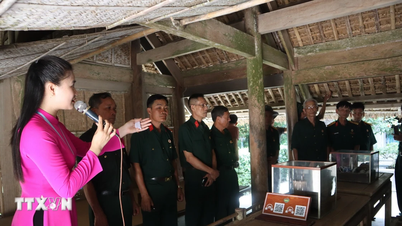
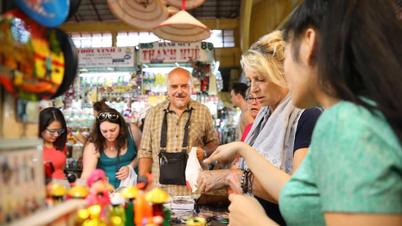
Mr. Cao Van Minh (on the right) and visitors in his "museum". Photo: Vu Dinh Dong |
Mr. Cao Van Minh's collection includes everything from tiny items like needles, threads, and yin-yang coins to tools and implements used by the people of Da Lat in the past, such as baskets, gongs, bows, crossbows, horse whips, and horse-drawn carriages. His thoughtful display helps viewers see that while Da Lat's culture was influenced by the French, all the imported items did not alter the core of its rich Central Highlands culture. This is also the message Mr. Minh wants to convey to visitors, the people of the Central Highlands, and the people of Da Lat across generations: always know how to "separate the wheat from the chaff" to enrich and beautify their unique cultural heritage. In the context of industrialization and urbanization, preserving the identity and soul of Da Lat is a significant challenge. To ensure Da Lat retains its profound and distinctive beauty requires the cultural awareness of everyone. Let's love Da Lat with appreciation, gentleness, empathy, and always say no to acts of brutal interference with nature and heritage...
“Do you know why I love the taste of Da Lat tea and cherish these images?” Mr. Minh asked as we looked at a photograph of workers at the Cau Dat Tea Factory. According to Mr. Cao Van Minh, this photograph was taken by the French about 100 years ago. Without waiting for our answer, he continued:
- That's because my parents worked as laborers at this factory since I was very young. I grew up surrounded by tea plants, deeply imbued with the hardships my parents endured every step of the way. Cau Dat was the first tea factory in Southeast Asia, built by the French in 1927. Now, it has become a historical and cultural site, with a museum for visitors. Every time I visit again, standing under those ancient tea trees, some about 100 years old, I feel a pang of nostalgia...
After listening to Mr. Minh's story, we asked:
- Is this garden a place that holds memories for your family?
- Oh no! This is another story, also beginning with a chance encounter in Da Lat. Please follow me...
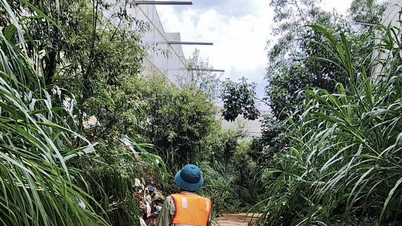
Mr. Minh led us around to the side of the house. The house nestled against the cliff, with a verdant forest valley in front and to the sides. In the hazy mist of the late afternoon, the forest before us seemed darker, deeper, and more evocative. We followed Mr. Minh slowly down into the valley. Between the patches of forest, Mr. Minh had meticulously laid bricks and stones to create paths and tied branches to make railings...
Stepping through the damp forest canopy, a stream appeared. Watching him hunched over as he led the way, occasionally reminding us to be careful, we understood even more deeply the passion and love for Da Lat within him, as profound as the stream itself. Walking along the stream a little further, Mr. Minh led us to a long, winding concrete tunnel xuyên through the mountain. This was the Hoa Xa Tunnel. We had heard and read about it, but had never set foot there. Over hundreds of years, the cogwheel railway, with its steam-powered locomotives connecting Da Lat with Phan Rang-Thap Cham... only these traces remain. And it is a part of the memories of the people of Da Lat, inextricably linked to the Cau Dat tea region, quietly and solemnly nestled amidst the misty mountains. The entire line has five tunnels. Mr. Cao Van Minh lives and volunteers as a tunnel guard in the area of tunnel number 4. The Hoa Xa tunnel system has an ancient, wild, and somewhat mysterious feel, sparking curiosity and a desire to explore . “About 10 years ago, I came here and was immediately captivated by this tunnel. I sold my property, bought this piece of forest land, and built it into a ‘Railway Tunnel rest stop.’ I want tourists, especially young people, to understand Da Lat more deeply and love Da Lat more through these heritage sites. It helps us connect with history to better understand the land and people of Da Lat,” Mr. Minh said about the circumstances that led him to his current work and passion.
Returning to his house, which he likened to a "museum" of Da Lat, Mr. Minh brewed tea for us. The flavor of Cau Dat-Da Lat tea is a matter of personal preference, but enjoying tea alongside someone as passionate about tea and Da Lat as Mr. Minh is undeniably delightful. We were surprised and amused to see, in a corner of the "museum," his neatly arranged belongings of a soldier: a backpack, uniform, helmet, canteen, shell casings... All bearing the marks of time. "It seems you used to be a soldier?" my friend asked. Mr. Minh replied:
- I am a veteran, having spent many years fighting and serving internationally in Cambodia. These artifacts are a part of my memories from my military life.
In 1982, putting aside his plans to study and become a civil servant, Cao Van Minh enlisted in the Lam Dong Provincial Military Command. After training, he went to Cambodia to fight on Front 479. “On the fierce battlefield, I was lucky that the bullets avoided me, so I returned safely. Many of my comrades sacrificed their lives. The remains of many of my comrades have yet to be found,” Minh confided.
In 1987, Cao Van Minh returned to Vietnam and was assigned to work at the Lam Dong Irrigation Department as a construction team leader. His experiences fighting and working there allowed him to deeply immerse himself in the life of Da Lat. His passion for collecting and preserving the essence of Da Lat began from there. Many people who knew him provided information, and some even donated artifacts for him to display and serve visitors.
Bidding farewell to Mr. Cao Van Minh's "railway tunnel stop," my friend continued to take me on a tour of the outskirts of Da Lat. "This land has many wonders hidden behind its mystical mist, and also many noble values concealed beneath its simple exterior. These are the touches that make Da Lat profound, romantic, and unforgettable..." my friend exclaimed! As for me, I thought, among the touches he just mentioned, I should add one more name: Cao Van Minh!
Source: https://www.qdnd.vn/phong-su-dieu-tra/cuoc-thi-nhung-tam-guong-binh-di-ma-cao-quy-lan-thu-17/lang-sau-mot-tinh-yeu-da-lat-1029680
![[Photo] General Secretary and President To Lam presides over the meeting to approve the draft report on the results of the second inspection by the Politburo of the Standing Committee of the Hanoi City Party Committee.](https://vphoto.vietnam.vn/thumb/1200x675/vietnam/resource/IMAGE/2026/05/26/1779789811432_a2-bnd-4430-9620-jpg.webp)
































































Comment (0)