

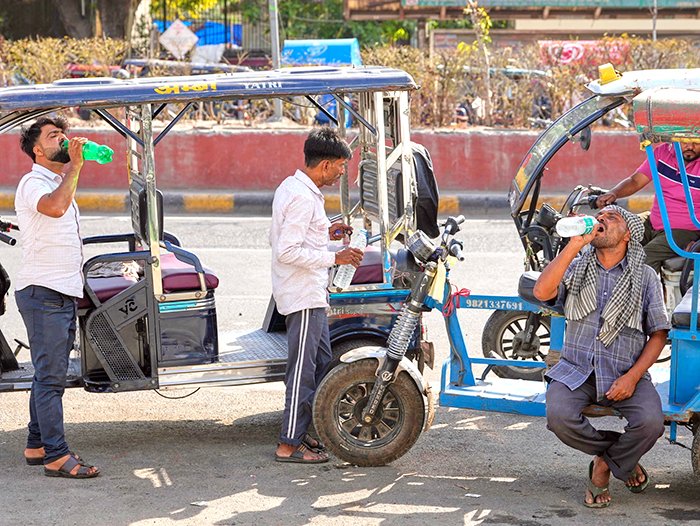
Indian rickshaw drivers take a break from the scorching heat. Photo: AP
Every morning as he prepares for work, Jalaj Jha feels exhausted. Waking up in a cramped room in the capital New Delhi, with no ventilation other than an old fan, this seasonal worker faces a long 12-hour grocery delivery shift. “I only get about three or four hours of sleep each night. I wake up tired and feel like I don’t want to do anything anymore,” Jha explains.
Even at just 7 a.m., the temperature in New Delhi had already reached 30 degrees Celsius. This was the lowest temperature of the day, before it could soar to over 45 degrees Celsius. This week, New Delhi set a "sad record" by recording its highest daytime temperature in the past two years and its highest nighttime temperature in 14 years.
In some areas of Uttar Pradesh, India's most populous state, some small traders have switched to early morning trading as markets close in the afternoon; farmers have switched to working at night to avoid the scorching daytime temperatures. The heat has also disrupted education. Authorities in some areas have even announced early summer holidays and suspended classes as temperatures soar.
For self-employed workers such as delivery drivers, construction workers, and street vendors living in cramped, poorly ventilated residential areas with unreliable electricity, even sleeping is difficult. This leads to numerous illnesses related to harsh weather, reduces productivity, and pushes already vulnerable workers into deep economic stress.
Eighty percent of the 2,200 freelance workers interviewed by PCI said that extreme heat disrupted their livelihoods. They lost income because they couldn't work enough shifts, had to spend more money on drinking water, medicine, and transportation, and frequently suffered from headaches, dizziness, and fatigue during long days working outdoors.
Against this backdrop, India, where nearly 90% of the workforce is employed in the informal economy, has issued early warnings about the heatwave and opened temporary “cooling zones.” Meanwhile, health authorities are urging people to stay indoors during the afternoon rush hour, drink plenty of water, and seek medical attention if they experience symptoms such as dizziness or high fever.
Experts say rising temperatures in India are partly linked to climate change. In recent years, India has faced more frequent and intense heatwaves. “India has warmed considerably due to climate change. Northwestern India alone has been much warmer than many other parts of the country,” said Anjal Prakash, Professor of Public Policy at Flame University (India).
| European countries are also experiencing an unusual heatwave, breaking many temperature records. The French National Meteorological Office reported record-breaking temperatures exceeding 30 degrees Celsius in many parts of the country. A similar situation is occurring in the UK. At Heathrow International Airport, temperatures reached 33.5 degrees Celsius, surpassing the previous record of 32.8 degrees Celsius set in 1922 and repeated in 1944. The UK's Health Security Agency warned of an increase in deaths, particularly among the elderly, during the hottest times of the day. |
TRI VAN (Compiled)
Source: https://baocantho.com.vn/lao-dong-an-do-kiet-suc-vi-nang-nong-a205577.html


![[Photo] Standing Committee member of the Party Central Committee Tran Cam Tu working with the Central Inspection Committee](https://vphoto.vietnam.vn/thumb/1200x675/vietnam/resource/IMAGE/2026/05/28/1779969579668_ndo_br_bnd-2495-jpg.webp)














































































































Comment (0)