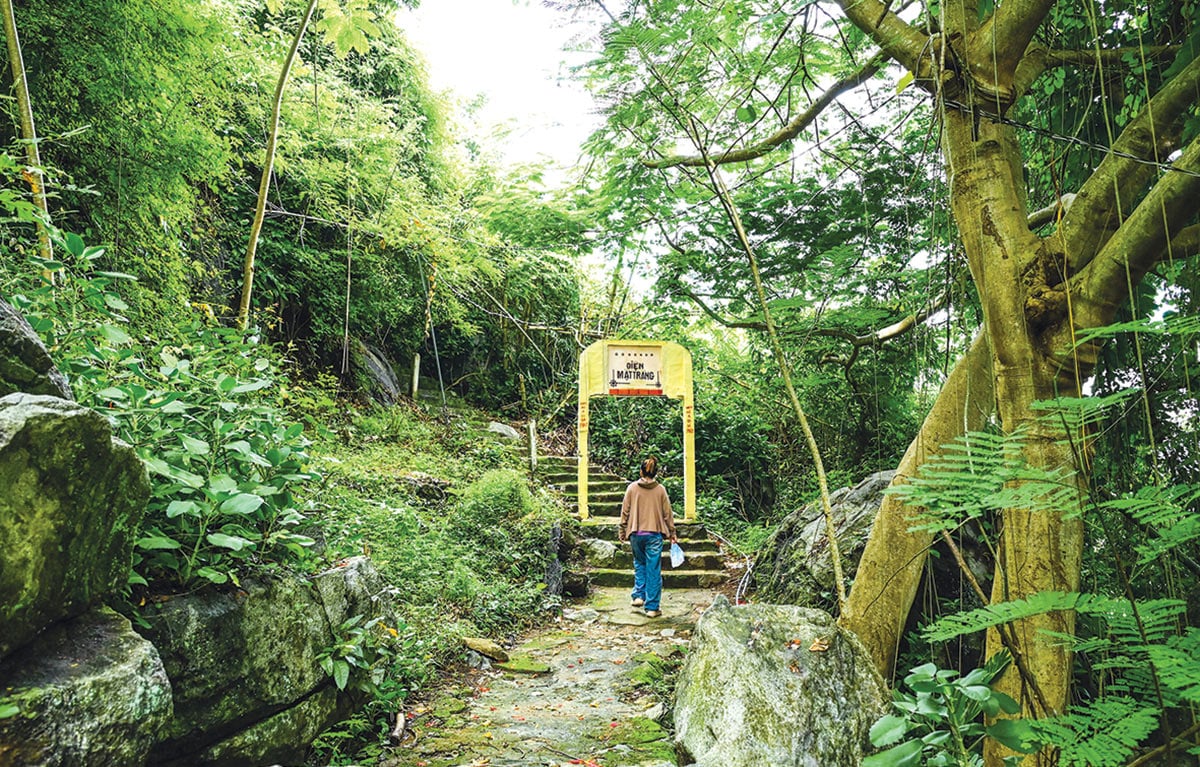
The road to the Moon power plant. Photo: PHAM HIEU
The Moon Temple is located about 2km east of the Ba Hon historical site. From the foot of the mountain, a 200m climb up a stone staircase leads to Cave No. 3, and a few more steps will take you to the Moon Temple at the summit. The path to the temple is quite steep, but it looks like a thin silk ribbon winding along the mountainside, nestled among lush green trees. Wildflowers grow abundantly on both sides of the path, interspersed with rocks. Occasionally, strong gusts of wind rustle the old bamboo groves, their creaking sounds blending with the birdsong, creating a gentle, peaceful symphony amidst the hills.
The road to the Moon Temple is also full of winding curves. Each new bend reveals a peaceful, poetic corner of the sky, waiting for visitors to experience and explore . Upon reaching the summit, visitors will be greeted by a cool breeze, light white clouds drifting across a stunning blue sky, and a vast, majestic expanse of the southwestern sea and sky unfolding before their eyes like a "paradise."
The space at the Moon Temple today is largely dedicated to worship; it houses shrines to President Ho Chi Minh, national heroes and martyrs, and the national hero Nguyen Trung Truc. Shrines dedicated to the Heavenly Emperor (Jade Emperor), Lac Long Quan, and Mother Au Co (the Old Mother)... were built by the locals many years ago and are regularly maintained and worshipped. The name Moon Temple is said to come from the cave entrance's shape resembling the moon. Others say it derives from the moonlight shining down on the temple at night. Regardless, the Moon Temple is very suitable for pilgrimage, exploration, and trekking.
Meanwhile, Cave No. 3 boasts a winding, beautiful space with many entrances and nooks, capable of holding hundreds of people. It was once a refuge for revolutionary cadres and soldiers, and today's generation returns to learn about, nurture, and cultivate revolutionary traditions. Furthermore, there's the legend of Lady Hai Hon Tre, or the female general who fought against pirates and helped the people, a story that resonates deeply. Even more interesting is that both Cave No. 3 and the Moon Temple on the summit of Hon Dat Mountain are dedicated to this Lady Hai.
According to local resident Nguyen Binh An, the path to the Moon Temple has about 600 stone steps for visitors to conquer. Visitors from afar can admire most of the beauty of the Hon Island countryside from above; vast fields stretching like a mirror, with glimpses of houses with bright red tiled roofs beside straight, peaceful canals, laden with silt, nourishing the fertile fields. In the distance, Turtle Island emerges beautifully from the vast ocean… “Nothing is more important than the fact that amidst the hustle and bustle of life, the mountains, forests, and towering hills offer us peace and a place to reflect,” Mr. An shared.
According to official historical records, during the years of resistance against French colonialism and American imperialism, Hon Dat was always a fierce battlefield. The Ba Hon area was where our soldiers and people fought tenaciously and persistently. Located on the main corridor from the Central Committee to the Western region, it served as a key launching pad for attacking the enemy due to its strategic location bordering both the sea and the land. Our revolutionary soldiers used the natural caves to hide from bombs and bullets, turning them into extremely strong bunkers. The enemy continuously attacked Ba Hon, but we continuously repelled them, turning Hon Dat into a battlefield.
From these open cave arches, venturing deep inside reveals an entire network of tunnels with hundreds, even thousands, of interconnected rock crevices and gaps, winding throughout the area. Thanks to its strategic location, Hon Dat was used by the armed forces of Chau Thanh A district as a strong defensive stronghold. It was once the headquarters of the district's resistance command, a gathering place for many youth volunteer units operating on Route 1C, and a stopping point for main army units on their way to the U Minh region.
Many fierce battles and glorious victories, such as the 11-day and 11-night battle (1962); the heroic 78-day and 78-night battle (1969); and the glorious 132-day and 132-night battle (1971), also took place here. Associated with these battles are many heroic sacrifices that have gone down in the glorious history of the nation, such as People's Armed Forces Hero Phan Thi Rang, Nguyen Van Kien, and others.
PHAM HIEU
Source: https://baoangiang.com.vn/len-dien-mat-trang-a426786.html


![[Photo] National Assembly Chairman Tran Thanh Man attends the groundbreaking ceremony for the National Highway 1A spatial axis project.](https://vphoto.vietnam.vn/thumb/1200x675/vietnam/resource/IMAGE/2026/05/19/1779161360398_ndo_br_bnd-1412-jpg.webp)

![[Photo] Capturing the moment the tide recedes at Yen Binh Son rapids - a million-year-old scenic spot in Quang Ngai.](https://vphoto.vietnam.vn/thumb/1200x675/vietnam/resource/IMAGE/2026/05/19/1779175463885_yen9-1199-jpg.webp)





















































![[Photo] General Secretary and President To Lam receives Indian Defense Minister Rajnath Singh](https://vphoto.vietnam.vn/thumb/402x226/vietnam/resource/IMAGE/2026/05/19/1779184046302_anh-man-hinh-2026-05-19-luc-16-46-58.png)





















Comment (0)