

 |
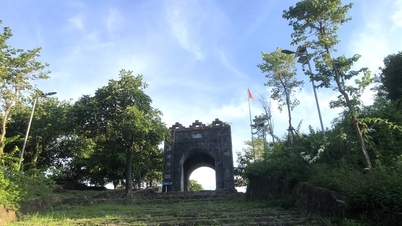
| The road to the summit of Phja Khao. |
The temple on the "silver mountain"
From the center of Cho Don commune, we traveled nearly 35km of mountain roads, including more than a dozen kilometers only accessible by pickup truck. The vehicle roared up the steep slopes, winding along the mountainside, sometimes seemingly plunging straight into the gray clouds. The higher we climbed, the milder the air became, the scent of damp earth and forest mingling with the mountain breeze, gradually dispelling the fatigue from the long journey.
Nestled halfway up the mountain, amidst the swirling mist, the signpost indicating the Phja Khao Temple historical and cultural site appears as an invitation. The temple sits at an altitude of nearly 800 meters above sea level, surrounded by lush ancient trees and the faint fragrance of magnolia blossoms. Few would imagine that, in this remote mountainous region, lies a temple steeped in the architectural and cultural traditions of the Northern Delta.
According to Ms. Le Thi Phuong, the manager of Phja Khao Temple: In the early 20th century, the area of the former Ban Thi commune, now Yen Thinh commune, had a large population, mainly laborers and mine overseers for the French colonial mining companies. In 1933, the Kinh community here went to Tran Temple in Nam Dinh to ask for incense sticks, invoke the spirit to enter the statue of Saint Tran, and bring him back to be worshipped at Phja Khao Temple.
The temple is built in a T-shaped architectural style with a front hall and a rear hall. The main hall is dedicated to Saint Tran, flanked by Nam Tao and Bac Dau; outside in the courtyard is a shrine dedicated to the Mountain God. In 2017, the temple was recognized as a provincial-level historical and cultural relic.
Having weathered many ups and downs, the temple has always been a center of spiritual and cultural activity, not only for the Kinh people but gradually becoming a shared religious space for people of all ethnic groups in the region. Amidst the solemn incense smoke, the sounds of forest birds, and the mountain winds, the temple stands as a testament to the cultural exchange and interaction between the lowlands and the highlands.
Leaving Phja Khao temple, we continued our journey to the summit of the mountain, which is over 1,000 meters above sea level. The pickup truck could only go a short distance; for the rest of the journey, we followed a trail covered with purple rhododendron flowers and wildflowers.
 |
| The flowers bloom on the summit of Phja Khao. |
Phja Khao appears with a beauty that is both fierce and poetic. The towering mountains are shrouded in white clouds, and small villages peek out in the distance like delicate brushstrokes amidst the vast wilderness. But Phja Khao possesses more than just the beauty of its mountains and forests.
Hidden amidst the mist and vegetation are still sections of railway tracks and ore hoisting cable systems that have existed for over a hundred years, a testament to a painful and devastating period of colonial exploitation.
The wind tells stories of the olden days.
According to local historical documents, in 1895, immediately after completing the conquest of the former Bac Kan town, the French colonialists began exploiting the Cho Dien - Ban Thi mine, one of the mines with large reserves, to plunder mineral resources for the mother country.
They built a system of cable-driven ore hoists here, with the hoist located on top of Phja Khao mountain, covering an area of approximately 500 square meters.
The two stone embankments are very sturdy, about 7 meters wide and 10 meters high. In the middle is a system of iron pillars supporting two ore hoisting lines that run through and extend to the center of the old Ban Thi commune. The entire hoisting system, iron pillars, and stone embankments were built by the labor of Vietnamese miners.
To construct those structures deep in the mountains, thousands of Vietnamese people had to work hard in harsh conditions. For 27 years, from 1914 to 1941, more than half a million tons of zinc ore were transported back to the motherland. At that time, people passed down the haunting saying, "Those who go to Bản Thi never return," as a reminder of a time when miners were exploited to the extreme.
 |
| The remains of the ore hoisting cable system on the summit of Phja Khao. |
Our guide pointed towards a deep, mist-shrouded ravine not far from the historical site, where the French colonialists once threw exhausted or defiant miners into the abyss.
A biting cold wind swept up from the foot of the mountain. The clouds were so thick they could be grasped with one's hand. In that space, the old iron railway tracks suddenly became unusually silent, as if history had yet to stop telling its story.
Local people call the mountain peak where the French colonialists used to mine ore Phja Khao, which in the Tay language means "silver mountain". According to a document published in Tri Tan Magazine in 1943 by author Nhat Nham Trinh Nhu Tau, after the mining process, the layers of soil and rock peeled away, revealing undulating mountain ranges, creating a fascinating landscape resembling "Ha Long Bay on land".
At night, the light reflecting from the ore makes the entire mountain range glow with a magical silver hue. Perhaps that's why the name "silver mountain" came about and has remained to this day.
Evening descends quickly on Phja Khao. Clouds slowly creep up the mountain slopes from the deep valley, enveloping the old railway tracks and the silent temple roof in a lingering mist. Today, the "silver mountain" no longer echoes with the sounds of ore-mining carts or the hardships of yesteryear; only the mountain wind whispers old stories.
But perhaps, it is precisely in that silence that Phja Khao still holds within itself another kind of silver light - the silver light of memory, of history, and of values waiting for the traveler to discover and listen to.
Source: https://baothainguyen.vn/dat-va-nguoi-thai-nguyen/202606/len-phja-khao-nghe-vong-tieng-thoi-gian-9b00e93/

![[Photo] First session of the 14th Congress of the Vietnam Trade Union](https://vphoto.vietnam.vn/thumb/1200x675/vietnam/resource/IMAGE/2026/06/03/1780465947883_ndo_br_img-3852-jpg.webp)
















































![[Video] Sunset at Lap An Lagoon – Where the sun sets over the fishing nets](https://vphoto.vietnam.vn/thumb/1200x675/vietnam/resource/IMAGE/2026/05/31/1780192137701_beach-landscape-sea-water-nature-grass-745871-pxhere-com.jpeg)
































Comment (0)