

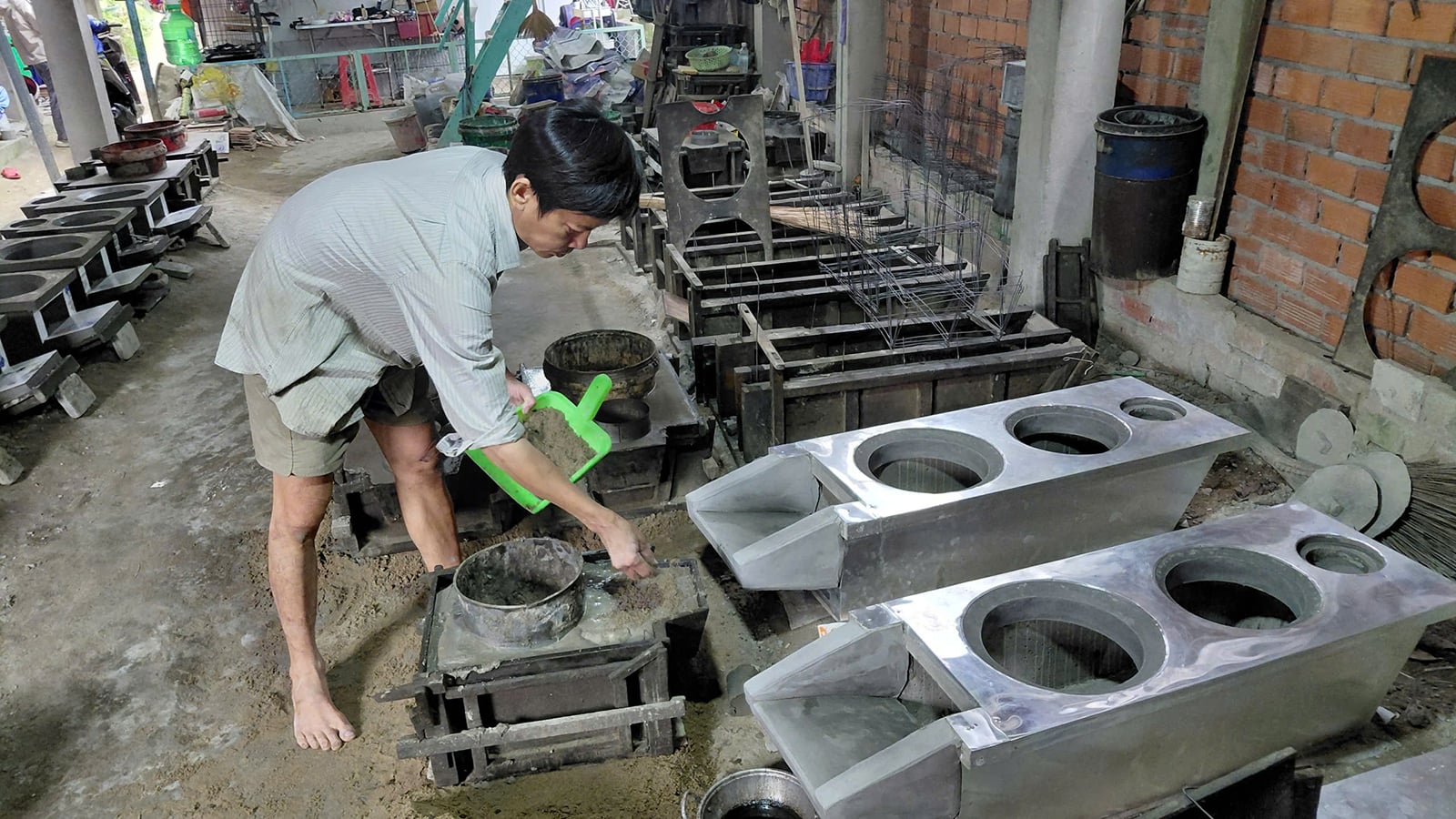
Mr. Nguyen Van Tam diligently works on the rice husk stove. Photo: Hanh Chau
The Long Dien rice husk kiln village was established around 1970. Responding to the practical needs of the people, the rice husk kilns were gradually improved in design, size, and price, making them affordable and quickly expanding their market. In 2007, the village was recognized by the Provincial People's Committee as a traditional handicraft village. During stable periods, the average income of village workers ranges from 3 to 5 million VND per person per month.
According to the People's Committee of Long Dien commune, the craft village not only creates jobs for local workers but also contributes to poverty reduction in rural areas. Production households continuously improve their products to meet the needs of the people, gradually improving the lives of the workers. Currently, the craft village has 84 production households with 175 workers. The diverse products include: rice husk kilns for tile making, wood-fired kilns, and kilns with compartments and tubes… The market extends throughout the Mekong Delta and the Southeast region, mainly through traders or customers placing direct orders at the facilities.
The craftspeople in the village usually start their work early in the morning. While busy sealing the stove opening, Mr. Bui Van Menh, a representative of the village, shared: "After doing this job for so long, I've grown to love it. I spend all day around these stoves." According to Mr. Menh, initially, the village only made rice husk stoves. Later, when the price of rice husks increased, many housewives suggested making wood-fired stoves to utilize the readily available wood in their gardens. From then on, new types of stoves were created, becoming increasingly diverse in size and number of openings, to suit the needs of each family.

Mr. Bui Van Menh has been dedicated to the craft of making rice husk kilns. Photo: Hanh Chau.
During its heyday, the entire village had hundreds of households engaged in the craft. Along Provincial Road 946, rice husk kilns were stacked high in front of yards and on both sides of the road. Workers toiled day and night to meet delivery deadlines for traders. The atmosphere became even more bustling during the Tet holiday season. "After the rice harvest and near Tet, people bought a lot of kilns, both to replace old ones and to buy more for cooking during the Tet holiday," Mr. Menh recounted.
In the past, boats and canoes bustled along the Ong Chuong canal, transporting kilns to various places. Now, with improved road transport, trucks have gradually replaced boats and canoes, reducing transportation costs. The price of a kiln currently ranges from 150,000 VND to 1.5 million VND per unit. However, the number of households practicing the craft is decreasing, with most young people leaving their hometowns to work in industrial zones, leaving only a few dedicated individuals in the village. Among them are the families of Mr. Bui Van Tang, Mr. Lam Ngoc Hoa, Mr. Lam Van Le… who grew up in the village, live by the craft, and pass it on to their children and grandchildren. While diligently polishing a kiln, Mr. Nguyen Van Tam, a craftsman with over 35 years of experience, shared: “My wife and I earn about 400,000 - 500,000 VND a day. In the countryside, this amount is enough to live comfortably, raise our children, and save money.”
Having dedicated themselves to their craft for many years, these artisans quietly create each stove, evoking cherished images of the familiar kitchen corners of their hometowns. Watching their diligent hands work at the stove molds, one can believe that as long as the kitchens of the Mekong Delta continue to burn brightly, rice husk and wood-fired stoves will have a place, and the Long Dien rice husk stove village will continue to preserve a warm part of the memories of the countryside.
| While rice husk stoves were once a familiar sight in Southern Vietnamese kitchens, many families now replace them with gas, electric, or induction stoves. However, in many rural areas of the Mekong Delta, the tradition of cooking rice in rice husk stoves is still preserved. According to older generations, rice cooked in a rice husk stove is fragrant and sticky, and when the lid is opened, the aroma of rice blends with the smoke. The crispy rice crust, topped with braised meat sauce, is "absolutely delicious." |
Source: https://baoangiang.com.vn/lo-trau-long-dien-truc-yeu-cau-thi-truong-a474151.html


![[Image] Pleasant weather helps students enter the 10th grade entrance exam with confidence.](https://vphoto.vietnam.vn/thumb/1200x675/vietnam/resource/IMAGE/2026/05/29/1780034401612_ngay-1-thi-lop-10-minh-duy-8-5009-jpg.webp)
![[Photo] Ba Lang An Lighthouse - the "eye of the sea" amidst the "rock museum" of Quang Ngai province.](https://vphoto.vietnam.vn/thumb/1200x675/vietnam/resource/IMAGE/2026/05/29/1780038698840_anh-man-hinh-2026-05-29-luc-14-10-42.png)
















































































Comment (0)