

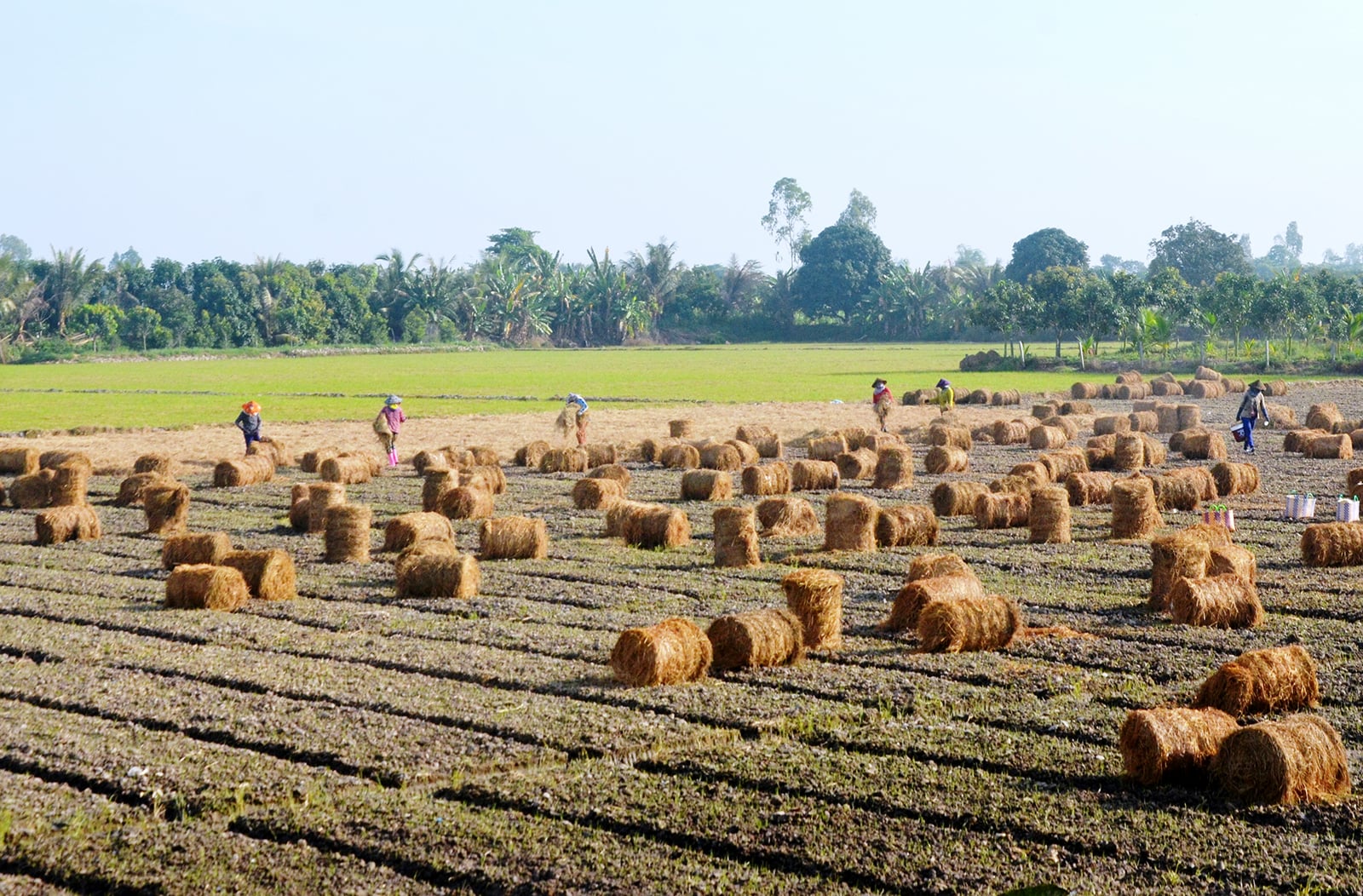
Farmers collect rice straw after harvesting. Photo: THANH THANH
According to the International Rice Research Institute, Vietnam currently produces approximately 45-50 million tons of rice straw annually, with the Mekong Delta contributing 24 million tons. However, managing this byproduct faces significant challenges. Currently, the rate of rice burning in the Mekong Delta remains high at around 54%, causing air pollution and greenhouse gas emissions. Plowing rice straw under flooded conditions increases methane emissions and poses a risk of organic poisoning, affecting subsequent rice crops. Dr. Katherine Nelson, a science expert at the International Rice Research Institute in Vietnam, stated: “To address these issues and contribute to Vietnam’s climate commitments, people need to view straw as a resource rather than a byproduct, and shifting towards straw collection is a crucial solution.”
According to Tran Thanh Hiep, Deputy Director of the Department of Agriculture and Environment, An Giang is one of the key rice-producing provinces in the country, with its annual rice acreage and production consistently high. Each year, An Giang cultivates approximately 1.3 million hectares, yielding about 7 million tons of rice straw. If rice straw is collected, managed, and utilized effectively, it will create a new value chain, increase people's income, and promote the development of circular agriculture.
Implementing the Sustainable Development Project for 1 million hectares of high-quality, low-emission rice cultivation linked to green growth in the Mekong Delta by 2030, the province is actively deploying advanced farming models and applying comprehensive technical solutions to reduce production costs, increase farmers' income, and reduce greenhouse gas emissions. Managing rice straw after harvest is a crucial aspect. If properly collected and reused, rice straw can become a valuable resource for circular agricultural production, such as producing organic fertilizer, cultivating mushrooms, making animal feed, or as a raw material for processing industries.
The Department of Agriculture and Environment, in collaboration with the International Rice Research Institute, recently organized a consultation workshop on methods for assessing the potential of mechanized straw collection in An Giang province. The workshop focused on introducing a method for evaluating the potential of mechanized straw collection for each rice crop, integrating factors such as seasonality, machinery, soil conditions, weather, and transportation infrastructure, combined with surveys of existing straw collection facilities in the Mekong Delta. The research results were visualized through a potential zoning map, providing a scientific basis for managers and investors to identify priority areas for infrastructure and machinery investment. This is the first time a method for assessing the potential of mechanized straw collection has been developed in Vietnam, and An Giang is the first province to participate in evaluating and providing feedback on this method. Assessing the potential and proposing solutions for managing rice straw through mechanized collection, reuse, and emission reduction contributes to achieving the goal of developing high-quality, low-emission rice production associated with green growth in the province.
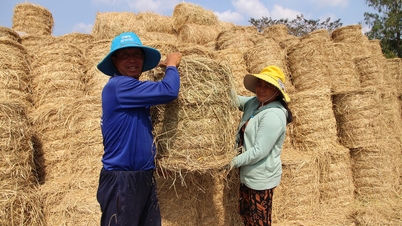
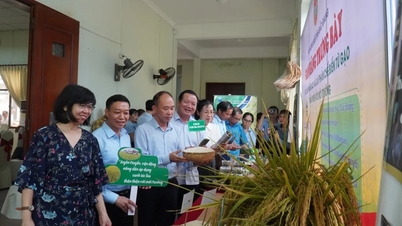
In reality, the reuse of rice straw is widely adopted by farmers, contributing to benefits for rice growers themselves, protecting the environment, and moving towards sustainable agricultural production. After each rice harvest, farmers utilize the straw to grow mushrooms, increasing their income. In addition, the decomposed straw residue after mushroom harvesting can be used as organic fertilizer, replenishing the soil, making it loose and maintaining its fertility. To ensure better and faster decomposition of rice straw and prevent organic poisoning in rice fields, farmers spray biological preparations onto the straw before plowing.
Mr. Nguyen Van Dong, a resident of Cho Moi commune, said: “Straw is the main material for farmers to grow mushrooms and vegetables. Using straw to cover cultivated land helps reduce soil erosion when watering, limits weed growth, and retains soil moisture. After a while, the straw decomposes, helping vegetables grow faster and better.”
In the context of increasingly complex climate change, shifting production methods towards sustainability, reducing emissions, and increasing added value is an urgent requirement. Therefore, utilizing straw after harvest is not only an environmental solution but also an opportunity to increase agricultural production efficiency in the future.
Source: https://baoangiang.com.vn/loi-ich-cua-tai-su-dung-rom-ra-a486516.html
![[Image] Hanoi's urban life under the challenge of a "scorching hot" environment](https://vphoto.vietnam.vn/thumb/1200x675/vietnam/resource/IMAGE/2026/05/25/1779706979265_nang-nong-t5-2026-minh-duy-7-4636-jpg.webp)




![[Image] Close-up view of the interchange connecting the two expressways and Long Thanh Airport.](https://vphoto.vietnam.vn/thumb/1200x675/vietnam/resource/IMAGE/2026/05/25/1779703378210_ndo_br_z7863716673926-224453a31600126cce10622af6290afd-4549-jpg.webp)





































































Comment (0)