


At the seminar, experts argued that Ho Chi Minh City is entering a new phase of development, in which the requirements are not only economic growth, but also restructuring the development model towards a smarter, more sustainable direction with greater adaptability to global changes.
Challenges such as infrastructure overload, population pressure, climate change, digital transformation, green transformation, and the need to enhance international competitiveness are demanding that Ho Chi Minh City have sufficiently strong, flexible, and innovative institutional tools to lead development in the new phase.
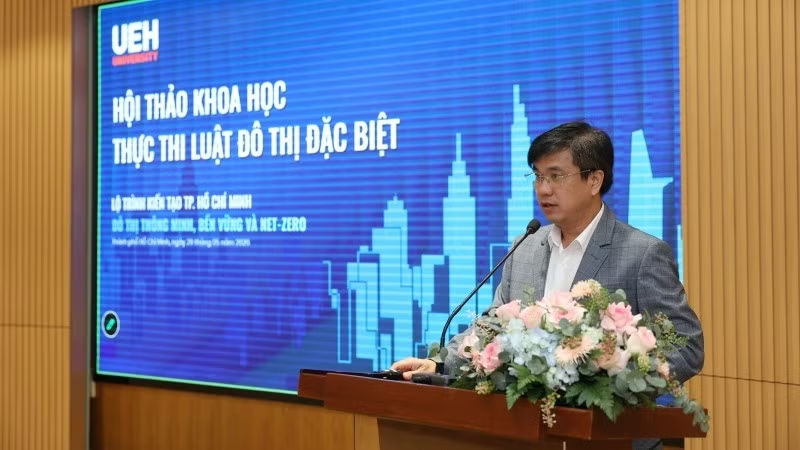
Speaking at the event, Associate Professor, Dr. Bui Quang Hung, Director of the Ho Chi Minh City University of Economics, said that in this context, the development and implementation of the Law on Special Urban Areas for Ho Chi Minh City is not only a step towards perfecting the legal framework, but also a historic opportunity to shape a new urban governance model for Vietnam.
This should be a development-oriented law, allowing Ho Chi Minh City more institutional space to proactively experiment, innovate, truly decentralize, and effectively implement strategic goals.
According to Associate Professor, Dr. Bui Quang Hung, from an academic and practical perspective, the greatest value of a groundbreaking law lies not only in the regulations it promulgates, but in its ability to transform regulations into action, policies into results, and institutions into drivers of development.
Therefore, during the process of providing feedback on the Draft Law on Special Cities, the Ho Chi Minh City University of Economics emphasized that the focus was not simply on adjusting technical details, but on redesigning the operational mechanism of institutional power, creating conditions for Ho Chi Minh City to proactively implement it immediately, without waiting too long for intermediate levels of guidance.
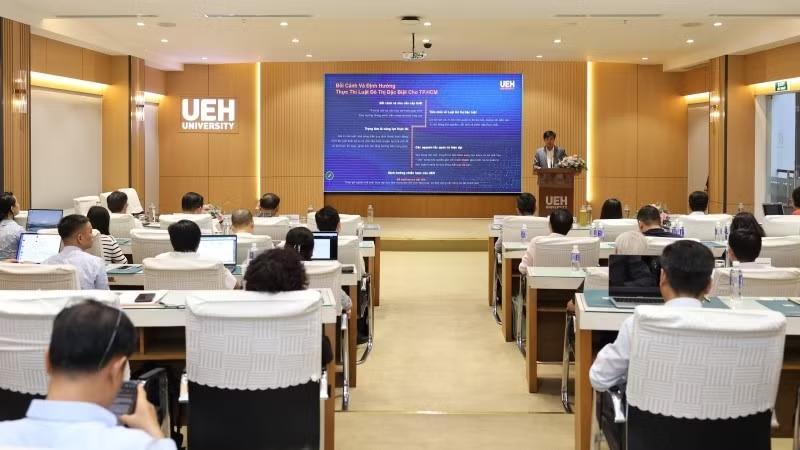
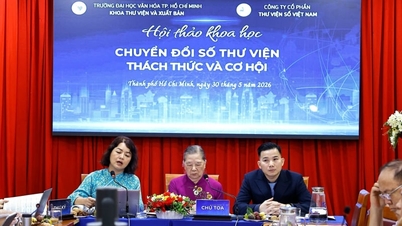
At the workshop, experts and scientists focused on analyzing and contributing ideas on topics related to financial institutions and the digital economy; digital transformation and smart city governance.
Experts and scientists also discussed urban spatial reconstruction and green infrastructure aimed at achieving net zero emissions; the co-creation ecosystem model and testing mechanism (Sandbox); and the Sandbox mechanism in urban management.
Source: https://nhandan.vn/luat-do-thi-dac-biet-dinh-hinh-mo-hinh-quan-tri-do-thi-moi-post965643.html

![[Image] Nearly 125,000 Hanoi students completed the Literature exam for the 10th grade entrance exam.](https://vphoto.vietnam.vn/thumb/1200x675/vietnam/resource/IMAGE/2026/05/30/1780117233041_ndo_br_thiet-ke-chua-co-ten-2-png.webp)













![[Photo] The General Secretary, President and Prime Minister of Singapore attend the tree planting ceremony at the Singapore Botanic Gardens.](https://vphoto.vietnam.vn/thumb/402x226/vietnam/resource/IMAGE/2026/05/30/1780122934945_vna-potal-tong-bi-thu-chu-tich-nuoc-va-thu-tuong-singapore-du-le-trong-cay-8794687-jpg.webp)
![[Photo] Admire the coral "masterpiece" amidst the million-year-old heritage of Dak Lak province.](https://vphoto.vietnam.vn/thumb/1200x675/vietnam/resource/IMAGE/2026/05/30/1780107638639_y25-jpg.webp)















































Comment (0)