

What are cluster bombs?
Cluster munitions, also known as cluster bombs, are containers holding dozens to hundreds of smaller bombs, or secondary munitions. These containers can be dropped from aircraft, launched from missiles, or from military artillery.
The containers would then be released at a fixed altitude, depending on the target area, and the small bombs would then be scattered over a wide area. They would be detonated by a trigger mechanism upon near or impact with the ground, releasing multiple shrapnel fragments to kill soldiers or destroy armored vehicles such as tanks.
What type of cluster munitions did the US supply to Ukraine?
The US possessed a stockpile of DPICM cluster munitions, or improved conventional munitions, which have been out of use since 2016.
According to a post on the US military website eArmor, the DPICM cluster munitions that the US is supplying to Ukraine will be fired from 155mm howitzer batteries, with each container holding 88 small bombs. Each bomb has a lethal radius of approximately 10m, so each container will be able to cover an area of up to 30,000m² , depending on the altitude from which the bombs are released.
The article also states that the DPICM's small bombs have a mechanism where, upon detonation and impact with tanks or armored vehicles, they create metal fragments that penetrate the metal armor. Approximately 10 small bombs are needed to destroy an armored vehicle, but just one metal fragment is enough to disable the vehicle's weapons or render it immobile.
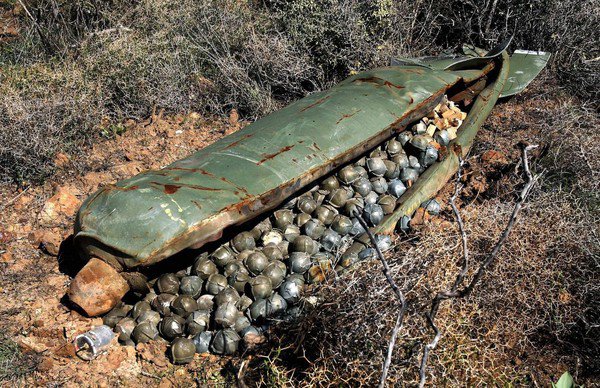
A close-up view of the inside of a cluster bomb.
Have cluster munitions been used on the battlefield in Ukraine before?
Both Ukraine and Russia have used cluster munitions since the Russian military invasion in February 2022. More recently, the Ukrainian army has begun using Turkish-supplied cluster munitions on the battlefield.
However, since last year, Ukrainian officials have begun urging the U.S. to supply them with American cluster munitions, arguing that they would provide additional ammunition for ground-based weapons systems already supplied by the West, thereby narrowing Russia's artillery numerical advantage.
Why are cluster munitions more controversial than other types of bombs and ammunition?
Because the small bombs are spread over a wide area, they can pose a danger to civilians.
In addition, the Red Cross reports that 10-40% of cluster munitions fail to detonate. However, these cluster bombs can then be detonated by civilian activities years, even decades, later.
The Cluster Munitions Coalition, an organization working to ban the use of this type of weapon, believes that many deadly cluster bombs and munitions may still be scattered throughout Laos and Vietnam years after they were dropped.
In a statement on Friday, Human Rights Watch said that both Ukraine and Russia have killed numerous civilians through the use of cluster munitions.
At a meeting in Switzerland last year on munitions, the President of the International Council of the Red Cross, Gilles Carbonnier, said: “Cluster munitions remain one of the world’s most horrific weapons. They cause mass destruction and are highly likely to cause casualties beyond control. Any use of cluster munitions anywhere, by anyone, must be strictly prohibited.”
Most of the world has banned the use of this type of weapon through the Cluster Munitions Treaty (CCM), which prohibits their stockpiling, production, and transfer.
However, while 123 countries have joined the treaty, the United States, Russia, Ukraine, and 71 other countries have not.
According to human rights organizations, using ammunition to attack enemy troops or vehicles does not violate international law, but attacking civilians with weapons can be considered a war crime.
When were cluster munitions used in the past?
Cluster munitions have been used since World War II, and in more than three dozen conflicts since then.
The last time the U.S. used this type of weapon was in Iraq, between 2003 and 2006.
According to a 2017 statement from the U.S. Central Command, U.S. military forces have begun phasing out this type of weapon due to the danger it poses to civilians .
Nguyen Quang Minh
Source





![[Image] Nearly 125,000 Hanoi students completed the Literature exam for the 10th grade entrance exam.](https://vphoto.vietnam.vn/thumb/1200x675/vietnam/resource/IMAGE/2026/05/30/1780117233041_ndo_br_thiet-ke-chua-co-ten-2-png.webp)






















![[Photo] Admire the coral "masterpiece" amidst the million-year-old heritage of Dak Lak province.](https://vphoto.vietnam.vn/thumb/1200x675/vietnam/resource/IMAGE/2026/05/30/1780107638639_y25-jpg.webp)




































































Comment (0)