

Using fire, they created some of the earliest stone tools.
The 2025 excavation by the Institute of Archaeology has yielded very new insights into the stratigraphic structure of the Ngườm rock shelter site (Thần Xa commune, Thái Nguyên province). While previous excavations only identified 3-6 cultural layers, the new excavation has revealed a total of 10 layers. In addition, the excavation process uncovered stone tools and flakes along with animal remains.
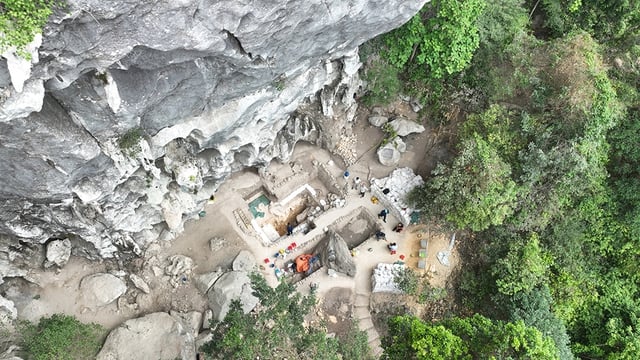
Ngườm Rock Formation viewed from above.
PHOTO: PHAM THANH SON
According to Dr. Pham Thanh Son, the excavation supervisor, the Soviet cultural layer contains red-orange sediments with limestone nodules of varying sizes. These sediments also contain numerous fragments of tools, flakes, core tools, raw stone nodules, animal bones, and freshwater mollusk shells. "Notably, several samples of charcoal ash were discovered along with some burnt bone fragments. This development is similar to the research results from the 2024 excavation. These could be the clearest evidence of the first appearance of fire during the Middle Paleolithic period in Vietnam, dating from 124,500 to 100,000 years ago," Dr. Son stated.
According to the research team, numerous burnt bone fragments, samples of bivalve mollusks that live in rivers and streams, some charcoal samples, and a significant number of stone tools are direct evidence of the presence of humans. This also provides evidence that fire was used at the Ngườm rock shelter from over 100,000 years ago.
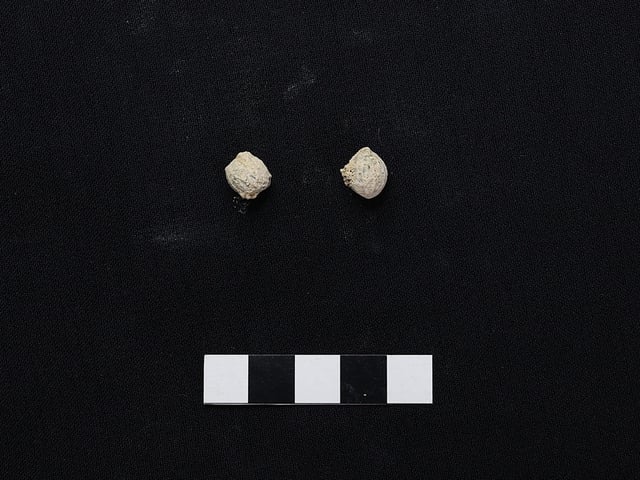
The fruit seeds, dating back 100,000-125,000 years, were found at the Ngườm rock shelter.
PHOTO: PHAM THANH SON
Many seeds of the Terminalia catappa tree were also discovered during the 2025 excavation. According to the Institute of Archaeology: "This may be the clearest evidence of the first recorded instance of searching for and consuming plant seeds in our country, found in an archaeological site dating back over 124,500 years. Given the current documentation, Ngườm is also the site with the earliest recorded evidence of fire use in Vietnam and the entire Southeast Asian region."
Furthermore, the excavation team also hypothesized that the earliest habitation at Ngườm is certainly over 124,590 years old. The estimated age could be between 140,000 and 150,000 years old. And to date, with an absolute age not yet at the deepest level of the cultural development at the Ngườm rock shelter, we can affirm that this is the first type of cave/rock shelter site recording evidence of the earliest stone tool manufacturing and use in the entire territory of Vietnam and mainland Southeast Asia. This is also the second site with an absolute age of over 130,000 years in the entire Southeast Asian region.
Potential to become a UNESCO World Heritage site
Associate Professor Bui Van Liem, Vice President of the Archaeological Society, highly praised the research conducted at the Nguom rock shelter. According to him, this was a large-scale excavation utilizing many modern research techniques.
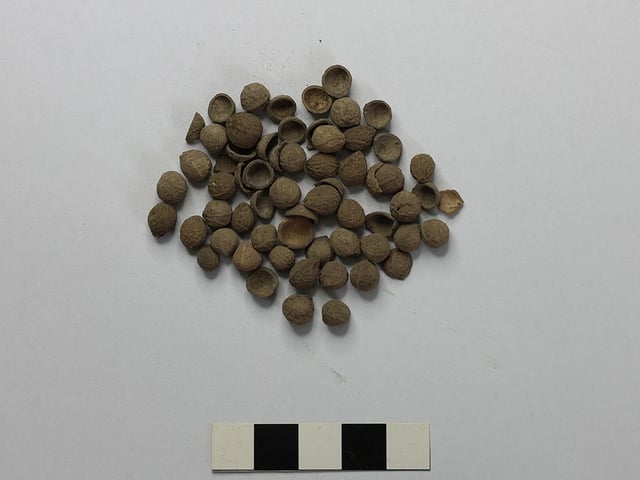
The fruit seeds were found on the Ngườm rock face.
PHOTO: PHAM THANH SON
Regarding the research results, Dr. Nguyen Van Doan, Director of the National Museum of History, said that the museum will access and adjust the exhibition content on the Nguom rock shelter in terms of age, types of stone artifacts, and flora and fauna discovered from the 2024-2025 excavation. Accordingly, the oldest known habitation date, previously estimated at only 23,000 years, may now be over 125,000 years old. "The National Museum of History will access the new research results to adjust the exhibition," Dr. Doan said.
Meanwhile, Associate Professor Dr. Nguyen Khac Su (Institute of Archaeology) believes that this is a typical relic of mainland Southeast Asia, deserving to become a special national relic. This is also the reason why the research group proposed preparing a dossier for this site to be a special national relic. According to Associate Professor Dr. Nguyen Khac Su, we could consider preparing a UNESCO heritage dossier for the Nguom rock shelter. Previously, Dr. Su was part of the expert group that prepared the UNESCO dossier for the Trang An mixed heritage site.
Research by the Institute of Archaeology also warns about the safety of the site. According to the study, the Ngườm rock shelter is not only famous domestically but also holds continental significance, being a major center of human evolution and stone tool technology in Southeast Asia. Therefore, protecting the site's current state is urgent. Currently, besides the lack of supervision and inspection, tourists visiting the site often descend into the excavation pits and light incense in unauthorized areas, causing the natural beauty of the site to be lost. Therefore, in the short term, management agencies need to erect more signboards to introduce the site's value and provide specific guidance to prevent unwanted impacts and damage.
Source: https://thanhnien.vn/mai-da-nguom-noi-su-dung-lua-va-che-tac-cong-cu-da-som-nhat-dong-nam-a-18525072721241787.htm

![[Photo] The General Secretary, President and his wife begin their state visit to the Philippines.](https://vphoto.vietnam.vn/thumb/1200x675/vietnam/resource/IMAGE/2026/05/31/1780230559452_anh-man-hinh-2026-05-31-luc-19-28-11.png)
![[Image] Hanoi Police officially crowned champions of V-League 2025/2026](https://vphoto.vietnam.vn/thumb/1200x675/vietnam/resource/IMAGE/2026/05/31/1780244769054_ndo_br_039d561b692be875b13a-jpg.webp)
![[Photo] Solemn bathing ceremony and Buddha procession in Hue](https://vphoto.vietnam.vn/thumb/1200x675/vietnam/resource/IMAGE/2026/05/31/1780228263543_1-jpg.webp)
![[Photo] Admire the coral "masterpiece" amidst the million-year-old heritage of Dak Lak province.](https://vphoto.vietnam.vn/thumb/1200x675/vietnam/resource/IMAGE/2026/05/31/1780221235105_anh-man-hinh-2026-05-31-luc-16-53-27.png)






![The Essence of the Village: [Part 1] Wine on the mountain, tea in the clouds - Bang Phuc](https://vphoto.vietnam.vn/thumb/402x226/vietnam/resource/IMAGE/2026/05/27/1779841729178_3821-1jpg-nongnghiep-103814.jpeg)















![[Video] Sunset at Lap An Lagoon – Where the sun sets over the fishing nets](https://vphoto.vietnam.vn/thumb/340x192/vietnam/resource/IMAGE/2026/05/31/1780192137701_beach-landscape-sea-water-nature-grass-745871-pxhere-com.jpeg)







































![[Photo] Admire the coral "masterpiece" amidst the million-year-old heritage of Dak Lak province.](https://vphoto.vietnam.vn/thumb/402x226/vietnam/resource/IMAGE/2026/05/31/1780221235105_anh-man-hinh-2026-05-31-luc-16-53-27.png)

































Comment (0)