

One of the highlights is the project "Applying scientific and technical advancements to build a closed-loop model of hybrid cattle breeding farms ensuring biosafety," implemented in Cho Don and Ba Be districts, led by the Institute of Animal Husbandry from June 2023 to June 2026.
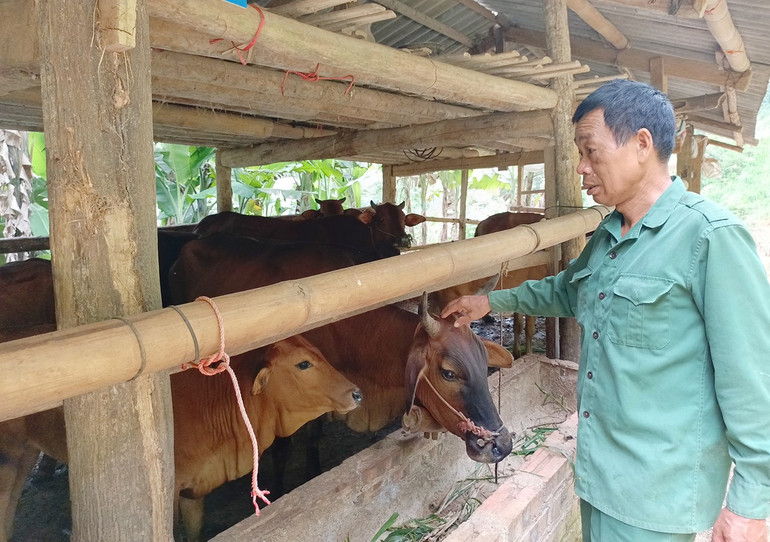
The project established two livestock farming models in Dong Lac commune (Cho Don district) and Ha Hieu commune (Ba Be district). Throughout the implementation process, the participating households have reported positive results. Mr. Dong Phuc Chien from Ban Trang village, Dong Lac commune, shared: "The hybrid cows grow well, the calves are healthy and grow faster than local cows. In particular, the model combines the production of earthworm biomass and worm castings from livestock waste, effectively treating the environment while creating a safe source of organic fertilizer for crops."
Other households, such as the family of Mr. Dong Phuc Huyen (Dong Lac commune) and the family of Mr. Hoang Van Luat (Ha Hieu commune), also highly appreciate the effectiveness of the closed-loop livestock farming model and the technical support in production.
The project includes various components such as: building a closed-loop livestock farming model ensuring biosafety, training and technology transfer, compiling documents, organizing workshops for dissemination, and conducting evaluation and acceptance testing. According to MSc. Nguyen Ngoc Luong, the project leader, participating farmers receive support covering 30% of the cost of breeding cattle, supplies, and artificial insemination. This is a model of a circular economy, serving as a basis for replication in local production practices.
During the implementation process, participating households also received training in techniques for preventing and treating diseases in cattle, guidance on growing and processing animal feed, and how to utilize agricultural by-products and livestock waste to produce earthworm biomass and worm castings. To date, the cattle herds in participating households have developed stably, with 8-9 calves born from artificial insemination techniques per household, exceeding the target set for the entire period.
According to Mr. Hoang Van Thien, Director of the Provincial Department of Science and Technology, the project is currently progressing on schedule and ensuring quality. Based on the results achieved, the relevant departments will propose expanding the model to increase the local cattle herd, promote the application of science and technology in livestock farming in a modern, bio-safe manner, and in line with sustainable development orientations, supporting livelihoods for people in the highlands.
Source: https://baobackan.vn/mo-hinh-chan-nuoi-bo-lai-an-toan-khep-kin-post71474.html



![[Image] Nearly 125,000 Hanoi students completed the Literature exam for the 10th grade entrance exam.](https://vphoto.vietnam.vn/thumb/1200x675/vietnam/resource/IMAGE/2026/05/30/1780117233041_ndo_br_thiet-ke-chua-co-ten-2-png.webp)
















![[Update] Announcement Ceremony for the Merger of Provincial and Commune-Level Administrative Units in Thai Nguyen and Bac Kan Provinces](https://vphoto.vietnam.vn/thumb/402x226/vietnam/resource/IMAGE/2025/6/30/0de85cb56da843d897e30016b57b1412)

































































Comment (0)