

 |
| In recent years, Thai Nguyen has gradually affirmed its position as a dynamic international education center. In the photo: The International Faculty ( Thai Nguyen University) held a graduation ceremony to honor 54 new graduates of 2025, including many international students. Photo: Provided. |
Advantages from reasonable costs and practical policies.
According to statistics from Thai Nguyen University, the institution currently trains nearly 1,000 international students from 26 countries and territories. Each academic year, the university accepts approximately 200 additional international students. Compared to many regional universities nationwide, this is a significant number, reflecting the growing trend of international students expanding their study destination options.
Along with the increase in numbers, the composition of international students is becoming increasingly diverse. Previously, the majority were Lao students under the traditional cooperation agreement between Vietnam and Laos; now, the number of students from Africa, South Asia, Southeast Asia, and Europe is increasing quite rapidly. This shows that the educational environment in Thai Nguyen is expanding its scope of cooperation and participating more deeply in the international education network.
A key factor attracting international students is the affordable cost of tuition and living expenses. Compared to many countries in the Asian region, tuition fees in Vietnam in general, and Thai Nguyen in particular, are significantly lower while still maintaining the quality of education. Many students studying under local cooperation programs, scholarship programs, or friendship programs also receive tuition support, dormitory accommodation, and living allowances during their studies.
 |
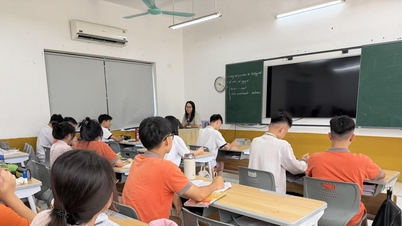
| The modern educational environment in Thai Nguyen is increasingly attracting international students. In the photo: Lao students studying at the University of Education (Thai Nguyen University). |
At Thai Nguyen College, Lao students are accommodated in dormitories with guaranteed living conditions, receive support in learning Vietnamese, participate in cultural and sports exchange activities, and regularly receive companionship from the Vietnamese youth union, lecturers, and students.
Thavikhot Khounthavy, a student in class K20.48G2 majoring in Information Technology, from Savanakhet province (Laos), said: "When I first came to Vietnam, I was quite worried about the language barrier and the living environment. After studying in Thai Nguyen for a while, I quickly adapted thanks to the enthusiastic support from the school and my friends."
According to Thavikhot Khounthavy, besides the training program that aligns with digital technology trends, what reassures her is the relatively affordable cost of living, convenient and safe dormitory facilities close to the school. “The teachers regularly care for and support us in our studies and daily lives. That makes me feel like Thai Nguyen is my second home,” Thavikhot Khounthavy shared.
 |
| Students enrolled in the Advanced Program at the University of Agriculture and Forestry (Thai Nguyen University). |
For Khonechaleun Latdaphone, a student in class K20.63A1 majoring in Finance and Banking, from Luang Prabang (Laos), the most profound impression was the friendliness of the people of Thai Nguyen. “At first, I thought it would be difficult to adapt because I was far from home, but the Vietnamese students were very enthusiastic. We often studied together, participated in cultural and sports activities, and explored the local culture,” Khonechaleun Latdaphone shared.
According to statistics, Thai Nguyen College alone has trained over 1,530 Lao students in the past 15 years. This result contributes to strengthening the traditional friendship between Vietnam and Laos through educational cooperation.
Teacher Nguyen Hoang Anh, Deputy Head of the Student Affairs Department and Secretary of the Ho Chi Minh Communist Youth Union of Thai Nguyen College, said: "The school always considers caring for international students, especially Lao students, as both a responsibility in education and a contribution to fostering friendly relations between the two countries."
Along with academic support, the school regularly organizes cultural exchange activities, takes care of students' well-being, and creates conditions for international students to quickly integrate into the new environment. Many students, after graduating and returning to their home countries, have become officials, entrepreneurs, and teachers, contributing high-quality human resources to their localities.
 |
| Thai Nguyen University is strengthening international training cooperation through strategic cooperation agreements. |
Multidisciplinary training, broad opportunities for integration.
The appeal of education in Thai Nguyen also stems from its multidisciplinary and multi-field training system, with many academic disciplines meeting the needs of the global labor market. Currently, Thai Nguyen University offers 25 advanced programs and English-language training programs, while also collaborating with many international partners in the UK, the US, Japan, South Korea, the Philippines, and Taiwan to provide training according to international standards.
The fields of study that attract the most international students include: Information technology, multimedia communications, economics, international trade, business administration, environment, high-tech agriculture, medicine, and education... These are all areas linked to the trends of digital transformation, green growth, and international economic integration.
The training structure of Thai Nguyen University is quite compatible with the human resource development needs of the ASEAN region. Many Southeast Asian countries are accelerating digital transformation, leading to a great demand for human resources in information technology, finance, e-commerce, logistics, and business administration. As a result, graduates have more job opportunities in Vietnam as well as in their home countries.
Another advantage lies in the local thriving industrial ecosystem. The presence of many large corporations provides students with access to a real-world environment, allowing them to participate in practical training and internships during their studies.
 |
| International students participate in an experiential learning program in Thai Nguyen's tea-growing region. Photo: Provided. |
Educational institutions in the area also focus on building a multicultural learning environment, creating conditions for international students to develop foreign language skills, integration skills, and global thinking. Every year, many cultural exchange programs, international festivals, language competitions, and experiential activities are organized to strengthen connections between Vietnamese and foreign students.
Aniebonam Paschal Chisom, a student from Nigeria, said: "I chose Thai Nguyen University because the training program aligns with my career aspirations in the fields of technology and economics. International students always receive strong support from lecturers and peers throughout their studies."
Ei Kabyar Moe, a student from Myanmar, shared: "Initially, I faced many language difficulties, but I quickly adapted thanks to the Vietnamese classes and the open learning environment."
Meanwhile, Lionel, a student from Sweden, was impressed with the combination of modern training and local cultural experiences in Thai Nguyen. Field trips to tea-growing regions and traditional craft villages, along with community activities, helped international students gain a deeper understanding of Vietnamese culture and the local people.
 |
| Lecturer Meng JinGuo (China) participates in teaching at the Faculty of International Studies (Thai Nguyen University), contributing to improving the quality of Chinese language training. |
According to lecturer Meng JinGuo from Yunnan University (China), Thai Nguyen possesses many advantages in training in the fields of economics, technology, environment, and communication, which are suitable for the development needs of the ASEAN region and the world.
Associate Professor Hoang Thi Bich Thao, Head of the International Faculty (Thai Nguyen University), affirmed: The unit's goal is to build a global educational environment where students can develop comprehensively in foreign languages, international thinking, and intercultural skills.
The internationalization of education in Thai Nguyen is clearly demonstrated through the increasingly extensive scale of cooperation. Last academic year, Thai Nguyen University welcomed over 1,300 international experts, lecturers, and students to participate in conferences, research, teaching, and cooperation agreements. During the same period, more than 400 faculty members, lecturers, and students from the university were sent abroad for study and research.
Thai Nguyen University also organized 8 international workshops and 3 major thematic conferences with the participation of more than 1,630 delegates, including 378 international guests. Many international cooperation projects with a total budget of approximately 3 million USD are being implemented in the fields of environment, public health, innovation, ecotourism, and sustainable development.
These figures show that education in Thai Nguyen is shifting strongly from a training model that serves the region to a model that connects with international knowledge...
From a regional education center, Thai Nguyen is gradually asserting its position as a reliable international education destination. Its modern, multidisciplinary training system, reasonable costs, safe living environment, practical support policies, and well-structured internationalization strategy are creating increasing appeal for international students.
The learning journey of thousands of students from many countries is clear evidence of integration, knowledge connection, and sustainable development, while also creating a foundation for Thai Nguyen to continue affirming its position on the regional and international education map.
Source: https://baothainguyen.vn/giao-duc/202605/mo-rong-canh-cua-hoi-nhap-tu-giao-duc-f1c5544/

![[Image] Checking the security conditions at the exam site, ready for the 10th grade exam.](https://vphoto.vietnam.vn/thumb/1200x675/vietnam/resource/IMAGE/2026/05/28/1779943458889_z7872507660648-d764421a26e8cd7b61d70d142a48a685-jpg.webp)
![[Photo] Opening Ceremony of the National People's Council Conference on the Implementation of Directions and Tasks for the 2026-2031 Term](https://vphoto.vietnam.vn/thumb/1200x675/vietnam/resource/IMAGE/2026/05/28/1779939257690_ndo_br_bnd-1991-jpg.webp)





























































Comment (0)