

 |
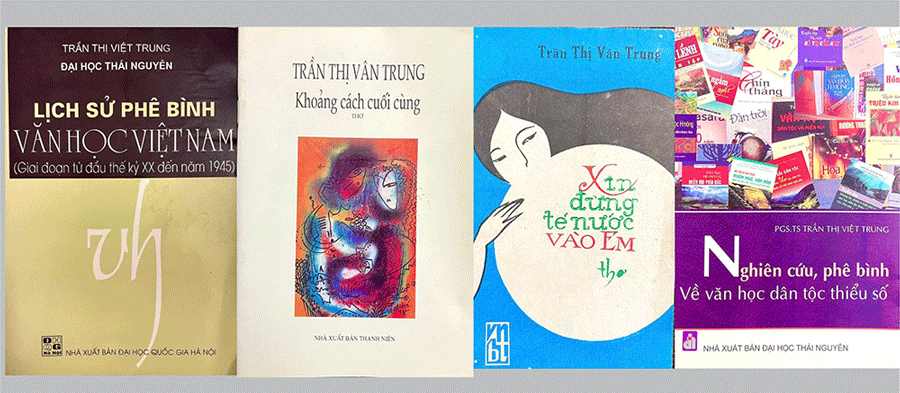
| Some books by Associate Professor, Doctor, and poet Tran Thi Viet Trung |
1. Starting romantic relationships
Actually, I've known Ms. Van Trung for a long time, since I was a young boy just starting high school. Our class was the first year transitioning from 8th grade (the final year of junior high) to 10th grade in high school, without having to go through 9th grade like now. I was in the same class as Tam Than, the youngest in Ms. Trung's family. That's why I visited her house often. Of course, I never had the chance to meet her. My only impression of her was a picture of her and her younger brother in military officer uniforms, taken in Cambodia. At that time, she was an education expert in that country. Interestingly, her younger brother (Tam Than's brother), a military officer, was also on international duty there. The photo captured a beautiful moment, a meaningful reunion. My initial impression was that she was young and very beautiful, with long, flowing hair and eyes that sparkled with intelligence, both clever and dreamy. That was all. Much later, when I was in my second year of university, she had completed her assignment and returned to continue her passionate journey as a young lecturer on the university campus. She taught us Romantic Literature of the 1930s-1945, specializing in New Poetry. It's worth adding that in our generation, studying high school in the 1970s and early 1980s in North Vietnam, almost no one knew anything about New Poetry. We could memorize poems by Ho Chi Minh, To Huu, Song Hong, anti-French poetry (except for Huu Loan's *The Purple Sim Flower*, Quang Dung's *Tay Tien*, and Hoang Cam's *On the Other Side of the Duong River*... at that time, these poems hadn't been re-evaluated or included in textbooks), and anti-American poetry; Even in the provincial-level gifted student competition, I analyzed and appreciated Le Duc Tho's poem "The Pillar of Support," a highly topical poem that most of our teachers at the time were unfamiliar with. Yet, I had only heard a few lines from famous poems like Luu Trong Lu's "The Sound of Autumn" and Xuan Dieu's "Hurry," let alone Nguyen Binh, Han Mac Tu, or other New Poetry poets. I remember, while preparing for the national gifted student competition, my teacher once read me a few lines from Luu Trong Lu: "Rain falls endlessly/My heart longs for someone/The moon sets behind the mountains and never returns/Why does it rain so much/My heart longs endlessly/But who do I long for…" Needless to say, the feeling of someone so accustomed to the themes of "love, hatred, war, and joy," now being treated to the novel pleasure of romantic poetry, was exhilarating. But no matter how much I pleaded, my teacher absolutely refused to read it aloud. I waited until break time, secretly opened the teacher's schoolbag, determined to find that "treasure trove" of poems. Alas, there were only a few lines, which the teacher had somehow obtained. The rest were all "revolutionary" poems; I couldn't find a single similar line. I longed for New Poetry from that day until I had the opportunity to study with her.
 |
| Associate Professor - Doctor of Education Tran Thi Viet Trung. |
The first book I read from her about New Poetry wasn't the well-known "Vietnamese Poets" (though I hadn't read it by then), but a rather special book. I still remember the words on the cover: "Pre-War Vietnamese Poets, Volume 1, Second Edition, published by Sống Mới, Saigon, 1968." The book was published in my birth year. Needless to say, I was overjoyed. For a week, I stayed in the library with my school notebook, carefully transcribing the entire collection of poems, every single poem, even the preface and afterword. I learned about Chế Lan Viên, who "suddenly appeared in the world of poetry like a terrifying phenomenon"; I learned about Nguyễn Bính, "a wonderfully gifted talent, a pure sadness of the soul of the countryside," and the entire world of New Poetry. And of course, I felt immense admiration for her. She seemed to come from another realm, distant yet radiant, to us—students in this faraway university lecture hall. Even more admirable is that she also writes poetry, just like me, having started writing poetry in my final years of junior high school. My first poems were published in the Military Region One newspaper, read on the Voice of Vietnam's poetry program, heavily influenced by New Poetry, and perhaps, to some extent, by her as well.
2. The Journey of Companionship
I graduated from Viet Bac Teacher Training University in 1989, briefly taught in the remote Loc Ninh-Song Be area, then volunteered at the "Cultural Light" program in a Hmong village, taught at a secondary school, and then transferred to another institution. This continued until I was 40 years old before pursuing a Master's degree. And there I met her again. She taught a course. Without any hesitation or other choice, I applied to be her supervisor for my Master's thesis. During our meeting, she suggested that, given my close connection to and understanding of the Hmong people, I should focus my research on the literature of ethnic minorities. At that time, not many people were pursuing this field. I chose to research Hmong literature, especially Hmong poetry. It turned out that my years of volunteering in literacy programs hadn't been wasted. With my practical experience with the people, and now having the opportunity to read deeply about the Hmong people, I was truly interested in this topic. My thesis was defended with distinction. I was accepted into the postgraduate program (without taking the entrance exam). At that time, due to family circumstances and work commitments, I couldn't go to Hanoi to study. I expressed my desire to have her supervise me, and she agreed. Apparently, I was the only postgraduate student in literature in Thai Nguyen with only one supervisor. This was thanks to her understanding and support. She always gave her students a sense of autonomy in their scientific research. With her care, encouragement, and motivation, I completed my thesis ahead of schedule. She is meticulous in her research. In the context of writing my thesis, teaching at university, working on a ministerial-level scientific research project, writing articles, and publishing books, I sometimes felt overwhelmed and overloaded with work due to a lack of scientific rigor. She was the one who helped me overcome those difficulties and obstacles in a way that was both kind and skillful. Perhaps because she had previously served as Head of the Science and Technology Department at Thai Nguyen University, and later as Director of the Thai Nguyen University Publishing House, editing was a skill she was very proficient in. Among the many things she taught me, I remember and appreciate most the importance of collecting and citing sources. According to her, once you cite a source, you should try to obtain that source and carefully preserve it so that it can be used for verification when needed. In scientific research, plagiarism, however minor, is never permissible. Scientific integrity is a prerequisite and a mandatory requirement for a researcher. I learned a great deal from her about this. Later, witnessing many controversies in the research of some colleagues, I understood this even more deeply.
Both she and I are former students of the Literature Department. When I returned to teach at the department, she had already moved into management at the Publishing House. We often met during guest lectures or while sitting on thesis defense committees. She remained the same, always cheerful and open-minded, but also very serious and demanding of her students. She was willing to spend days, even weeks, helping a student revise and supplement their thesis after defense. Sometimes, it was just students she was reviewing, not her supervisors. Simply put, it was to ensure they had the "cleanest" possible product to use as reference material for libraries. That was also her way of helping students, including future generations.
3. Passion for writing and passion for life
Joining the Vietnam Writers Association as a critic, Ms. Van Trung never stopped writing, especially poetry, ever since she was a literature student. I read poems like "Immortal Flower" and "To the Poet Thanh Tong" and was particularly impressed when I was a student. Many in our class pursued writing careers. My class (K20) alone has produced three writers (members of the Vietnam Writers Association), a record that is perhaps unmatched by any other class in the 60 years since the founding of the Viet Bac Teacher Training University (now the Teacher Training University under Thai Nguyen University).
Ms. Vân Trung has a wide circle of acquaintances. This is partly due to her being born into an intellectual family. Later, her husband, Meritorious Artist Ngô Đình Thành, was also a very sociable person. Her house is always filled with vibrant pots and vases of fresh flowers. During holidays and Tet (Vietnamese New Year), flowers overflow from the yard into the house, filling the living room. She has a refined aesthetic sense. This is evident in everything from the arrangement and decoration of her office to her clothing and lifestyle. She is meticulous in every stroke of the pen when correcting her students' mistakes, and in her interactions with friends and colleagues. Being around her always gives one a feeling of comfort, but never casualness. On the contrary, she always creates an air of elegance for everyone, in every situation. It's a purely intellectual elegance, not ostentatious, yet still commanding respect and admiration.
It seems that, since I've known her, I've never heard her complain or grumble about teaching or her profession. Her perspective and viewpoint transcend the pettiness and envy that are rampant in society and in schools. Focusing on joy is how she accumulates and regenerates her life energy.
She was born in the year of the Monkey, exactly twelve years older than me. Interestingly, she turned seventy in the same year that my school (which will always be her school) celebrated its 60th anniversary. It was a great joy on such a meaningful day. For us, she never had the concept of "old age"; she was always cheerful and vibrant.
To me, she has always been an artist—an artist of beauty always intertwined with passion.
It is an honor and a source of pride for me to be one of the students of Professor Tran Thi Van Trung, an Outstanding Teacher, Associate Professor, Doctor of Science, and Poet—a person who inspires generations of students.
Thai Nguyen, exam season 2026
Source: https://baothainguyen.vn/van-nghe-thai-nguyen/202605/nghi-ve-co-mot-nguoi-truyen-lua-0f3310f/
![[Photo] The heat at the fireworks display site on the opening night of the Da Nang International Fireworks Festival 2026](https://vphoto.vietnam.vn/thumb/1200x675/vietnam/resource/IMAGE/2026/05/27/1779889741485_ndo_br_z7872039145157-fecaba5112f39e8352544099d7ef4738-5140-jpg.webp)
























































Comment (0)