

 |
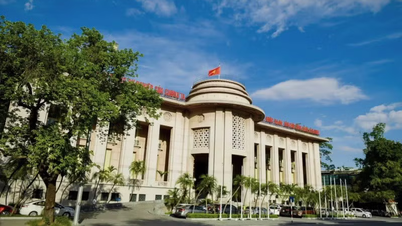
| Headquarters of the State Bank of Vietnam in Hanoi . |
In the context of increasing capital needs for infrastructure, this is seen as a technical adjustment with strategic implications: it both expands the capital space for growth and places higher demands on systemic risk management.
Untangling the capital bottleneck for large-scale projects.
According to the draft amendments to Decision No. 09/2024/QD-TTg on the conditions, documents, and procedures for requesting credit exceeding the limit, the State Bank of Vietnam proposes allowing credit institutions to grant credit exceeding the limit in certain cases, especially for large and important projects in Hanoi, in accordance with Resolution No. 258/2025/QH15 of the National Assembly , with a maximum limit of no more than 38% of equity capital for a single customer and 52% for a group of related customers. This is significantly higher than the current regulations of the Law on Credit Institutions, which are capped at 13% and 21% (and will continue to decrease according to the roadmap).
This adjustment reflects a reality: the scale of strategic infrastructure projects is growing larger, far exceeding the capacity for individual financing under traditional credit limits. Data from the State Bank of Vietnam shows that, given the current capital of major commercial banks, the room for lending under the new mechanism is considerable. For example, with Vietcombank 's capital of over 222 trillion VND and VietinBank's of over 229 trillion VND, each bank could provide credit of up to approximately 87 trillion VND to a single customer, or about 119 trillion VND to a group of related customers.
Meanwhile, according to estimates from the Ministry of Finance, many key projects in Hanoi have a total investment of approximately 300 trillion VND, with a borrowing requirement of up to 85% (equivalent to 255 trillion VND). Therefore, without flexible mechanisms, the funding problem for these projects is almost impossible to solve through bank credit alone.
In practice, bank credit remains the primary source of financing infrastructure projects in Vietnam. Large projects such as the Son La Hydropower Plant, Lai Chau Hydropower Plant, Vinh Tan 4 Thermal Power Plant, and more recently, the Quang Trach 1 Thermal Power Plant, have all previously utilized credit mechanisms exceeding the limits, similar to the current proposal. Recently, the syndicated loan model between commercial banks has been further promoted. A prime example is the Hanoi Capital Region Ring Road 4 project, with a total investment of over 85 trillion VND, financed by a consortium of major banks.
According to BIDV Deputy General Director Doan Viet Nam, given the underdeveloped domestic capital market, bank credit still plays a crucial role in supporting infrastructure projects. However, to meet the growing demand for capital, diversifying fundraising channels, from bonds and international capital to green finance funds, is an inevitable trend. From the perspective of credit institutions, the mechanism of relaxing credit ceilings not only solves the immediate capital problem but also creates conditions for banks to improve their capital arrangement capacity and develop project financing products according to international standards.
Driving force for capital city growth and regional expansion.
The proposal to raise the credit ceiling needs to be considered within a larger context: the development strategy for Hanoi in the new phase. According to established guidelines, Hanoi aims for an average annual GRDP growth of over 11% during the 2026-2030 period, reaching over US$113 billion by 2030, and a minimum per capita income of US$12,000. To achieve these goals, infrastructure systems, from transportation and energy to smart cities, must be developed ahead of time. This means a huge capital requirement that cannot rely solely on the state budget.
In this context, the mechanism of exceeding credit limits can act as a "lever," activating private capital flows, promoting public-private partnership (PPP) models, and creating a ripple effect on other sectors of the economy.
However, raising the credit ceiling also raises the question of whether it will increase the risk of credit concentration within the banking system. Currently, the amended Law on Credit Institutions has designed a roadmap to gradually reduce the loan-to-customer ratio and related customer groups to 10% and 15% by 2030 to limit the risk of credit concentration and dispersion. Meanwhile, the new mechanism allows exceeding the ceiling by up to 38% and 52% in some special cases. This is a policy paradox that needs to be handled carefully.
The State Bank of Vietnam affirms that the review of credit exceeding the limit will be conducted very strictly, ensuring full compliance with current legal regulations. However, international experience shows that the risk lies not in the regulations on paper, but in the implementation phase: project appraisal, risk management, and especially market discipline. If projects do not achieve the expected results, the consequences will not only affect one bank but may spread throughout the entire system, especially in the context where loans are often granted in the form of syndicated loans.
Furthermore, it's worth noting that while bank credit plays a key role, it cannot and should not be the sole source of funding for infrastructure. According to Pham Thi Thanh Tam, Deputy Director of the Financial Institutions Department (Ministry of Finance), the ministry is proposing a comprehensive revision of the Law on Public Debt Management to create a more favorable legal framework for mobilizing capital through government bonds; simultaneously, it aims to strongly develop the bond market and improve the national credit rating to attract capital from international markets at a reasonable cost. Alongside this, the PPP mechanism also needs to be reformed in a more substantive direction, especially the revenue risk-sharing mechanism – a key factor in attracting private investors.
The target of achieving a stock market capitalization of at least 100% of GDP by 2026 is a significant indicator of the gradual shift from a "credit-led" model to a "capital market-led" model. In other words, raising the credit ceiling is only a short- and medium-term solution. In the long term, the capital structure of the economy must be rebalanced, reducing dependence on the banking system.
Overall, the proposal to relax the credit granting mechanism beyond limits is a reasonable step in the current context, helping to remove capital bottlenecks for key projects, creating momentum for growth and infrastructure upgrades. However, this policy can only be effective when accompanied by conditions such as: strict project selection, applying only to projects with genuine socio-economic significance and clear cash flows; raising risk management standards, especially credit appraisal and post-lending supervision; and developing the capital market in parallel to reduce pressure on the banking system. Otherwise, "opening the tap" on credit could become a double-edged sword. How to both promote growth and ensure the safety of the banking system is the challenge facing regulators.
https://nhandan.vn/mo-van-tin-dung-cho-cong-trinh-trong-diem-post951502.html
Source: https://huengaynay.vn/kinh-te/mo-van-tin-dung-cho-cong-trinh-trong-diem-164107.html
![[Photo] Secretary of the National Assembly Party Committee, Chairman of the National Assembly presides over the meeting of the Standing Committee and Executive Committee of the National Assembly Party Committee.](https://vphoto.vietnam.vn/thumb/1200x675/vietnam/resource/IMAGE/2026/06/03/1780480353201_ndo_br_bnd-2585-jpg.webp)
![[Photo] First session of the 14th Congress of the Vietnam Trade Union](https://vphoto.vietnam.vn/thumb/1200x675/vietnam/resource/IMAGE/2026/06/03/1780465947883_ndo_br_img-3852-jpg.webp)
![[Photo] General Secretary and President To Lam presides over a meeting with the Central Organizing Committee.](https://vphoto.vietnam.vn/thumb/1200x675/vietnam/resource/IMAGE/2026/06/03/1780482764658_a1-bnd-4741-3342-jpg.webp)






























































![[Video] Sunset at Lap An Lagoon – Where the sun sets over the fishing nets](https://vphoto.vietnam.vn/thumb/1200x675/vietnam/resource/IMAGE/2026/05/31/1780192137701_beach-landscape-sea-water-nature-grass-745871-pxhere-com.jpeg)


































Comment (0)