

 |
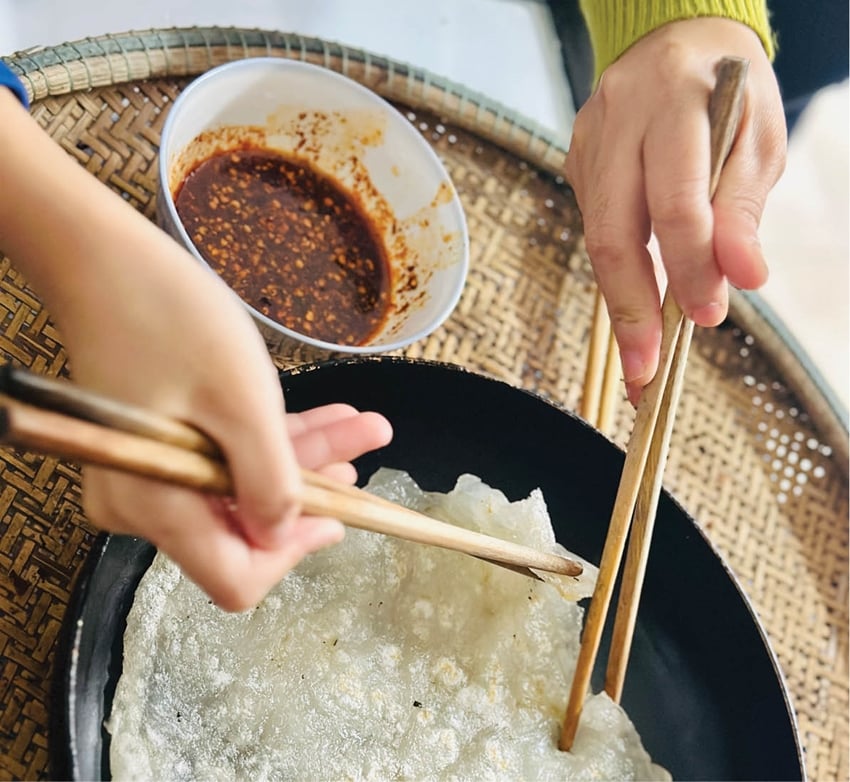
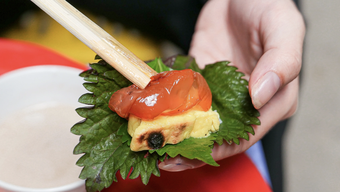
| Stirring the filter powder. Photo: BAO PHUOC |
Tapioca flour, or stirred tapioca starch, is a dish closely associated with my childhood. When I was a child living in the countryside, on cold, rainy days, my family would gather around the charcoal stove to warm ourselves, enjoying fragrant, chewy sweet potatoes simmered in the embers, their aroma wafting warmly, and my grandmother's stir-fried tapioca flour – a dish I can never forget. Back then, there weren't many snacks, so those dishes are unforgettable memories. They're especially memorable on those dreary, rainy nights.
These days, probably not many people are fond of this dish. Stir-fried tapioca dumplings are interesting because of the way they're made and the joyful, reunion-like atmosphere they bring, but their flavor can't compare to tapioca dumplings with shrimp, pork, or mung bean fillings. This was originally a "leftover" dish; in the old days, when there was a lot of leftover tapioca or cassava flour but not enough money to buy shrimp and pork for the filling, people would boil and stir the dough to eat quickly to feel full. Stir-fried tapioca dumplings are perfect for the long, cold, rainy winter days in Hue ; each piece of dough is hot and crispy. I like the feeling of "making with my own hands to eat," a little "labor" makes the food more worthwhile.
After stirring the rice flour in the pan, some parts will be slightly firm, similar to the crispy and chewy pressed rice cakes from Nam Dong (now Phu Loc). Using chopsticks, preferably large ones for a firm grip, pierce the dough, pull it up, and roll it up before dipping it in fish sauce. The fish sauce is prepared according to preference, and you can add garlic, chili, sugar, lemon, etc., for extra flavor. The cake, still soft, hot, and fresh, blends and soaks up the spicy fish sauce, seemingly melting in your mouth, yet remaining chewy and firm.
The recipe for this dish is as simple as its name suggests. Put tapioca starch or cassava starch into a saucepan, add water, and stir until the mixture thickens. Stir-fried tapioca starch is best eaten immediately; if left for too long, the starch will harden, lose its softness, and become difficult to lift. Stir-fried tapioca starch has a slightly different taste from regular tapioca dumplings, perhaps because it's freshly mixed with water, making the dumplings feel more tender and fresh.
Eating stir-fried tapioca pearls is most enjoyable when you scrape the bottom of the pot, using a spoon to scrape away the stubborn layers of flour clinging to the pan. The translucent, shiny pieces of flour look like giant crystal stones, very lovely. Apparently, nobody sells this dish in Hue; those who like it make it themselves, because the recipe is simple, it's just a snack, a fun pastime.
In Binh Dinh, there's a similar dish called "stir-fried tapioca flour," served with fermented fish sauce or with salted anchovies, and enjoyed as part of a main meal. In the North, there's also a similar dish called "cooked cassava flour," which is similar to our stir-fried tapioca flour. Both tapioca flour and stir-fried cassava flour are not only found in Hue but are also popular in the central provinces, but in Vietnam, they retain their unique and distinctive flavor.
Source: https://baothuathienhue.vn/du-lich/am-thuc-hue/moi-tay-voi-bot-loc-khuay-149785.html
![[Photo] Conference on the transfer and reception of Party organizations and Party members between the Party Committee of the Government and the Party Committees of the Central Party Agencies](https://vphoto.vietnam.vn/thumb/1200x675/vietnam/resource/IMAGE/2026/04/01/1775036784472_ndo_br_bnd-2620-jpg.webp)

![[Photo] Conference announcing the Politburo's Decision on organizational and personnel matters](https://vphoto.vietnam.vn/thumb/1200x675/vietnam/resource/IMAGE/2026/04/01/1775017881825_bnd-2410-1472-jpg.webp)






































![[Photo] Prime Minister Pham Minh Chinh receives the Ambassador of the Russian Federation to Vietnam](https://vphoto.vietnam.vn/thumb/402x226/vietnam/resource/IMAGE/2026/04/01/1775046774818_anh-man-hinh-2026-04-01-luc-19-32-33.png)



















Comment (0)