

January concludes with processions, the lively sounds of lion dance drums, and crowds of people lining the streets with clasped hands in reverence. Looking back at this year's festivals, one can see many positive, less boisterous movements, and subtle signs of adjustments to better suit modern urban life.
For example, in Cholon ( Ho Chi Minh City), the procession of the statue of Quan Thanh De Quan on the morning of March 1st attracted over 800 participants and thousands of onlookers. The statue of Quan Cong was carried on a palanquin and paraded through long-standing guildhalls such as Nghia An, Hai Nam, Nhi Phu, Ha Chuong, On Lang, and Tue Thanh… A long procession of lion and dragon dancers, along with costumes recreating the Eight Immortals, the Red Hare horse, and other legendary characters, created an atmosphere that was both sacred and vibrant.
 |
| The New Year festival is a way for the community to express their wishes for peace, favorable weather, and national prosperity. (Photo: Xuan Truong) |
What is remarkable is not just the scale, but the way the Chinese community in the city preserves the festival as part of their identity. A young person participating in the procession shared their pride in contributing to spreading traditional culture. As a New Year's tradition, a family in Phu Lam has not missed a single festival for the past five years; even the children are familiar with the rhythm of the lion dance drums at the beginning of spring. The festival, therefore, is not just a religious ritual but also a family memory, a thread connecting generations.
In Dong Nai , the procession of the deity at Ong Pagoda (Phung Son Tu, Tran Bien) took place in the spring rain. More than 800 people braved the rain to parade along a 2.2 km route. Locals, sheltering under umbrellas and wearing raincoats, watched and recorded the moments the procession passed. The rain did not diminish the festival, but seemed to highlight the spirit of community: When a ritual has become a spiritual need, the weather is merely a minor challenge.
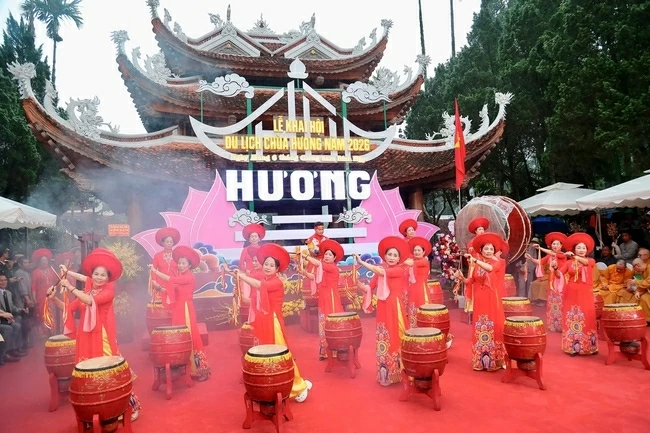
In Hanoi , this year's Huong Pagoda Festival aims for "Safety - Friendliness - Quality". A dedicated hotline has been established, a rapid response team operates continuously, AI cameras are installed at key locations, and electronic tickets and QR codes control visitor numbers according to time slots. The free parking for service cars and vehicles with 10 seats or more is a commendable move, demonstrating that the local authorities are shifting from a "seasonal management" mindset to a "sustainable service" approach.
While not everything is perfectly smooth, the "six clear" approach – clear people, clear tasks, clear timeframes, clear responsibilities, clear products, and clear results – is a step forward in festival management. When festivals are organized professionally, transparently, and utilize technology, familiar frustrations like overcrowding, price gouging, and chaos are gradually brought under control. This signals that festivals are not exempt from the digital transformation and administrative reform process.
At the national level, the "Spring Festival Across the Nation" brought together over 300 artisans representing 33 ethnic communities from 15 provinces and cities. The rituals for praying for a good harvest in the Central Highlands, folk songs, and distinctive customs were recreated not just as performances, but as an affirmation that culture is the inherent strength of the nation. When government leaders emphasized the role of culture as a pillar of sustainable development, this message showed that the festival was not just about celebrating spring, but as part of a long-term development strategy.
Broadly speaking, this year's early-year festivals share a common thread: a greater harmony between tradition and modernity. Localities are no longer prioritizing "high crowds for success" at all costs. Instead, they are talking more about safety, quality experiences, year-round tourism, and conservation alongside livelihoods. At Huong Pagoda, the goal of developing year-round tourism instead of focusing solely on the festival season is a way to alleviate pressure and create a stable flow for the local economy.
 |
| The 2026 Huong Pagoda Festival aims for "Safety - Friendliness - Quality". (Photo: Xuan Truong) |
Of course, festivals always have downsides if they are poorly managed: excessive commercialization, overcrowding, superstition, and litter. But instead of focusing only on the negative aspects, perhaps we should consider the efforts to improve them.
The increased use of cameras, standardized tour guides, traffic flow management, and strict handling of touting demonstrate that the authorities are not standing idly by. More importantly, people are also gradually changing their behavior as community awareness improves.
In the processions, it's not uncommon to see young people participating with seriousness and pride. They don't view the festival as "something for the elderly," but rather as a space to understand their roots. The participation of the younger generation is a guarantee of the festival's vitality. When traditions are passed down through practical experience, not just through books, then culture truly continues.
Ultimately, the New Year festival is a way for the community to express their wishes for peace, favorable weather, and national prosperity. These prayers may vary in form, such as lighting incense in front of the community hall, releasing lanterns on the Dong Nai River, or taking a boat trip to Huong Tich Cave, but they all share a common hope: that the new year will be better than the old one.
In the hustle and bustle of urban life, festivals create moments of quiet reflection, allowing people to reconnect in shared spaces. A family watching lion and dragon dances in Cholon, a group of young people checking in at Huong Pagoda, an elderly person attentively observing a harvest prayer ceremony… all contribute to a vibrant tapestry of culture.
It's safe to say that this year's festival was not only more crowded, but also seemed more "orderly" and "organized."
With better management and more conscious participation, the festival will shed some of the controversial and offensive images, retaining its essence: reverence, community joy, and pride in cultural identity.
Maintaining the rhythm of festivals is not about preserving a habit, but about preserving a cultural heritage. And when that heritage is guided by civilized thinking, technology, responsibility, and community participation, then spring is not just the first few weeks of the year, but becomes a positive energy that spreads throughout all four seasons.
Source: https://baoquocte.vn/mong-le-hoi-moi-ngay-mot-van-minh-365321.html
![[Photo] Secretary of the National Assembly Party Committee, Chairman of the National Assembly presides over the meeting of the Standing Committee and Executive Committee of the National Assembly Party Committee.](https://vphoto.vietnam.vn/thumb/1200x675/vietnam/resource/IMAGE/2026/06/03/1780480353201_ndo_br_bnd-2585-jpg.webp)
![[Photo] First session of the 14th Congress of the Vietnam Trade Union](https://vphoto.vietnam.vn/thumb/1200x675/vietnam/resource/IMAGE/2026/06/03/1780465947883_ndo_br_img-3852-jpg.webp)
![[Photo] General Secretary and President To Lam presides over a meeting with the Central Organizing Committee.](https://vphoto.vietnam.vn/thumb/1200x675/vietnam/resource/IMAGE/2026/06/03/1780482764658_a1-bnd-4741-3342-jpg.webp)








































![[Video] Sunset at Lap An Lagoon – Where the sun sets over the fishing nets](https://vphoto.vietnam.vn/thumb/1200x675/vietnam/resource/IMAGE/2026/05/31/1780192137701_beach-landscape-sea-water-nature-grass-745871-pxhere-com.jpeg)



























Comment (0)