

Golden season across the fields
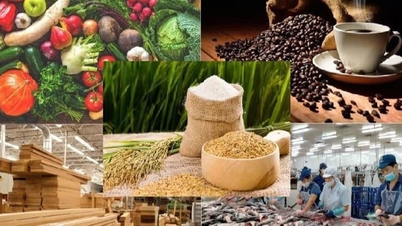
Despite successive storms and floods, Vietnam's agriculture sector is expected to have a truly golden harvest in 2025. The latest report from the Ministry of Agriculture and Environment indicates that in the past 10 months, agricultural exports reached over $58 billion, a 13% increase compared to the same period last year. Notably, the trade surplus reached nearly $18 billion, a 16.4% increase compared to the same period in 2024, with seven product categories exceeding $1 billion in export surplus.
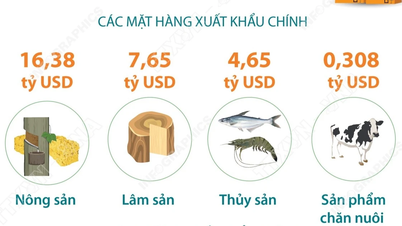
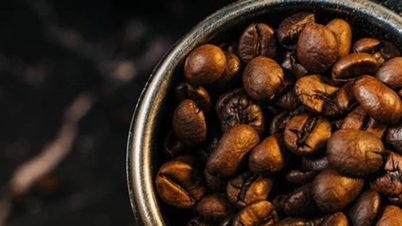
First and foremost, we must mention coffee. Currently, farmers in the Central Highlands, the country's coffee granary, are entering the peak harvest season. On the market, the price of green coffee beans remains above 110,000 VND/kg, an unprecedented high for the harvest season. According to estimates by the Vietnam Coffee and Cocoa Association (VICOFA), this year's harvest may be about 10% higher than last year due to favorable weather and good cultivation practices, leading to increased yields. With good prices and increased volume, coffee exports have reached a record high in the past 10 months. The total export volume reached 1.3 million tons and the value reached 7.4 billion USD. Exports increased by 13.5% in volume and 62% in value compared to the same period in 2024. It can be said that there has never been a year with such high export prices for coffee, averaging $5,653 per ton, a 42.5% increase compared to the same period in 2024. It is estimated that coffee exports for the whole year of 2025 will reach $8-8.5 billion, exceeding 2024 by approximately $3 billion.
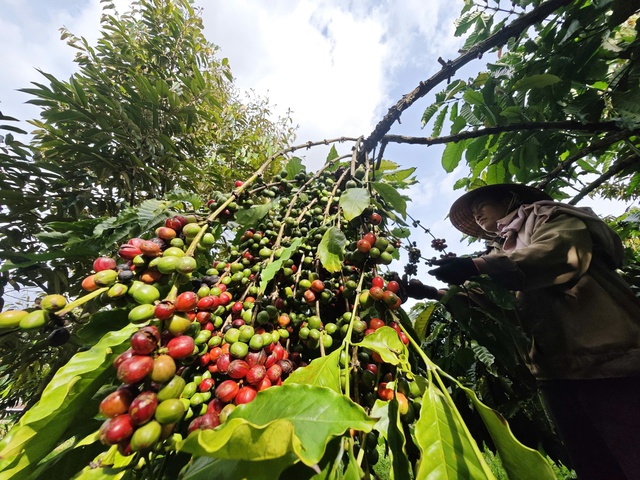
Farmers in the Central Highlands are in the midst of harvesting coffee, enjoying a bumper crop and good prices this new season.
PHOTO: DAO NGOC THACH
Unlike the coffee industry, the success of the seafood sector bears the mark of overcoming challenges with great effort. Besides the US countervailing duties, key products such as shrimp and fish also face additional anti-dumping and countervailing duties. Yet, in the first 10 months of 2025, seafood exports reached US$9.3 billion, a 13% increase compared to the same period in 2024. The forecast for the whole year 2025 is that this figure could reach US$11 billion, continuing strong growth compared to the previous year.
Not only have our businesses maintained a strong presence in the US market with an impressive growth rate of 6.2%, accounting for a 17.4% market share, but they have also successfully diversified into other markets. The Chinese market, in particular, grew by 35%, becoming Vietnam's largest seafood consumer with a 20% market share. Following closely behind is Japan, with an 11.2% growth rate and a 15.1% market share compared to the same period last year. Among the top 15 largest export markets, Brazil stands out with a 43% increase. This is a crucial foundation for the seafood industry to aim for export revenue of $14-16 billion by 2030.
The agricultural boom season wouldn't be complete without the fruit and vegetable sector. Despite facing numerous difficulties in the first half of 2025 when its main product, durian, was found to contain banned substances, the industry reversed the situation in the final months of the year, achieving a total export value of $7.1 billion in the first 10 months, a 15% increase compared to the same period in 2024.
While pepper exports in 2024 celebrated their return to the billion-dollar "club," this year it only took 9 months to reach that milestone; and the cumulative figure for the first 10 months reached 1.4 billion USD. Cashew exports reached nearly 4.3 billion USD, an increase of 2.2% in volume and nearly 19% in value compared to the same period in 2024.
We need a "central brain".
agricultural commander
The Netherlands has built the "central brain" of these agricultural strategies: Wageningen University & Research (WUR), a world-leading agricultural university and research institute. Currently, about 45% of WUR graduates are working in over 100 countries. In contrast, in Vietnam, investment in scientific research in agriculture has only been sufficient for operating expenses such as salaries. If Vietnam wants to become a true agricultural powerhouse, playing a crucial role in the global food supply chain and security, it is essential to invest heavily in research and development in science and technology.
Professor Bui Chi Buu , former Director of the Southern Institute of Agricultural Science and Technology.
In terms of export value, wood is the star, with total exports of wood and wood products reaching US$14 billion in the first 10 months, a 5.4% increase compared to the same period in 2024. Like other industries, wood faces significant tariff pressure from its main market, the US. However, businesses in the industry have quickly overcome this by increasing imports of raw materials from the US for processing; innovating designs; and accepting smaller orders. As a result, the US maintains its position as Vietnam's largest buyer, holding a 56% market share, a 7.2% increase compared to the same period last year. Besides the US, the important Japanese market saw growth of over 25% and now holds an 11.3% market share.
By 2025, Vietnam has surpassed Thailand to become the world's second-largest rice exporter, after India, with an estimated volume of 8 million tons. Notably, Vietnamese rice has maintained the highest prices even during periods of sharp declines in global prices.
A sturdy pillar in extreme weather conditions.
Amidst the joy of a bountiful harvest and favorable prices, the agricultural sector also faces concerns about increasingly extreme weather. Currently, cold fronts continue to intensify, causing severe cold in the North, which could affect livestock and crops. Central Vietnam is experiencing heavy rains lasting for a week, potentially disrupting coffee harvesting in the Central Highlands. In addition, high tides and heavy rains continue to threaten farmers in the South. Looking back at this year, the East Sea has seen 14 typhoons, many of which were very strong, and there is still a possibility of one or two more typhoons appearing between now and the end of the season.
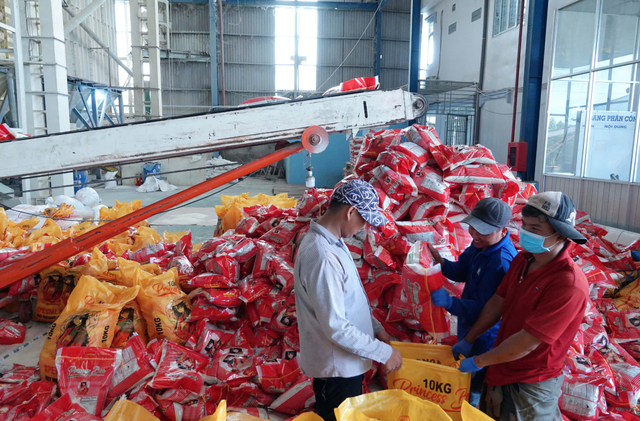
Despite facing significant challenges in the Philippine market, Vietnam's rice exports have surpassed Thailand to become the world's second-largest exporter.
On a global scale, climate change is becoming increasingly severe, with increasingly extreme weather events becoming commonplace. At the 30th Conference of the UN Framework Convention on Climate Change (COP30) in Brazil, international organizations released alarming reports. Specifically, the Global Carbon Budget report stated that the Earth will continue to warm over the next four years; particularly by 2029, it will exceed the safe threshold of 1.5°C above pre-industrial levels. It predicts a further 2.6°C increase, reaching "unlivable" levels by the end of this century. Temperatures exceeding 2°C could trigger catastrophic climate "tipping points," such as the collapse of large ice sheets leading to rising sea levels and submerging cities.
Speaking at the 80th anniversary celebration of the Agriculture and Environment sector, General Secretary To Lam emphasized: For the past 80 years, the Agriculture and Environment sector has always been a companion to the nation and has become a pillar of the economy, the foundation of livelihoods, and an important factor in development in the new era.
In the new era and in the context of particularly challenging environmental, climate, and market conditions, General Secretary To Lam requested that the agricultural sector continue to improve institutions, policies, and strategic foundations for the new phase. Furthermore, it is crucial to promote the development of science and technology (S&T), innovation, and digital transformation, considering these as key drivers of development. This includes building a synchronized data system on land, water resources, forests, meteorology, hydrology, and biodiversity; developing digital maps for the sector and a unified national land database. Science and technology should be placed at the heart of agricultural production, from plant and animal breeding, biotechnology, automation, to traceability and digital commerce. The agricultural sector should be restructured towards increasing added value and sustainable development. Production should continue to be linked with deep processing, national branding, market expansion, and deeper participation in the global agricultural value chain.
Invest heavily in research and development in science and technology.
Professor Bui Chi Buu, former Director of the Southern Institute of Agricultural Science and Technology, expressed his delight that the country's leader is very interested in investing in science and technology in agriculture. This is the key and a valuable lesson learned from many agricultural powerhouses around the world. "The Netherlands shares many similarities with Vietnam in facing numerous environmental and climate challenges. Therefore, the experiences from this European country are worth learning from," Professor Buu said.
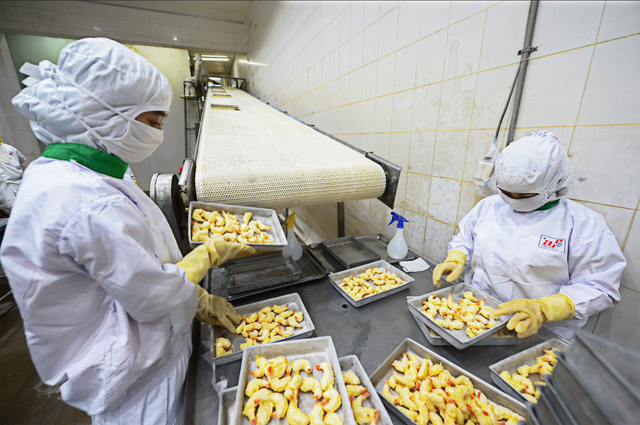
Despite numerous difficulties and challenges, seafood exports are aiming for the milestone of 11 billion USD.
He cited the example of the Netherlands, which has only about 2 million hectares of agricultural land, with an average cultivated land area per capita of 0.058 hectares, among the lowest in the world. Yet, the Netherlands ranks first in the EU and second in the world, only after the US, in terms of agricultural export value. The Netherlands' agricultural export value reached $144 billion in 2023, while Vietnam's in 2024 was only $67 billion. "The Netherlands is currently the world's largest producer of milk and dairy products. Annual exports of dairy products from the Netherlands are estimated at $2.9 billion. One-third of the world's exported peppers, tomatoes, and cucumbers come from this country. Besides that, the Netherlands is also a leading exporter of onions, flowers, potatoes, etc.," Professor Bui Chi Buu recounted, emphasizing that all these successes are based on systematic investment in science and technology.
In the field of agriculture, the Dutch government places great importance on land improvement and fertility surveys. The average investment is €4,000 per hectare per year. The state also funds the reorganization of agricultural land, converting small fields into larger, contiguous ones. Irrigation systems are built to ensure mechanization. The rate of scientific and technological development in Dutch agriculture is among the highest in the world. The Dutch have achieved agricultural success with the motto "high investment, high returns, high efficiency." In 2022, spending on R&D (research and development) and innovation in agriculture in the Netherlands alone was $11.6 billion. In addition, priority is given to funding the development of science, education, and the transfer of technological advancements. Agricultural scientific research, education, and the transfer of technological advancements are becoming a mutually supportive triangle, serving the interests of farmers.
"Those successes were built and developed based on high efficiency in state management. They view effective state management as a rare and valuable resource," Professor Bui Chi Buu affirmed, suggesting that Vietnam can learn from the Netherlands to develop efficient and sustainable agriculture in the context of increasing climate change.

Graphics: Van Nam
Developing multi-billion dollar industries.
Currently, only wood and seafood have reached export values of tens of billions of USD per year, but many other sectors have the potential to join this club. Regarding coffee, Mr. Nguyen Nam Hai, Chairman of the Vietnam Coffee and Cocoa Association (VICOFA), said that businesses in the industry are also actively expanding their markets into emerging regions like China and other Asian countries with deeply processed products and instant coffee. In addition, they are actively promoting and building the brand of Vietnamese coffee in new markets. It is hoped that in the next few years, the export ratio of green coffee beans will decrease to 80% and deeply processed products will increase to 20%, bringing the export value of this sector to over 10 billion USD.
Mr. Dang Phuc Nguyen, General Secretary of the Vietnam Fruit and Vegetable Association (VINAFRUIT), also optimistically predicts that by the end of 2025, the fruit and vegetable industry will reach the milestone of over 8 billion USD, but more importantly, the market potential is still vast. For example, durian could reach 4-5 billion USD next year if we standardize the process. In addition, bananas, pineapples, coconuts, and passion fruit... are facing the opportunity to bring in billions of USD. These are the potentials for the fruit and vegetable industry to achieve tens of billions of USD in export turnover in the coming years.
Source: https://thanhnien.vn/mua-vang-nong-san-viet-1852511152119393.htm

![[Photo] General Secretary and President To Lam presides over a meeting with the Central Organizing Committee.](https://vphoto.vietnam.vn/thumb/1200x675/vietnam/resource/IMAGE/2026/06/03/1780482764658_a1-bnd-4741-3342-jpg.webp)
![[Photo] Secretary of the National Assembly Party Committee, Chairman of the National Assembly presides over the meeting of the Standing Committee and Executive Committee of the National Assembly Party Committee.](https://vphoto.vietnam.vn/thumb/1200x675/vietnam/resource/IMAGE/2026/06/03/1780480353201_ndo_br_bnd-2585-jpg.webp)
![[Photo] First session of the 14th Congress of the Vietnam Trade Union](https://vphoto.vietnam.vn/thumb/1200x675/vietnam/resource/IMAGE/2026/06/03/1780465947883_ndo_br_img-3852-jpg.webp)








































![[Video] Sunset at Lap An Lagoon – Where the sun sets over the fishing nets](https://vphoto.vietnam.vn/thumb/1200x675/vietnam/resource/IMAGE/2026/05/31/1780192137701_beach-landscape-sea-water-nature-grass-745871-pxhere-com.jpeg)


























Comment (0)