

A report released on March 25 by US intelligence agencies concluded that China remains the top military and cybersecurity threat to the United States.
Accordingly, the U.S. intelligence community believes that China has the capability to attack the U.S. with conventional weapons, compromise U.S. infrastructure through cyberattacks, and target U.S. assets in space. U.S. intelligence also noted that Beijing is striving to surpass Washington to become the leading power in artificial intelligence (AI) capabilities by 2030, Reuters reported.
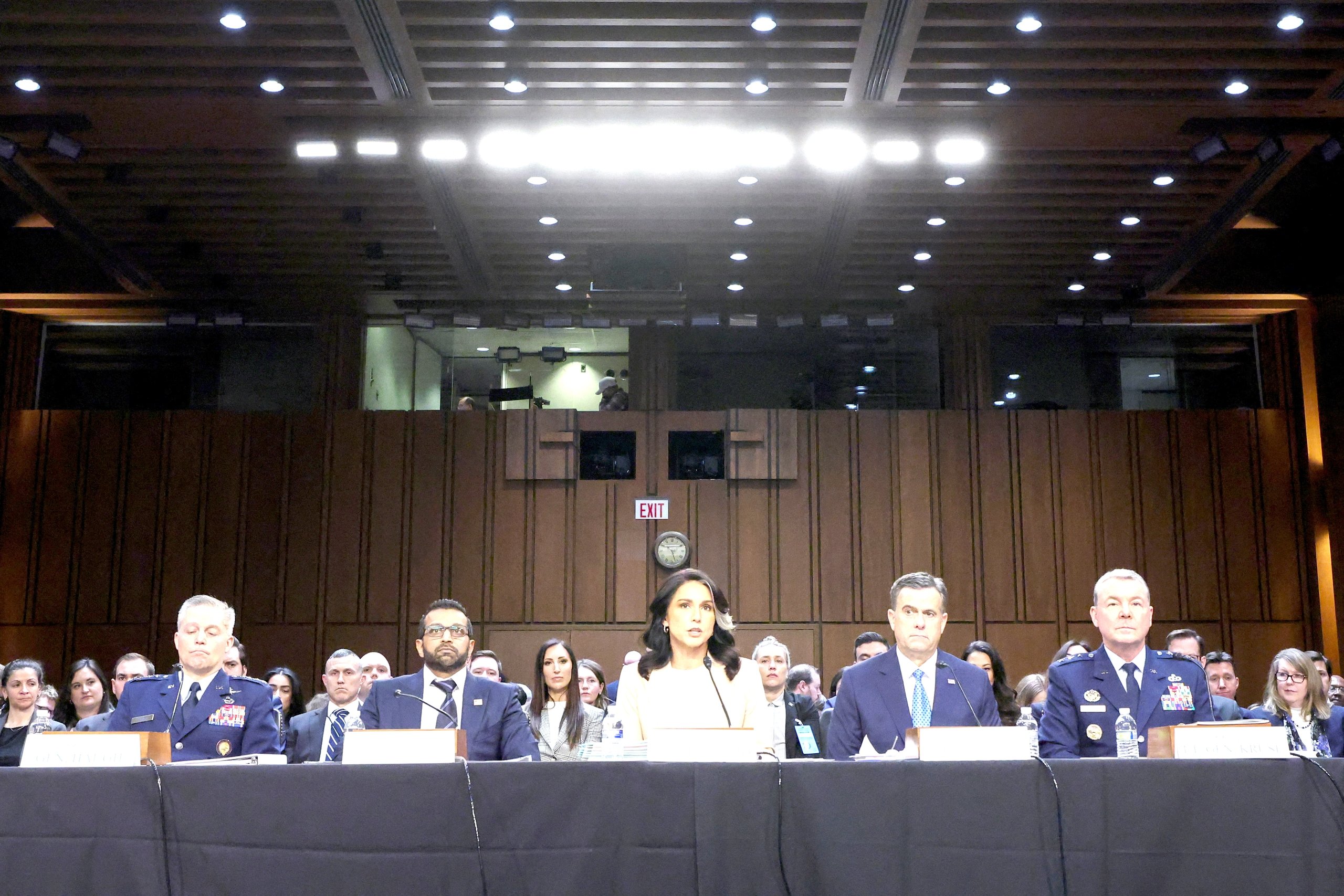
Leaders of US intelligence agencies to testify on March 25.
Responding at a hearing of the US Senate Intelligence Committee on March 25, Director of National Intelligence (DNI) Tulsi Gabbard called China "the most capable strategic adversary" to Washington. "The Chinese military is deploying many advanced capabilities, including hypersonic weapons, stealth aircraft, modern submarines, enhanced cyber and space warfare capabilities, and the development of a nuclear arsenal," Gabbard said. US intelligence also believes China will increase military and economic pressure on Taiwan. Furthermore, Washington believes Beijing has a long-term goal of expanding access to natural resources in Greenland and using the island as a "critical strategic springboard" in the Arctic.
Responding to the US report, Chinese Foreign Ministry spokesman Guo Jiakun said that the US should stop using "hegemonic thinking" when thinking about China. Guo emphasized that Washington's dissemination of the doctrine that views China as a threat is solely aimed at containing and pressuring Beijing.
Democrats demand the resignation of Trump's advisors and cabinet ministers over the leak of classified information.
Aside from the report on China, much of the content of the US Senate hearing focused on security concerns. This stemmed from the fact that President Donald Trump's national security advisor, Mike Waltz, inadvertently added a journalist to a messaging group chat used to exchange sensitive information about the US military's plans to attack Houthi forces in Yemen. Although Trump defended his subordinate and asserted that the mistake did not affect military operations, the incident still raised concerns among domestic officials and foreign intelligence partners about Washington's handling of classified information.
According to The Guardian , Canadian Prime Minister Mark Carney said on March 25 that the US error highlighted the need for allied nations in the intelligence community to "look out for themselves." Canada is one of five members of the "Five Eyes" group – the US, UK, Australia, and New Zealand – an alliance focused on sharing and gathering intelligence. Other countries in the group say the incident is a US government issue, and it is unclear how the leak of classified information will affect intelligence sharing among the "Five Eyes" countries.
Source: https://thanhnien.vn/my-xem-trung-quoc-la-moi-de-doa-quan-su-hang-dau-185250326205252283.htm


![[Photo] General Secretary and President To Lam presides over the meeting to approve the draft report on the results of the second inspection by the Politburo of the Standing Committee of the Hanoi City Party Committee.](https://vphoto.vietnam.vn/thumb/1200x675/vietnam/resource/IMAGE/2026/05/26/1779789811432_a2-bnd-4430-9620-jpg.webp)











































































Comment (0)