

Increase the proportion of trained workers.
At the time of the province's re-establishment (in 1992), the workforce in our province was mainly unskilled laborers without formal training, with only 14.5% of the workforce having received training. By 2020, this figure had increased to 65%, and by 2023, it had risen to 69.5%. However, these figures still fall short of the needs in terms of quantity, structure, and educational level, as well as professional skills, required for industrialization, modernization, and international economic integration.
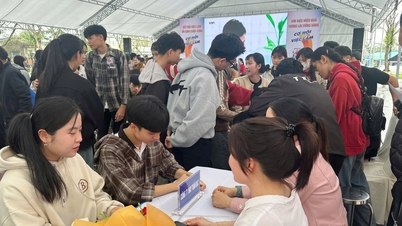
Observations of job fairs organized by the Provincial Employment Service Center in recent years show that the current labor market still lacks skilled technical experts, competent managers, and highly skilled workers; the proportion of trained workers employed in businesses does not match the actual potential. This leads to a situation where many businesses are short of labor but cannot recruit enough.
From a company facing significant difficulties due to a lack of orders and layoffs in 2022, MCNEX VINA Co., Ltd. (Phuc Son Industrial Park, Ninh Binh City) has made a strong recovery since mid-2023. The company needs to recruit a considerable number of workers to compensate for labor shortages and meet the demands of expanding production and business. At a job fair organized by the Provincial Employment Service Center at the end of 2023, in addition to hundreds of general labor positions, MCNEX VINA Co., Ltd. also sought dozens of high-skilled positions such as: Korean interpreters, programmers, machine tool designers, circuit designers, etc. However, according to company representatives, recruiting high-skilled workers has never been easy.
As a locality with a rapidly developing industrial sector in recent years, Gia Vien district currently has approximately 16,000 workers employed in local businesses. However, only about 30-38% of these workers have received formal training. In recent years, the district has added a goal to its annual job creation plan to increase the number of trained workers capable of holding important positions within businesses.
Ms. Dinh Thuy Hang, Head of the Labor, War Invalids and Social Affairs Department of the district, affirmed: The rapid development of technology has created pressure on workers in many aspects, especially as machines gradually replace human labor. This poses a challenge for functional agencies and vocational schools in changing and improving the quality of training so that workers are not left behind in this fiercely competitive "game".
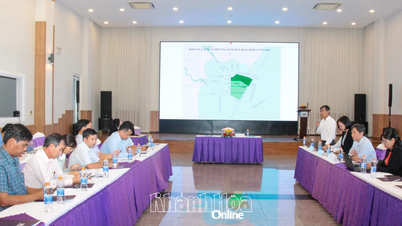
Specifically for Gia Vien district, in the period 2021-2025, the district assigned the Department of Labor, War Invalids and Social Affairs the task of coordinating with relevant units and functional departments to improve the quality of vocational training, gradually creating a high-quality workforce, and increasing the percentage of workers capable of taking on key positions and jobs in enterprises, instead of just being unskilled laborers as is currently the case.
Specifically, through the Provincial Employment Service Center, tens of thousands of workers are recruited annually by businesses through job exchanges; the proportion of trained workers is steadily increasing, accounting for 35-40%. In reality, the demand from businesses is much higher. To train a high-quality workforce to serve the socio-economic development of the province, in the 2021-2025 period, the Department of Labor, War Invalids and Social Affairs is actively implementing many solutions to achieve the goal of improving the quality of human resources, increasing the proportion of trained workers to 70%-72% by 2025, contributing to the shift in labor structure, meeting the requirements of economic development, poverty reduction, ensuring social security, and bringing Ninh Binh to rapid and sustainable development.
Businesses play a crucial role.
Not only relying on vocational training institutions, in recent years, businesses have also proactively and actively implemented many solutions to improve the quality of their workforce. In reality, the active involvement of businesses has significantly contributed to improving the quality of human resources. Accordingly, highly skilled and professionally qualified workers are always attracted by businesses with attractive incentives such as: salary, housing support, transportation, etc.
In particular, to secure a workforce that meets their needs, businesses have proactively collaborated with vocational training institutions to provide training and retraining, enabling workers to improve their skills and better meet job requirements. Through this training partnership, businesses also contribute to refining the school's curriculum. Thus, after graduation and employment, students can immediately begin working without requiring further training or retraining from the company.
Furthermore, businesses have placed special emphasis on fostering and promoting the creativity of each employee through the launching of emulation movements. These vibrant emulation movements have motivated employees to research and create innovative ideas that generate billions of dong in profits for businesses, contributing to their breakthrough and growth.
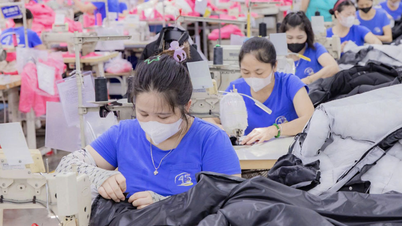
According to a representative of Nam&Co London Garment Co., Ltd. (Dong Huong Industrial Park, Kim Son District): In the context of deep integration, businesses must apply many new technologies to improve product quality and increase brand competitiveness. Recruiting suitable workers for job positions is not easy, because even trained workers still have a gap between theory and practice.
To proactively secure a workforce that meets demand, the company has actively organized training programs for its employees to improve their skills, learn new trades, and retrain. It regularly holds competitions such as "Skill Training and Excellent Craftsman Competitions," and "Excellent Workers, Creative Workers with High Productivity, Quality, Safety, and Efficiency"; and encourages the application of innovative ideas and technical improvements in production… attracting a large number of employees to participate. These emulation movements have motivated employees to develop their abilities and strengths, contributing to maximum efficiency in their work. Previously, completing 1,000 products required 10 days of production time, but now this has been shortened to 7-8 days.
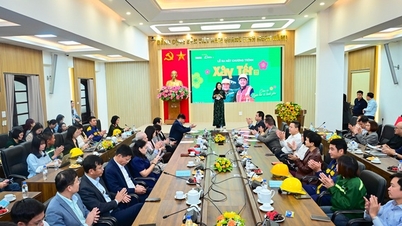
Mr. Dinh The Hung, Chairman of the Trade Union of Industrial Zones in the province, affirmed: In reality, effectively implementing emulation movements is the driving force and opportunity for each unit and enterprise to create breakthroughs in production and business activities. Over the years, grassroots trade unions have actively coordinated with business owners to launch emulation movements such as: "Promoting initiatives, technical improvements, rationalizing production, applying scientific and technological advancements and new technologies to production"; "Practicing thrift, reducing management costs, reducing consumption norms of raw materials, fuel, and energy to improve productivity and quality, enhancing the efficiency of machinery and equipment use, creating many high-quality products that are competitive when participating in regional and international integration"; "Creative labor, higher productivity, higher quality, higher income"... which have awakened the creativity and dedication of workers. These initiatives have contributed to increasing revenue and profits for businesses, fulfilling their obligations and responsibilities to the State, and improving the income and living standards of their employees.
Text and photos: Dao Hang
Source
![[Photo] Prime Minister Pham Minh Chinh attends the Conference on the Implementation of Tasks for 2026 of the Industry and Trade Sector](/_next/image?url=https%3A%2F%2Fvphoto.vietnam.vn%2Fthumb%2F1200x675%2Fvietnam%2Fresource%2FIMAGE%2F2025%2F12%2F19%2F1766159500458_ndo_br_shared31-jpg.webp&w=3840&q=75)




























































































Comment (0)