

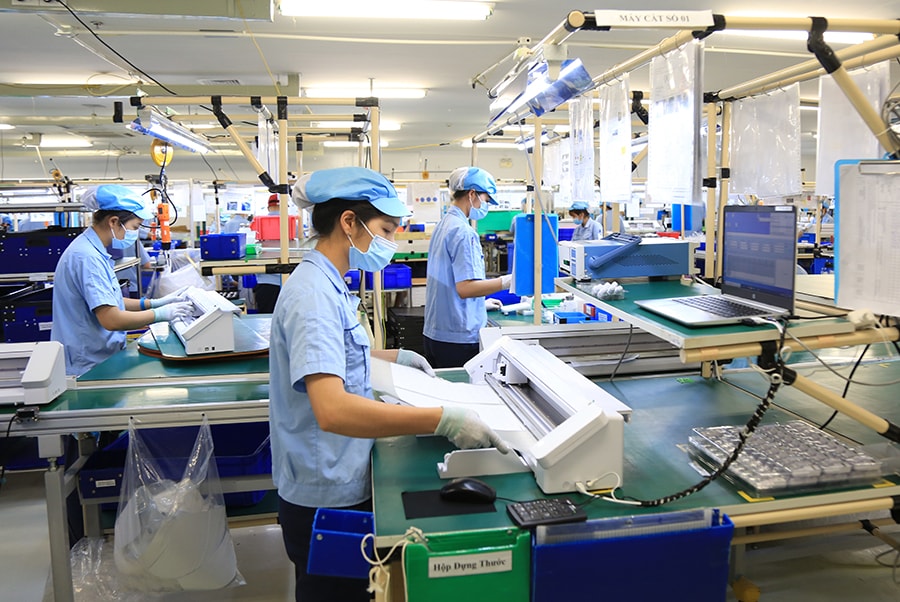
Over the past period, Hanoi has thoroughly grasped and determined that science, technology, innovation, and digital transformation are the levers, the foundation for development, the driving force for growth, and the tools for innovating the leadership, direction, and management methods of the entire political system.
1. The development model based on science , technology, innovation, and digital transformation in Hanoi has been specifically and systematically established in recent years, in accordance with the realities of the capital city.
Firstly , Hanoi has built a comprehensive institutional framework based on the "pilot - summarize - law" model. Notably, Hanoi did not wait for the Capital City Law to be amended before implementation, but proactively proposed that the National Assembly issue a pilot resolution first, then summarize the practical experience before the National Assembly legalized it into the Capital City Law in 2026.
Specifically, the important documents in chronological order include the Law on the Capital City No. 39/2024/QH15 - the first foundational legal framework, effective from January 1, 2025. Following that, Resolution No. 258/2025/QH15 dated December 11, 2025 of the National Assembly - this is a practical springboard, as Hanoi proactively proposed and piloted a special mechanism for investment, planning, urban development, land, and finance for large and important projects.
In particular, Resolution No. 02-NQ/TW dated March 17, 2026, of the Politburo on building and developing the Capital in the new era – is the highest political directive for the Capital. The Law on the Capital No. 02/2026/QH16, passed on April 23, 2026, is a step forward in legalizing the practical implementation of Resolution No. 258/2025/QH15, expanding the special mechanism to include science, technology, innovation, digital transformation, and talent attraction. In addition, the Master Plan for the Capital with a 100-year vision has established Hanoi's development according to a cluster urban model, multi-polar, multi-centered, with the Red River as the central landscape axis.
Secondly , the city has established a new growth model based on the structure of “3 pillars - 5 drivers - 4 development spaces”. The three pillars are: Innovation - productivity - digital economy; green growth - circular economy - low emissions; regional connectivity - modern infrastructure - multi-centered urban development. The five new growth drivers are: Institutions - governance; science, technology - innovation - digital transformation; cultural industry; exploiting the growth potential of economic sectors; and exploiting multi-polar, multi-centered, multi-layered, multi-tiered planning spaces. The four development spaces are: Innovation and knowledge space; high-tech industry and logistics space; green urban space, Transport-Oriented Development (TOD) model, public transport; and regional connectivity and economic corridor space.
Notably, according to Nguyen Xuan Luu, Standing Committee member of the Hanoi City Party Committee and Vice Chairman of the Hanoi People's Committee, the city is simultaneously implementing three shifts: from capital-based growth to productivity-based growth; from public investment to private investment; and from traditional industries to knowledge-based industries.
Specifically, the city is shifting from capital-driven growth to productivity-driven growth, aiming to increase the contribution of total factor productivity (TFP) to growth to 57% by 2030, and reduce the ICOR (Investment Capital Output Ratio) from 6.65 (2021-2025) to approximately 5.5. The city is also shifting from public to private investment, with the state budget playing a seeded role, meaning every dollar of budget capital must attract a multiple of private investment, aiming for a social investment target of 5 trillion VND in the 2026-2030 period...
Thirdly , regarding resources, in 2026, the city allocated over 9,090 billion VND for science, technology, innovation, and digital transformation, and has already disbursed over 2,529 billion VND (reaching 27.82% of the plan). Simultaneously, the city has issued 7 additional funding decisions totaling over 1,001 billion VND from the centralized management fund. This is the largest investment in this field to date.
Regarding the technology business ecosystem, by the first quarter of 2026, the city will have 221 science and technology enterprises (leading the country); over 1,000 innovative startups, accounting for over 26% of the national total; and 10,996 digital technology enterprises. Notably, based on an assessment of the capital's potential and advantages, the city is proactively setting a higher target than the national average.
Specifically, the digital economy is targeted to reach at least 22% of GRDP by 2026 and at least 40% by 2030, one and a half times higher than the national target. Hanoi's proactive setting of a higher target demonstrates strong political determination and creates internal pressure demanding stronger reforms throughout the entire political system. This target also serves as the basis for Hanoi to enact appropriate mechanisms, policies, and allocate resources accordingly, avoiding a scattered approach.
2. A very significant step forward in the innovation of development models based on science, technology, innovation, and digital transformation is that in recent times, Hanoi has formed good, creative, and effective models and practices that can be studied and replicated nationwide.
According to Vice Chairman of the Hanoi People's Committee Nguyen Xuan Luu, Hanoi has developed seven new models and approaches that have proven effective in practice. Specifically, these include: Work management based on key objectives and results (OKR/KPI) in the public sector; the publication of a list of 30 major challenges facing the capital; substantive cooperation among the "Four Stakeholders" (State - Schools - Enterprises - Financial Institutions); a joint-stock company model with 30% socialized capital within the Hanoi Innovation Center; breakthrough international cooperation in semiconductors and high technology; a strategy to attract Vietnamese experts and intellectuals abroad; and the conditions for the Hoa Lac High-Tech Park to become a regional science and technology center.
Particularly noteworthy is the list of 30 major challenges facing Hanoi, serving as a guide for the capital's development in the new era. This is an unprecedented approach, with each challenge designed by the city as a "strategic question" rather than a specific administrative task; simultaneously, it publicly seeks solutions from the entire society – research institutes, universities, experts, scientists, domestic and international businesses, etc.
The list of major problems is structured into four groups: Group 1: Persistent urban bottlenecks (including 5 problems related to traffic congestion, urban sanitation, pollution, flooding, and food safety). Group 2: Urban space (including 4 problems). Group 3: Creating economic growth and mastering technology (including 16 problems). Group 4: Security, social welfare, and sustainable development (including 5 problems). This approach fundamentally changes the way scientific and technological activities are organized, shifting from "funding per project" to "commissioning solutions to practical problems."
The Hanoi Innovation Center, operating as a joint-stock company, is also a highlight. The company's ownership structure follows a "three-legged stool" model: the city holds 70%, and CMC Technology Group and Hanoi University of Science and Technology (HUST) each hold 15%. The initial charter capital is approximately 100 billion VND, and the goal is to establish an Innovation Fund exceeding 500 billion VND by 2031-2035 to provide seed capital for startup projects. This is an unprecedented organizational model, operating under the "State-directed - Enterprise-operated - University-cooperative Innovation" model...
3. It can be seen that, in the process of reforming the development model based on science, technology, innovation, and digital transformation, the city has fundamentally shifted from "management by process" to "management by results." This is a revolutionary change in the method of leadership, direction, and operation. The OKR/KPI model is the clearest evidence of this; instead of focusing on checking compliance with procedures, the city measures the actual value created by each agency, official, civil servant, and employee. This approach overcomes the long-standing problem of superficial reporting.
In particular, in carrying out scientific, technological, innovative, and digital transformation tasks, the city has shifted from "funding per project" to "commissioning solutions to practical problems." This groundbreaking approach encourages research linked to application, overcoming the long-standing problem of "research being shelved."
Furthermore, the city has shifted from a "State-led" model to a "Four Substantive Stakeholders" model with the State playing a seed capital role. The Hanoi Innovation Center, operating as a joint-stock company, is a prime example. This approach aligns with the spirit of streamlining the administrative apparatus while simultaneously mobilizing resources and management capabilities from the private sector for public purposes.
Hanoi has identified the reform of its development model based on science, technology, innovation, and digital transformation as a historical requirement and a political task for the Party Committee and people of the capital city in the new era. The city is committed to proactively and decisively implementing new models and mechanisms; making full use of superior institutions and a streamlined administrative apparatus to become a testing ground for new mechanisms and policies from the central government.
Source: https://hanoimoi.vn/nen-tang-va-dong-luc-tang-truong-moi-975852.html
![[Photo] The heat at the fireworks display site on the opening night of the Da Nang International Fireworks Festival 2026](https://vphoto.vietnam.vn/thumb/1200x675/vietnam/resource/IMAGE/2026/05/27/1779889741485_ndo_br_z7872039145157-fecaba5112f39e8352544099d7ef4738-5140-jpg.webp)
![[Photo] Life on both banks of the river returns to its bustling pace on the day the Long Bien Bridge opens to traffic.](https://vphoto.vietnam.vn/thumb/1200x675/vietnam/resource/IMAGE/2026/05/28/1779949763708_cau-long-bien-minh-duy-7-3610-jpg.webp)









































































Comment (0)