

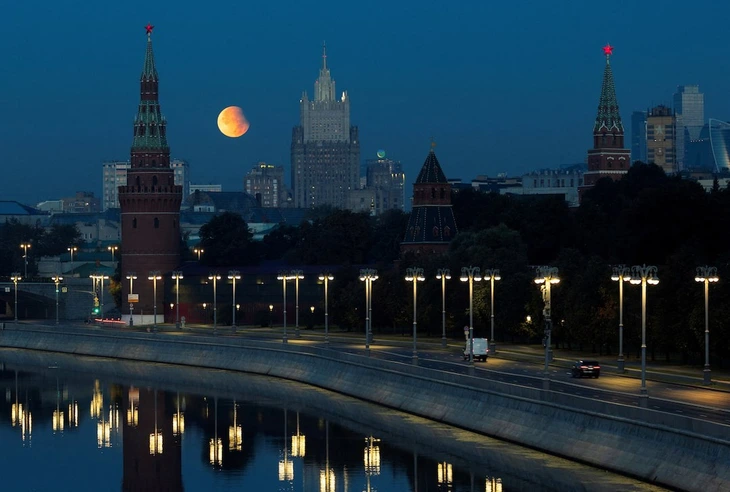
A partial lunar eclipse was seen over the Kremlin towers and the Russian Foreign Ministry building in Moscow, Russia, on September 18, 2024 - Photo: REUTERS/Maxim Shemetov
On December 24, the Russian Federal Space Agency (Roscosmos) announced plans to build a power plant on the Moon by 2036, marking a new step in Russia's long-term space expansion strategy. Reuters reported that Roscosmos has signed a contract with the Lavochkin Aerospace Company to implement the project.
According to Roscosmos, building a power plant on the Moon serves not only individual scientific missions but also lays the foundation for a long-term and sustainable research system. The goal is to shift from exploratory expeditions to a model of continuous human and scientific equipment presence on the Moon.
The power plant is expected to supply energy to rovers used for surface surveys, astronomical observatories, and other Russian infrastructure as part of the lunar exploration program.
Additionally, this power source is also designed to serve the International Lunar Science Station, a collaborative project in which Russia is participating to build an extraterrestrial research center.
In the lunar environment, ensuring a stable energy supply is a major challenge. Temperatures can fluctuate from over 120 degrees Celsius during the day to below -170 degrees Celsius at night, while each lunar day and night lasts approximately 14 Earth days.
This places many limitations on solar power systems, especially during long nighttime hours. Therefore, a dedicated power plant, most likely based on small-scale nuclear technology, is considered a suitable solution to maintain the continuous operation of equipment and research stations.
In June of this year, the head of Roscosmos, Dmitry Bakanov, stated that Russia aimed to develop its first nuclear power plant on the Moon and simultaneously continue its exploration missions to Venus, a planet considered Earth's "sister planet" due to its similar size and structure.
Russia aims for a long-term presence beyond Earth.
Experts believe that the plan to build a power plant on the Moon reflects a general trend among space powers to view the Moon as a springboard for deeper space exploration, including future missions to Mars.
Investing in extraterrestrial energy infrastructure is seen as a prerequisite for a long-term human presence in space, rather than just short-term flights as in the past.
According to Roscosmos, this project is still in the initial preparation and research phase and requires many more years of technology testing, safety assessments, and the establishment of operating standards before it can be implemented in practice.
However, this plan reveals Russia's long-term ambition to expand its scientific and technological activities and human presence beyond Earth, starting with our nearest natural satellite.
Source: https://tuoitre.vn/nga-len-ke-hoach-xay-nha-may-dien-tren-mat-trang-2025122507425171.htm
![[Photo] General Secretary and President To Lam presides over a meeting with the Central Organizing Committee.](https://vphoto.vietnam.vn/thumb/1200x675/vietnam/resource/IMAGE/2026/06/03/1780482764658_a1-bnd-4741-3342-jpg.webp)

![[Photo] Secretary of the National Assembly Party Committee, Chairman of the National Assembly presides over the meeting of the Standing Committee and Executive Committee of the National Assembly Party Committee.](https://vphoto.vietnam.vn/thumb/1200x675/vietnam/resource/IMAGE/2026/06/03/1780480353201_ndo_br_bnd-2585-jpg.webp)
![[Photo] First session of the 14th Congress of the Vietnam Trade Union](https://vphoto.vietnam.vn/thumb/1200x675/vietnam/resource/IMAGE/2026/06/03/1780465947883_ndo_br_img-3852-jpg.webp)













































![[Video] Sunset at Lap An Lagoon – Where the sun sets over the fishing nets](https://vphoto.vietnam.vn/thumb/1200x675/vietnam/resource/IMAGE/2026/05/31/1780192137701_beach-landscape-sea-water-nature-grass-745871-pxhere-com.jpeg)





































Comment (0)