

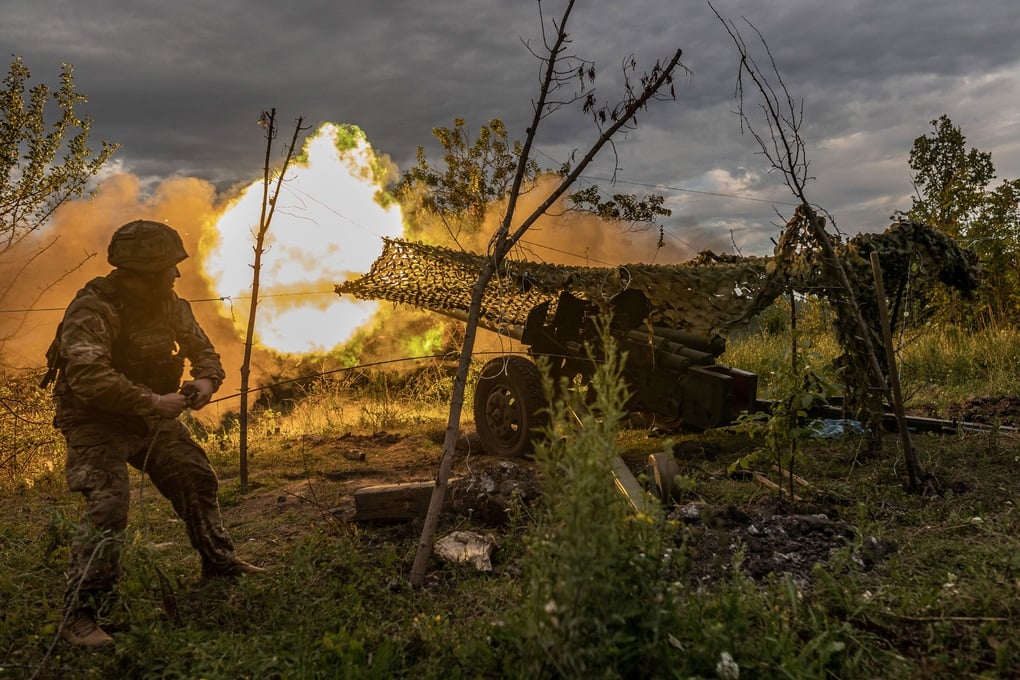
Ukrainian soldiers open fire in Bakhmut (Photo: Reuters).
Ukraine launched a counteroffensive in June with the goal of breaking through the front lines in the southeast. However, this counteroffensive "unfortunately lacked a crucial element, which is air power," retired General James Jones told RFE/RL in an interview.
"That means Russia has more time to lay mines in areas where they think Ukrainian ground forces will advance. That slows things down," added General Jones, former Supreme Allied Commander of NATO forces in Europe and former national security advisor to former US President Barack Obama.
According to the Washington Post , Ukraine's counteroffensive is being led by NATO-trained units. Ukraine has also achieved a breakthrough, albeit a small but significant one, in recent weeks as Kyiv's forces crossed the Dnieper River and advanced into Russian-controlled territory.
Volodymyr Fito, spokesman for the Ukrainian ground forces, said Ukraine would try to cut off Russian supply chains when cold weather arrives and push them out of Ukraine.
Meanwhile, Ukrainian President Volodymyr Zelensky warned citizens to prepare for a new wave of Russian airstrikes on Kyiv's infrastructure as winter approaches. He also predicted a fierce Russian offensive on the eastern front, including the city of Avdiivka.
Last month, the Chief of General Staff of the Ukrainian Army, Valery Zaluzhny, stated that the war between Russia and Ukraine was at a stalemate and that there would be no breakthrough in the near future. He also warned that in a prolonged war of attrition, Russia would have the advantage.
Since Ukraine launched its counteroffensive, Kyiv has clearly seen that Russia's tactical air power, superior in both quantity and quality, is posing an increasingly significant challenge. The air force has played a key role in Russia's military operations in Ukraine for more than a year of conflict.
Russian fighter jets have stepped up support for ground forces as they undertake riskier attacks, potentially incurring high casualties, to halt the advance of Ukrainian counter-attacks.
Lieutenant General Mykola Oeshchuk, commander of the Ukrainian Air Force, acknowledged that if Ukraine gained air superiority, the pace of the counterattack would be much faster.
He explained that one of the key rules for gaining dominance in battles is to halt the enemy's advance and force the other side of the front line to switch to a defensive stance, followed by gaining air superiority and control of the airspace.
According to him, Ukrainian aircraft are significantly inferior in technical capabilities compared to Russian ones, making it difficult for Kyiv to shoot down Moscow's fighter jets in air combat.
General Oeshchuk stated that, despite operating under difficult conditions, the Ukrainian Air Force still strived to complete its mission. He acknowledged that Kyiv had lost some aircraft and pilots, but also inflicted damage on Russia.
However, according to the Ukrainian general, Russia still has a sufficient fleet of aircraft to conduct air combat operations. Furthermore, Moscow still possesses the capability to produce new aircraft and missiles.
The fundamental difference between Russian and NATO air power is that the Western military alliance primarily uses long-range precision-guided weapons, while Moscow has mainly relied on unguided missiles or bombs. However, Russia's tactical air force has been gradually equipping itself with new long-range guided weapons over the past year.
Military analysts believe that Moscow relies on its air power to prevent Kiev's counterattack. Furthermore, anti-tank missiles, glide bombs from aircraft, combined with dense minefields and fortified Russian positions, have inflicted significant losses on Ukraine.
Source















































































Comment (0)