

The Southwestern region of Vietnam, the country's rice granary, is entering the harvest season for the 2024-2025 winter-spring rice crop, the largest of the year, but rice prices have fallen to their lowest level in the past three months.
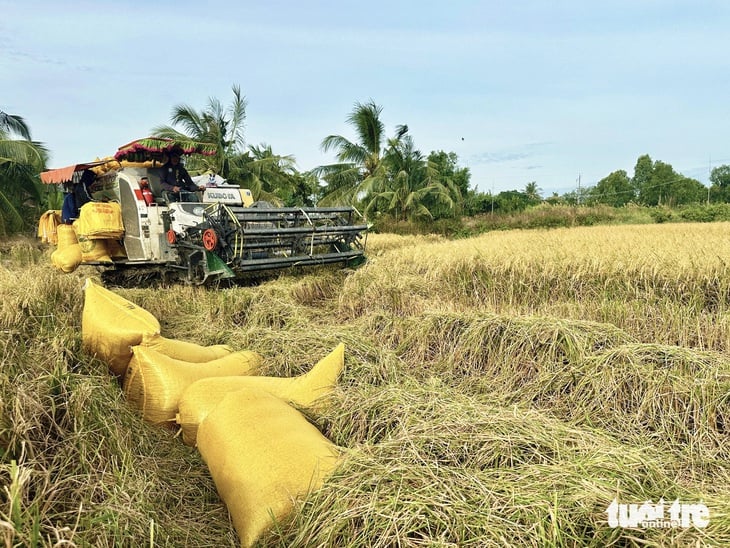
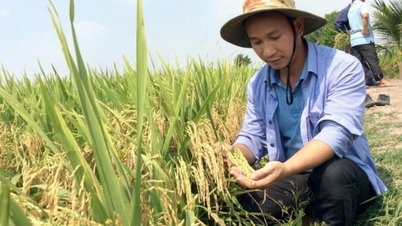
Farmers in Vinh Thuan district, Kien Giang province, are harvesting their late autumn-winter rice crop but are facing price manipulation - Photo: PHUONG DONG
The price of Vietnamese rice for export (5% broken rice) also plummeted to its lowest point, at only around 393 USD/ton. The situation became so critical that the Prime Minister had to issue a directive requesting increased stockpiling.
The issue now is that the rice industry needs to understand why the price of Vietnamese exported rice has plummeted.
Why is it that despite facing similar plummeting rice prices, Thai and Indian rice prices began falling in September 2024, while Vietnamese rice prices, starting in early 2025, have plummeted to rock bottom? These are questions that require satisfactory answers.
In mid-January 2024, Vietnam rejoiced at having the highest rice prices in the world , with the export price of 5% broken rice reaching $653 per ton. This price was significantly higher than that of other exporting countries of the same type, such as Thailand, India, and Pakistan.
Export rice prices have surged, businesses are competing to buy, and paddy prices have been pushed to record highs of 8,500 - 9,000 VND/kg, resulting in huge profits for farmers.
But the joy was short-lived, as in May 2024, two Vietnamese rice exporting companies won bids to sell rice to Indonesia at a price of only $563, $16/ton lower than the initial offer price.
The practice of businesses lowering rice prices has led to foreign buyers forcing down export prices, causing Vietnamese rice prices to stagnate and then plummet uncontrollably.
Clearly, the story of Vietnam's rice prices plummeting to rock bottom is not only due to the impact of global rice market supply and demand as India and some other countries eased their rice export bans, but also to poor management, opportunistic business practices, unfair competition, and price dumping by our own rice exporters.
Vietnam is one of the world's leading rice exporters, with improving rice quality, a wide-open export market, and increasing government support for agriculture.
But paradoxically, rice prices fluctuate erratically, and rice farmers constantly face the uncertainty of fluctuating rice prices.
This situation not only affects the livelihoods of millions of farmers but also negatively impacts the rice industry's value chain and exports.
To stabilize the rice market, it is necessary to immediately implement the solutions outlined in Prime Minister's Directive No. 21.
First and foremost, we must strengthen inspections and checks to restore order in the rice business, and thoroughly prevent the situation where rice exporting businesses engage in reckless selling and unfair competition as seen recently. We call on the business community to demonstrate shared responsibility in maintaining rice prices.
In the long term, the State must reorganize production, improve the efficiency of the sustainable rice value chain; closely connect farmers, businesses, and cooperatives; invest in warehousing and logistics infrastructure, reduce intermediary costs; and support farmers in applying science and technology and digital transformation in agriculture.
Establish a rice price stabilization fund that aligns with market mechanisms and guides businesses to operate responsibly.
Furthermore, banks need to innovate their credit policies, increasing loan limits and offering attractive interest rates during necessary times like now, so that farmers and businesses have sufficient stable financial resources to purchase and store rice in warehouses when the market is unfavorable.
Maintaining stable rice prices is not only the responsibility of the State but also requires the joint efforts of businesses and farmers. Only with the right direction and determined implementation can Vietnam's rice industry develop sustainably, helping millions of farmers alleviate their hardships.
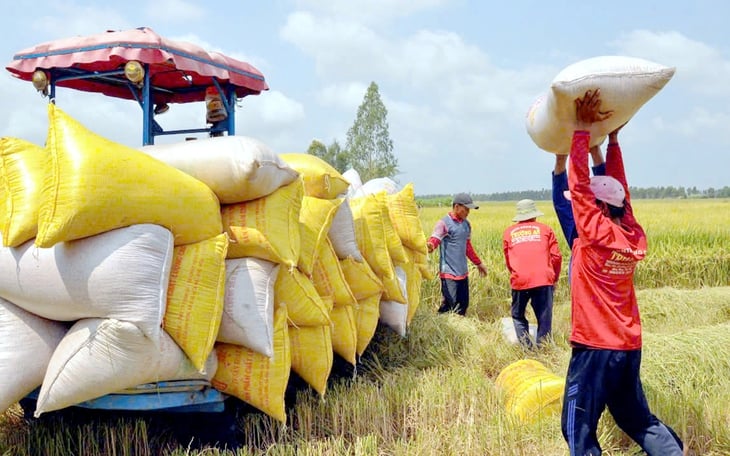 Let's work together to keep rice prices stable.
Source: https://tuoitre.vn/ngan-gia-lua-gao-chap-chon-20250308085555391.htm


![[Photo] General Secretary To Lam visits the exhibition space showcasing books, photo exhibitions, and achievements of digital transformation in journalism.](/_next/image?url=https%3A%2F%2Fvphoto.vietnam.vn%2Fthumb%2F1200x675%2Fvietnam%2Fresource%2FIMAGE%2F2025%2F12%2F19%2F1766110879215_1766110240024-jpg.webp&w=3840&q=75)

![[Photo] Enchanting ancient rose garden on the mountainside in Nghe An](/_next/image?url=https%3A%2F%2Fvphoto.vietnam.vn%2Fthumb%2F1200x675%2Fvietnam%2Fresource%2FIMAGE%2F2025%2F12%2F19%2F1766109900916_vuon-hong-chin-do-thu-hut-du-khach-toi-check-in-o-ha-noi-3-20162778-1671624890024-1671624890104198100259.jpeg&w=3840&q=75)






























![[INFOGRAPHIC] Overview of the Hoa Phat Dung Quat Rail and Special Steel Production Plant Project](https://vphoto.vietnam.vn/thumb/402x226/vietnam/resource/IMAGE/2025/12/19/1766111183203_z7339170069817-126a3e5a095f62e606a0be41015c1b80.jpeg)





































Comment (0)