

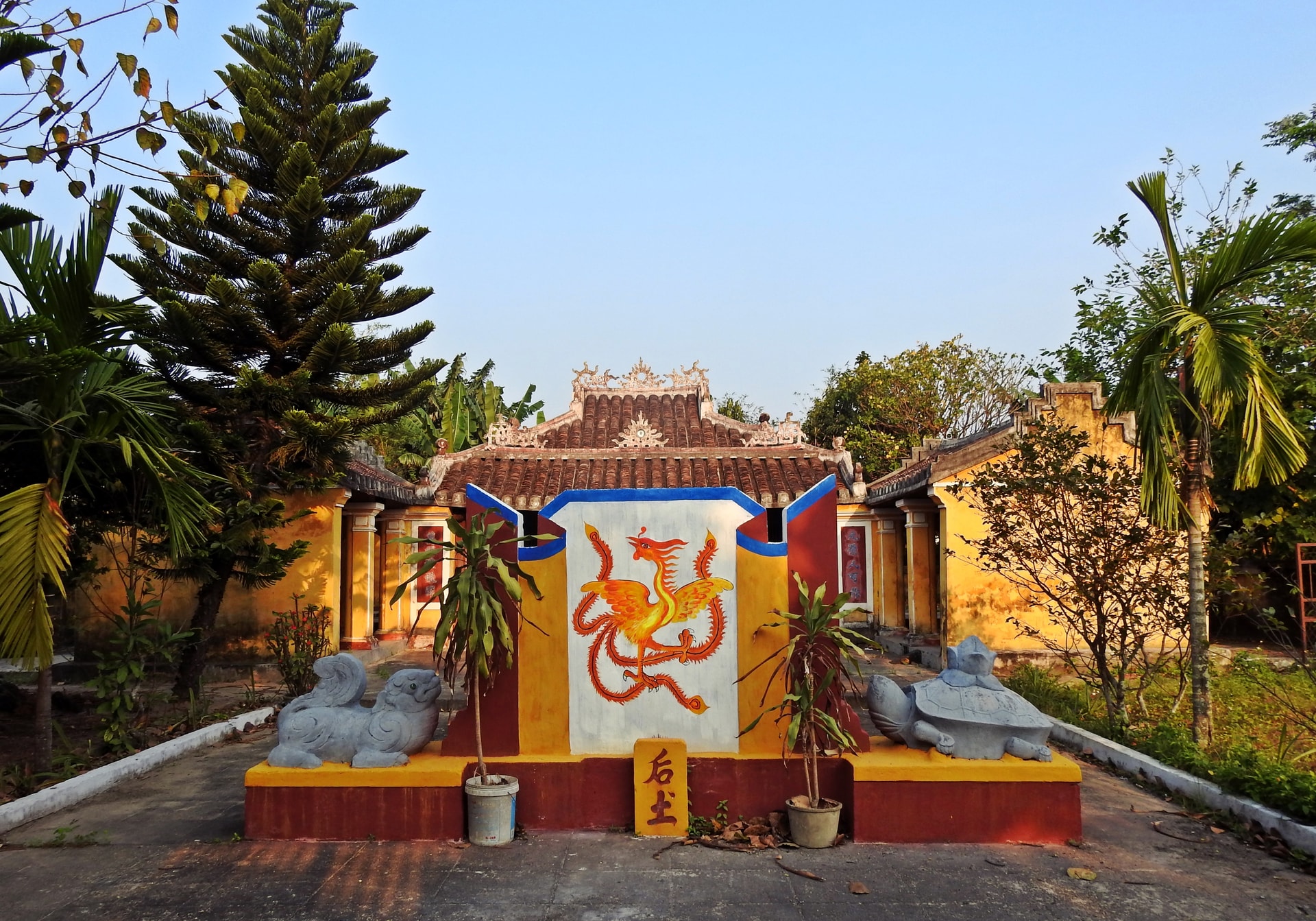
De Vong is one of the earliest villages/communes established in Hoi An. According to historical documents and oral traditions, the village was founded during the Later Le Dynasty, around the beginning of the 17th century.
A prominent characteristic of the De Vong community is its close connection with the waterways. During the feudal period, the De Vong commune was even granted the right by the imperial court to collect water-related taxes along the river from Cua Dai to the areas of Ha Bang, Tra Nhieu, Nui Ut, Tien Doa, Tinh Thuy, Phu Quy, Con Su, and An Hoa. This demonstrates the village's important position in the waterway trade system of the ancient Hoi An region.
The land register of the Nguyen Dynasty, compiled in the 13th year of Gia Long (1814), indicates that the village already had communal houses, temples, and pagodas. It can be confirmed that the De Vong communal house was built no later than 1814.
The Để Võng communal house is a place of worship for the Four Holy Mothers of the Great Ocean – a sea deity revered by the coastal inhabitants. In addition, the communal house also worships deities related to rivers and water, as well as ancestors, later generations, and unclaimed spirits. According to the Quảng Nam village chronicle, the village of Để Võng previously had 17 royal decrees from the Nguyễn dynasty, bestowing titles upon deities such as: the Local Guardian Deity, the Five Elements Immortal Mother, the White Horse Eunuch, the Great Ocean Deity, the Four Yang Spirit Deity, the Wood Longevity Deity, and the Bích Sơn Venerable Deity…
Regarding cultural and religious activities at the communal house, previously (during the time when the French School of Far Eastern Studies conducted a survey of villages in Quang Nam province in 1943-1944), it was reported that the local people organized three religious ceremonies at the communal house each year.
Having existed for over three centuries, De Vong communal house is not only an ancient architectural structure but also a symbol of community memory. The communal house preserves many valuable documents such as land registers, stone steles, horizontal plaques, and couplets, contributing to clarifying the formation process of villages in the Hoi An region. At the same time, the rituals and religious activities at the communal house reflect the rich spiritual life of the people living in this riverine area.
The continued existence of De Vong communal house through countless historical changes is a vivid testament to the enduring vitality of Vietnamese village culture. This ancient communal house still stands quietly in the heart of Hoi An city, continuing to preserve and pass on to future generations the precious values of national history and culture.
Source: https://baodanang.vn/ngoi-dinh-ven-song-3330761.html

![[Photo] The courage of new recruits of Brigade 144 on the training ground.](https://vphoto.vietnam.vn/thumb/1200x675/vietnam/resource/IMAGE/2026/05/27/1779881651341_anh-man-hinh-2026-05-27-luc-18-32-52.png)
![[Photo] General Secretary and President To Lam and his wife begin their official visit to Thailand.](https://vphoto.vietnam.vn/thumb/1200x675/vietnam/resource/IMAGE/2026/05/27/1779881249412_anh-man-hinh-2026-05-27-luc-18-10-51.png)




















![[Photo] The heat at the fireworks display site on the opening night of the Da Nang International Fireworks Festival 2026](https://vphoto.vietnam.vn/thumb/1200x675/vietnam/resource/IMAGE/2026/05/27/1779889741485_ndo_br_z7872039145157-fecaba5112f39e8352544099d7ef4738-5140-jpg.webp)


























![[Photo] The courage of new recruits of Brigade 144 on the training ground.](https://vphoto.vietnam.vn/thumb/402x226/vietnam/resource/IMAGE/2026/05/27/1779881651341_anh-man-hinh-2026-05-27-luc-18-32-52.png)





















Comment (0)