

During the years of the war for national liberation, for the first time in 1973, a film about President Ho Chi Minh was publicly screened in Saigon by a son of Hung Yen province and his comrades. The film served as a precious source of moral support, not only boosting the resolve of our cadres and soldiers fighting in enemy territory but also deeply moving the soldiers on the other side of the battlefield who saw President Ho Chi Minh on screen.
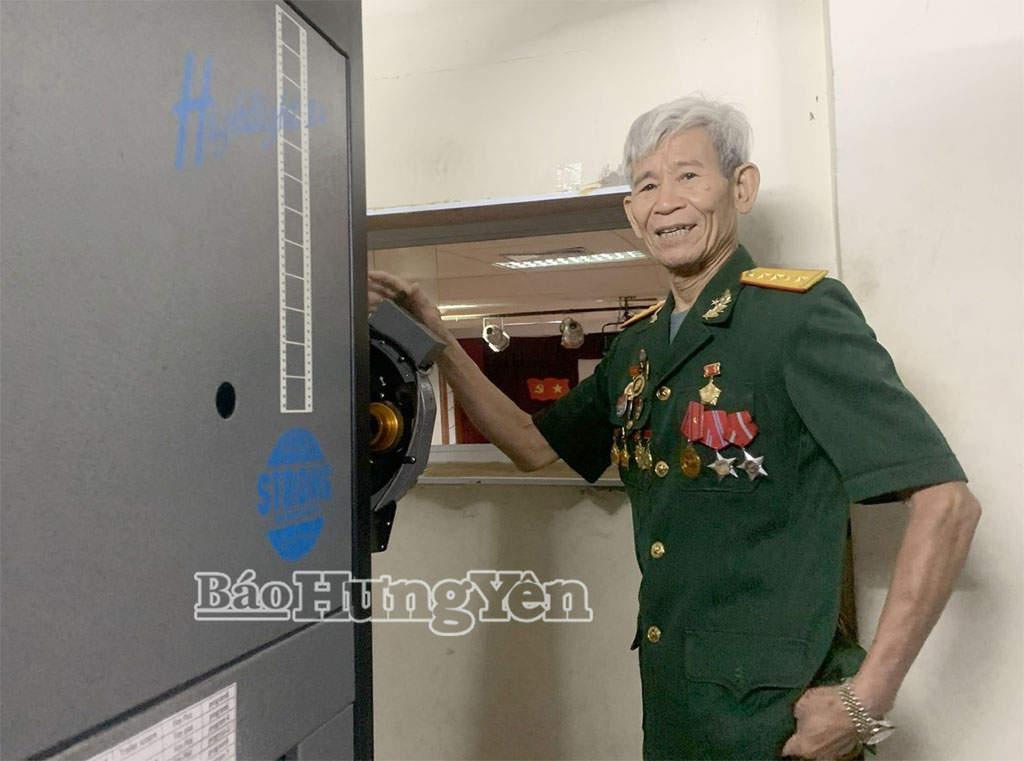
Resilient soldiers on the information front.
In 1971, leaving his hometown of Tan Thuan, young Pham Van Lai volunteered to join the army. After training, he was assigned to the Eastern battlefield (B2) to work in the film department of the Liberation Army, Political Bureau of the region. On rickety bicycles, undeterred by danger, Pham Van Lai and his comrades traversed forests and climbed hills, transporting films, projectors, and generators to rear-areas in the Southeast and Southwest battlefields to screen films and boost the morale of the soldiers.
In early 1973, after the Paris Agreement was signed, Camp Davis served as the headquarters of the Democratic Republic of Vietnam delegation and the Provisional Revolutionary Government of the Republic of South Vietnam in Saigon, fighting to ensure the Paris Agreement's implementation. This military camp was located near Tan Son Nhat airport, surrounded by dense barbed wire fences and guard posts, along with numerous tactics to wage psychological warfare, bribe cadres, monitor and control information, jam radio signals, and cut off electricity and water. In this surrounded and isolated situation, besides firmly grasping the Party's viewpoints and guidelines in the open and direct struggle on the diplomatic front against the US and the puppet regime, the films shown at Camp Davis provided strength, helping our cadres and soldiers maintain optimism, a love of life, and faith in justice and victory.
During his 823 days and nights working in the Four-Party Joint Military Commission and the Two-Party Joint Military Commission, Mr. Pham Van Lai was assigned the task of propaganda work, showing films to our officers and soldiers in Camp Davis, and also handling information and press work for the delegation. Every week, on transport flights from Gia Lam Airport to Tan Son Nhat Airport, alongside documents, newspapers, and a large quantity of food, supplies, and weapons secretly transported in, there were also invaluable film reels to serve the spiritual needs of our officers and soldiers in Camp Davis.
On the 35mm film projector brought from the North, from the first single-episode film, "The Flame of Nghe Tinh," along with famous films of revolutionary cinema such as "Tran Quoc Toan," "The Xa Nu Forest," "The 17th Parallel Day and Night,"... to the 54-episode film "Liberating Europe," which was shown continuously on April 27, 1975, to deceive the enemy while the liberation army was closing in on Saigon. There were times when air transport between the two regions was cut off, and Mr. Lai showed many films continuously for months, but our cadres and soldiers still eagerly watched.
Uncle Ho is in our hearts.
During his career in filmmaking serving the revolution, among the many films that Mr. Lai screened, "Uncle Ho with Children" left the deepest impression on him. Time and space seemed to stand still in the courtyard of the camp, hundreds of eyes, both ours and the enemy's, intently focused on the screen, tears streaming down the faces of many as they saw Uncle Ho for the first time.
The feeling when the film about Uncle Ho was shown was that his compassionate and benevolent heart seemed to erase the daily and hourly confrontations between people on two opposing sides. Although it was a short film, the familiar and kind images of Uncle Ho caring for and playing with children deeply moved our officers and soldiers. Therefore, throughout our time operating in Camp Davis, the film was requested to be shown hundreds of times. The image of the Father of the Nation was like a tremendous source of strength, reinforcing our will to fight and our belief in the day of ultimate victory.
The simplicity and nobility of President Ho Chi Minh also moved the hearts of those on the other side of the battle lines. On February 6, 1973, a US delegation arrived at Camp Davis to process identity cards for our delegation. Seeing a projector set up in the courtyard, they asked the liaison officer for permission to watch with them. Seeing for the first time "Mr. Ho," the national liberation hero and leader of the Vietnamese people, a man of immense stature yet so simple and kind, so completely opposite to what they had been indoctrinated with in their home countries, deeply moved the American soldiers. As soon as the film finished, without being prompted, the soldiers on the other side of the battle lines simultaneously stood up and shouted "Vietnam - Ho Chi Minh!" Before leaving, they asked to wear the Ho Chi Minh badge respectfully on their chests, requested permission to take commemorative photos under his portrait, and shouted "Vietnam - Ho Chi Minh" once more. On another occasion, the film was screened for a delegation of 80 journalists from major international news agencies working at Camp Davis. Many foreign journalists, who had never had the chance to meet or interview President Ho, expressed their immense admiration for him and their belief in the just victory of the Vietnamese people after watching the film.
After the complete liberation of South Vietnam, having held various positions, for veteran Pham Van Lai, it was during the arduous and fierce struggle against the enemy in Camp Davis that the thoughts, ethics, and style of President Ho Chi Minh, which he learned from the film "President Ho Chi Minh with Children," not only strengthened the morale of the officers and soldiers to successfully complete their tasks but also became an important asset that he carried with him throughout his life of serving the revolution.
Trinh Cuong
Source: https://baohungyen.vn/nguoi-chieu-phim-ve-bac-ho-giua-sao-huyet-dich-3195137.html
![[Photo] The heat at the fireworks display site on the opening night of the Da Nang International Fireworks Festival 2026](https://vphoto.vietnam.vn/thumb/1200x675/vietnam/resource/IMAGE/2026/05/27/1779889741485_ndo_br_z7872039145157-fecaba5112f39e8352544099d7ef4738-5140-jpg.webp)































































Comment (0)