


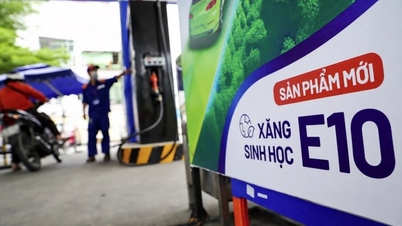
E10 bioethanol fuel will be used nationwide from June 1, 2026, replacing conventional gasoline.
Associate Professor Pham Huu Tuyen, Director of the Center for Research on Power Sources and Autonomous Vehicles ( Hanoi University of Science and Technology), who has over 10 years of research on E10 gasoline, said that E10 biofuel is a type of fuel consisting of about 10% ethanol and 90% mineral gasoline. While the ethanol blending ratio of 10% is quite low, it is sufficient to improve some fuel properties. Specifically, ethanol contains oxygen, which helps the combustion process in the engine to be more complete and cleaner. As a result, combustion efficiency is improved, contributing to better engine performance.
"Some argue that ethanol has a lower calorific value than mineral gasoline, so blending it could reduce the fuel's energy content, leading to increased consumption. However, in reality, this difference in calorific value is not significant (only a few percent) and is compensated by more efficient combustion in the engine," said Associate Professor Pham Huu Tuyen.
According to this expert, studies and tests show that when using E10 gasoline, engine power and fuel consumption are essentially equivalent to conventional gasoline. In some cases, fuel consumption can even be improved thanks to a more optimized combustion process.
Furthermore, a clear benefit of E10 gasoline is reduced emissions. Harmful substances such as CO (carbon monoxide) and some unburned organic compounds are significantly reduced. This not only contributes to environmental protection but is also better for public health.
In terms of cost, with current support policies, E10 gasoline is generally cheaper than conventional gasoline, helping consumers save on vehicle operating costs.
More importantly, E10 gasoline has been widely used around the world for decades, in countries such as the US, Brazil, and Thailand. In practice, this fuel has been shown not to negatively impact engine durability and is perfectly suitable for vehicles currently in circulation.
E10 gasoline does not harm the engine.
Associate Professor Pham Huu Tuyen affirmed that, technically, E10 gasoline does not negatively impact the operation of vehicles. When using E10 gasoline to replace traditional mineral gasoline, the indicators of power, operating efficiency, and emissions of vehicles do not change significantly. Switching to E10 gasoline, including equivalent types like RON95, basically does not affect the engine's performance.
However, just like with conventional gasoline, to ensure stable and durable vehicle operation, users still need to fully comply with the maintenance and servicing regulations recommended by the manufacturer. In fact, for any type of fuel, vehicle manufacturers provide specific guidelines on maintenance cycles. Therefore, when switching to E10 gasoline, users only need to continue following these recommendations to ensure the quality and lifespan of their vehicles.
Mr. Do Van Tuan, Chairman of the Vietnam Biofuel Association, stated that most motorcycle models manufactured since 2000 are compatible with E10 gasoline. The Vietnam Motorcycle Manufacturers Association (VAMM) also confirmed that these vehicles can safely use E10 gasoline. Current fuel tanks have been treated and coated internally; the piping system and related fuel components are also designed to be compatible with this type of biofuel. Therefore, concerns about E10 gasoline affecting newer motorcycles are unfounded.
Mr. Tuan added that for very old vehicles, manufactured before 2000, some parts such as rubber gaskets or fuel lines may age faster over time when using E10 gasoline. However, this mainly affects the rubber material after prolonged use, not directly impacting the engine. Replacing these parts is also quite simple and the cost is negligible. Concerns that E10 gasoline may damage the engine, corrode the machinery, or reduce the vehicle's lifespan are completely unfounded and unverified.
As for automobiles, the Vietnam Automobile Manufacturers Association (VAMA) – an organization that brings together the majority of automobile manufacturers and distributors in the Vietnamese market – assesses that most vehicles currently in circulation are compatible with E10 gasoline. According to this assessment, only about 60,000 Suzuki light trucks have been identified as unsuitable for this fuel type.
This is also one of the reasons why the Ministry of Industry and Trade continues to maintain the circulation of E5 RON 92 gasoline until the end of 2030, in order to ensure a suitable transition roadmap and avoid disruption to some specific types of vehicles that are not yet fully compatible with biofuels.
Meanwhile, E5 gasoline has been available on the Vietnamese market since 2015, and practical use over the years has shown that this fuel is suitable for most vehicles, including many older models still in circulation today.
Regarding the opinion that E10 gasoline causes higher fuel consumption, Mr. Tuan acknowledges that this is theoretically possible. The reason is that E10 gasoline generates about 3% less thermal energy than conventional gasoline. However, this difference is quite small, and in reality, it is difficult for users to clearly feel the 3% increase in fuel consumption.
Conversely, E10 gasoline has a higher octane rating than RON95 mineral gasoline, which helps the engine run more smoothly. A smoothly running engine also contributes to optimizing performance and fuel efficiency. Therefore, it is difficult to say whether actual fuel consumption will differ significantly when using E10 gasoline.
"Theoretically, E10 gasoline could increase fuel consumption by about 3%, but in real-world usage, this difference is almost imperceptible," the Chairman of the Biofuel Association affirmed.
According to Mr. Dao Duy Anh, Deputy Director of the Department of Innovation, Green Transformation and Industrial Promotion, Ministry of Industry and Trade, during the development of the biofuel roadmap, the Ministry of Industry and Trade conducted surveys and assessments on the potential impact of E5 and E10 bioethanol on engine performance and lifespan.
According to assessments by scientists at Hanoi University of Science and Technology and Hanoi University of Transport, E5 and E10 gasoline have virtually no significant negative impact on the performance or lifespan of engine components in gasoline engines.
Notably, Vietnam has been using E5 gasoline nationwide since 2018, while E10 has been piloted since August 2025. However, to date, neither distribution businesses nor the Ministry of Industry and Trade have received any feedback regarding E5 or E10 negatively impacting engine performance or lifespan.
International experience also shows that biofuels have been used for a long time. The US and Brazil have been using E10 gasoline since the 1980s. In Southeast Asia, Thailand and the Philippines are now using E15, and are even upgrading to E20 without reporting significant negative impacts on vehicle engines.
Anh Tho
Source: https://baochinhphu.vn/nguoi-dan-duoc-loi-gi-khi-su-dung-xang-e10-102260527124358652.htm
![[Photo] The courage of new recruits of Brigade 144 on the training ground.](https://vphoto.vietnam.vn/thumb/1200x675/vietnam/resource/IMAGE/2026/05/27/1779881651341_anh-man-hinh-2026-05-27-luc-18-32-52.png)




![[Photo] The heat at the fireworks display site on the opening night of the Da Nang International Fireworks Festival 2026](https://vphoto.vietnam.vn/thumb/1200x675/vietnam/resource/IMAGE/2026/05/27/1779889741485_ndo_br_z7872039145157-fecaba5112f39e8352544099d7ef4738-5140-jpg.webp)































































![[Photo] The courage of new recruits of Brigade 144 on the training ground.](https://vphoto.vietnam.vn/thumb/402x226/vietnam/resource/IMAGE/2026/05/27/1779881651341_anh-man-hinh-2026-05-27-luc-18-32-52.png)































Comment (0)