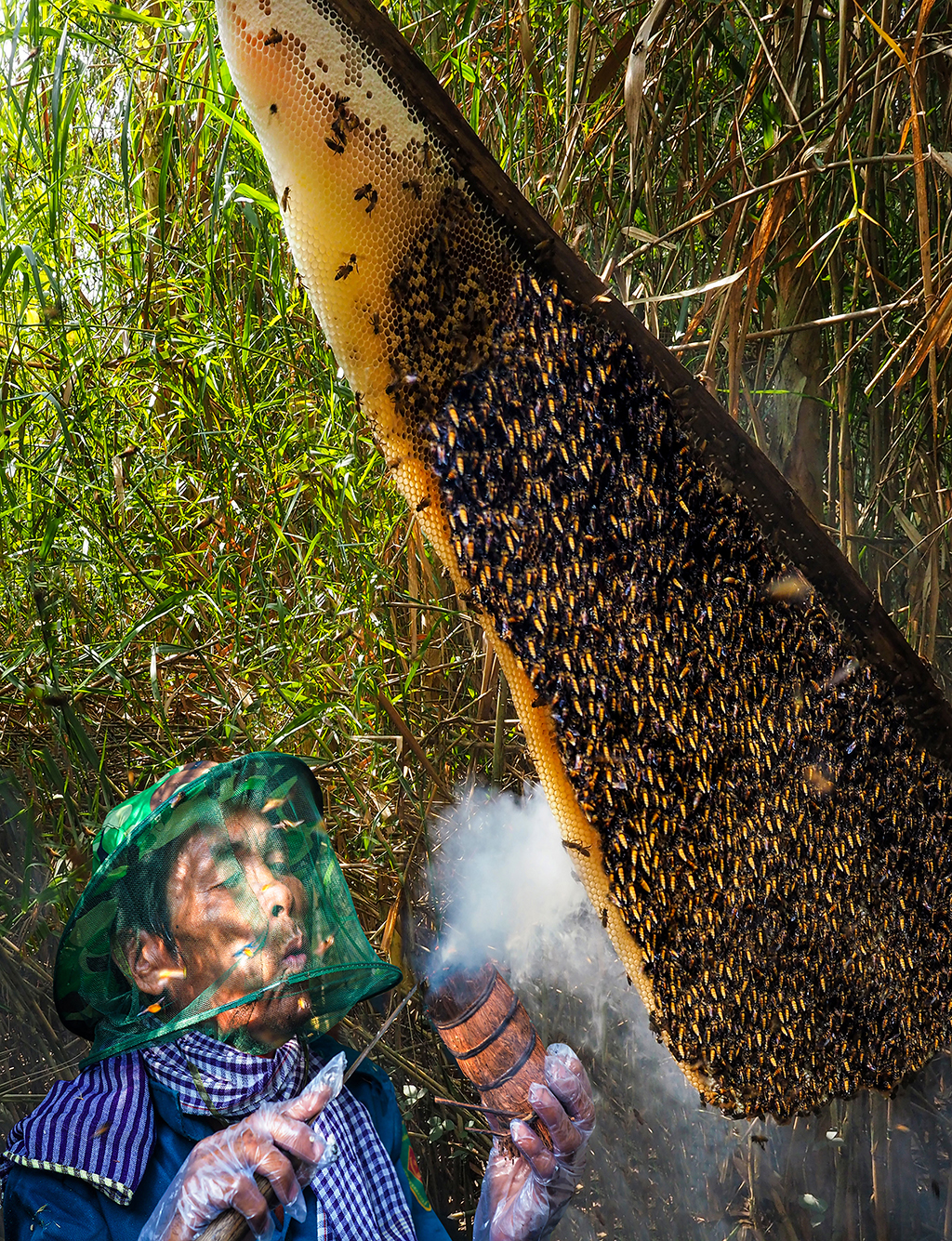
Born and raised amidst vast mangrove forests, where beekeeping is deeply ingrained in the lives of the local people, at the age of 17, Mr. Nhi followed his relatives into the forest to learn the trade. The painful stings of bees discouraged newcomers, but for him, they were challenges to overcome. After persistently learning, he became a skilled beekeeper, mastering the techniques of honey harvesting to produce high-quality products. To date, he has been in the profession for 48 years.
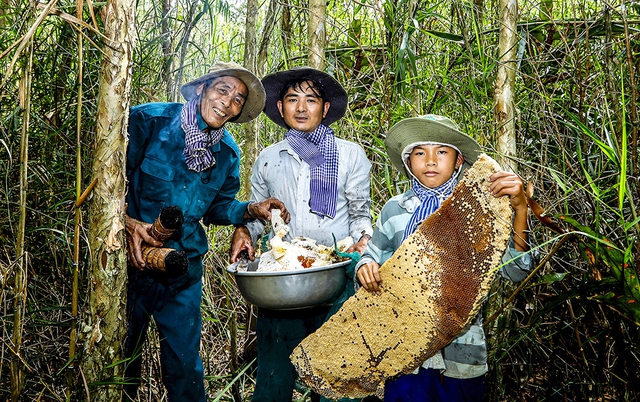
Three generations of Mr. Tran Van Nhi's family have been engaged in the profession of beekeeping.
PHOTO: GIA BACH
Protecting forests means protecting our livelihoods.
Mr. Nhi shared that the secret to setting up beehives is to carefully and meticulously select the trees for the frames, with Melaleuca trees always being the number one choice because of their quality and lifespan of about two years. Besides choosing the right type of tree for the frames, the location also determines whether bees will come to build their nests. It must be a place with reed beds, where sunlight shines on part of the frames in the morning and afternoon. This ensures that when the bees build their nests, they will produce high-quality honey.
"Looking at the melaleuca flowers blooming, I know whether that year will be a good or bad harvest. Watching the bees fly, I know whether they'll choose to build their nests nearby or far away," Mr. Nhi said with the pride of an experienced man. His long years of venturing into the forest have given him a deep understanding of the workings of nature.
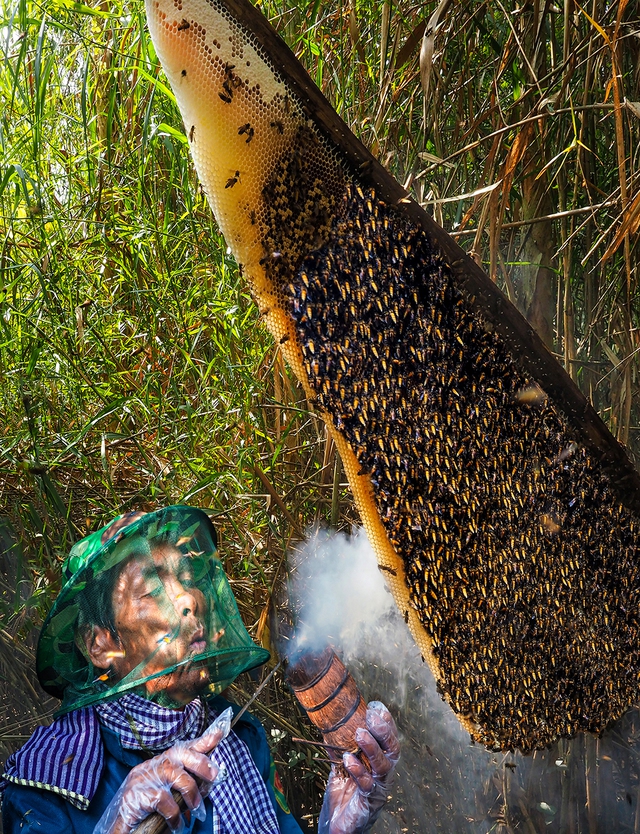
Each year, Mr. Nhi harvests about 600 liters of honey, earning a stable income of over 300 million VND.
PHOTO: GIA BACH
Mr. Nhi doesn't just practice this craft for himself. His entire family, from his son, Mr. Tran Van Chon (44 years old), to his grandson, Tran Tuan Anh (only 13 years old), have followed in his footsteps. Since the age of 16, Mr. Chon has mastered the technique of beekeeping, and young Tuan Anh also followed his grandfather into the forest to learn the trade from the age of 10. Three generations live together and protect this traditional craft as a sacred heritage, a testament to Mr. Nhi's love and dedication to beekeeping.
Driven by passion and a commitment to preserving his craft, Mr. Nhi constantly learns and shares his knowledge with neighboring residents. Before 1975, he and 40 other families established the Phong Ngan Group, a model of collective forest management and exploitation. The group not only ensured livelihoods for the families but also helped protect the forest, preventing disputes and forest fires for decades. Currently, the group has been upgraded to the 19.5 Cooperative, granting it greater legal standing and continuing to manage and exploit the forest on an area of 540 hectares, with Mr. Nhi's family managing 13.5 hectares.
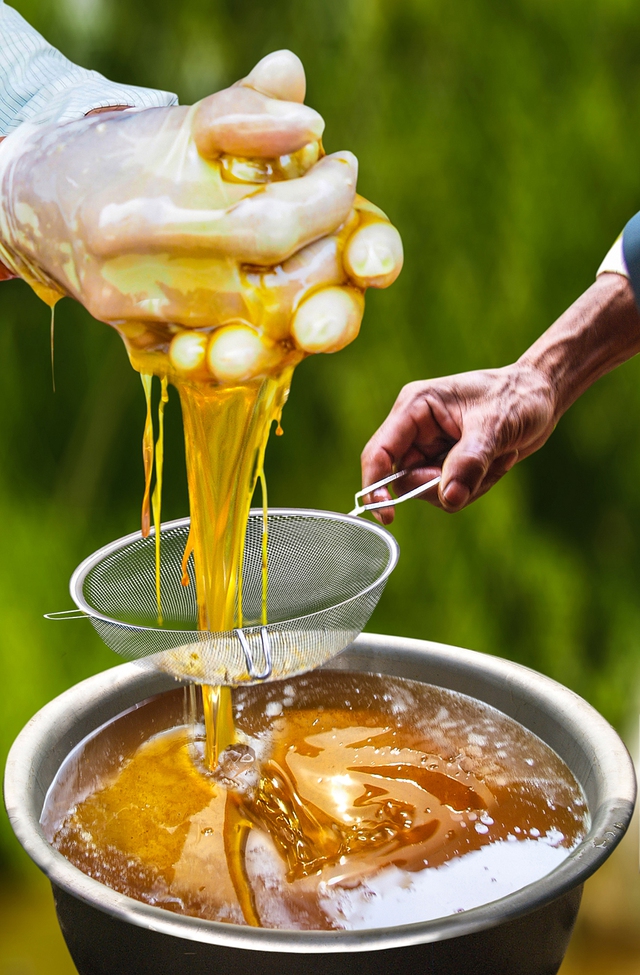
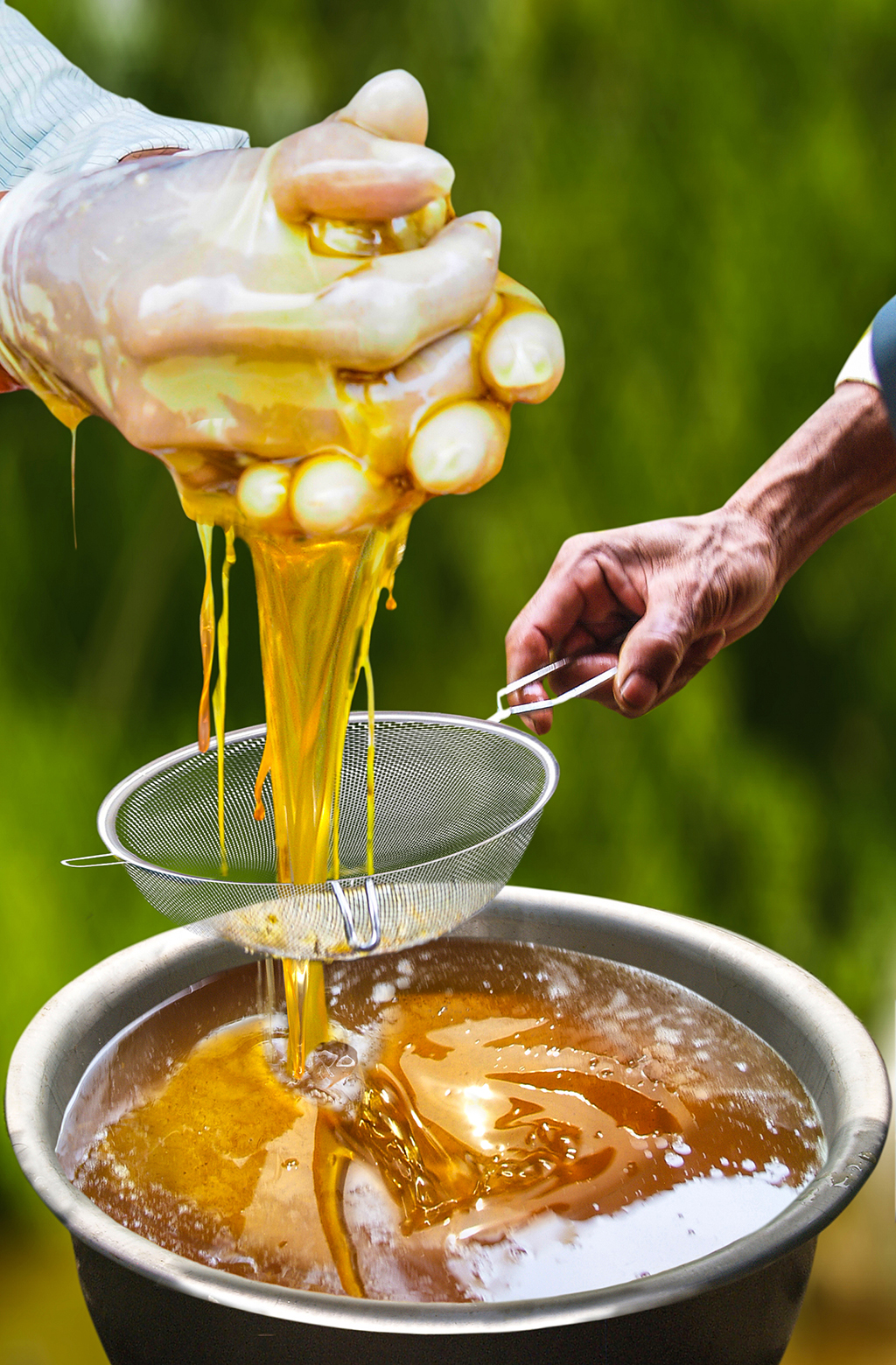
Having worked as a beekeeper for nearly 50 years, Mr. Nhi has always believed in not mixing honey with other substances, which would reduce its quality.
PHOTO: GIA BACH
According to Mr. Nhi, for beekeepers, the first criterion for survival within the community is the awareness of preserving shared property. That property is the vast forests that sustain the lives of many people in this area. "Protecting the forest is protecting our livelihoods," Mr. Nhi said.
Thanks to his tireless efforts and extensive experience, Mr. Nhi harvests approximately 600 liters of honey each year, earning over 300 million VND. Combined with other sources of income, his family's total income exceeds 500 million VND per year.
Mr. Nguyen Van Vinh, Director of the 19.5 Cooperative, said that for many years, the honey-eating groups have been tightly organized, with strict rules such as mutual support, not stealing other people's beehives, and not mixing water into honey... All members strictly adhere to these rules.
Preserving heritage
The profession of beekeeping became a national intangible cultural heritage in 2020. This is well-deserved recognition for the tireless efforts of artisans like Mr. Ut Nhi. Mr. Nhi proudly stated: "To have quality honey, we must preserve the bee colonies. To have bees, we must preserve the forest. That is the responsibility of those of us in this profession."
While many of his friends have switched to other professions, Mr. Nhi has kept his passion alive, continuing to pass on his skills to the next generation. This unwavering commitment has contributed to the widespread success of U Minh honey, making it a source of pride for the Ca Mau region.

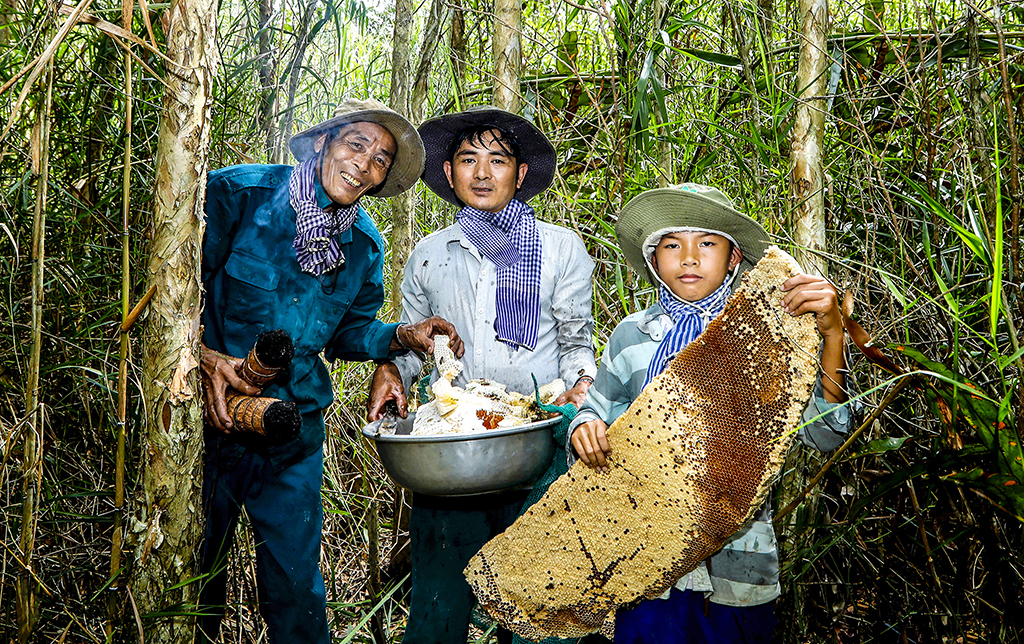
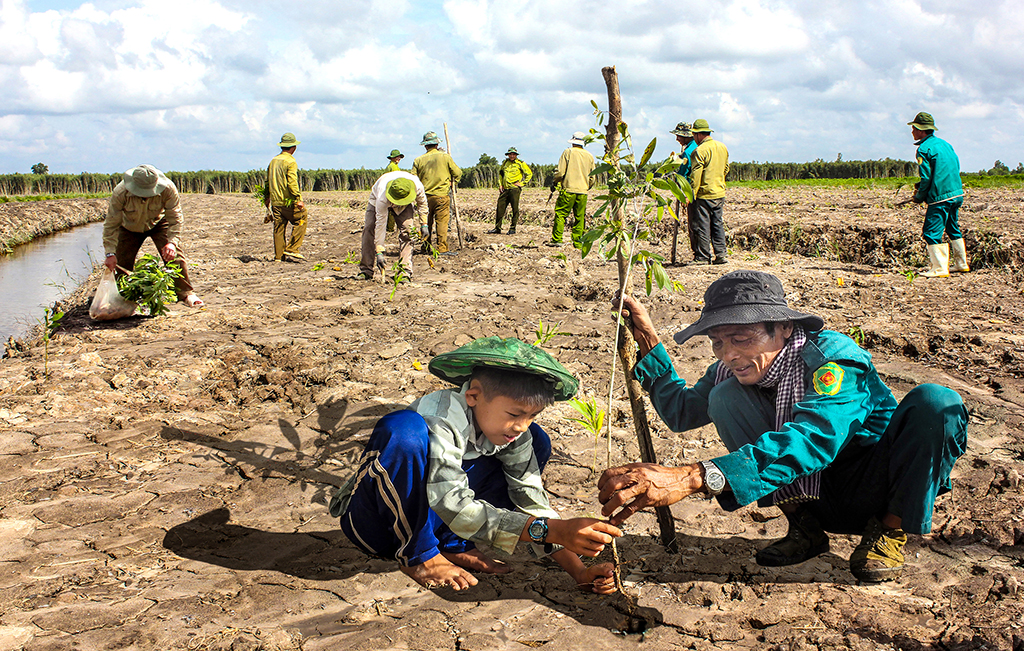
Planting and preserving forests is how Mr. Nhi educates his children and grandchildren to protect their livelihoods.
PHOTO: GIA BACH
Not only does Mr. Nhi keep the passion for the craft alive, but he also spreads his love for the forest to his descendants, reminding them of the value of natural resources and heritage. "Preserving the forest is preserving the future, preserving the U Minh honey brand is preserving our lives," he said with unwavering belief.
Having spent more than half his life as a beekeeper, Mr. Nhi has always believed that no matter how difficult things get, one must never engage in dishonest business practices or adulterate honey. "I sell the honey exactly as I harvest it; I haven't changed it for decades. Just one instance of selling a substandard product would cause customers to lose trust, and a person who loses their integrity loses everything," Mr. Nhi confided.
Thanks to people like him, beekeeping is not just a means of livelihood, but also a symbol of the connection between people and nature, between life and culture in the U Minh Ha region. Mr. Tran Hieu Hung, Director of the Department of Culture, Sports and Tourism of Ca Mau, said: "Beekeeping not only creates a sustainable livelihood for many people living under the melaleuca forest canopy, but is also a unique tourism product that attracts visitors. The experience of eating honey is one of the most attractive activities for tourists when coming to Ca Mau. From this, the image of the kind and generous people of Ca Mau emerges clearly."
The traditional beekeeping profession in U Minh and Tran Van Thoi districts ( Ca Mau province ) was recognized as a national intangible cultural heritage by the Ministry of Culture, Sports and Tourism in 2020. U Minh honey was also ranked among the top 100 tourism gifts in 2021 by the Vietnam Record Organization.







































































Comment (0)