

Businesses that haven't paid taxes, and individuals who haven't received refunds.
Mr. NTK (Ho Chi Minh City) reported that he recently received a notice stating his tax refund application was ineligible. According to the Ho Chi Minh City Tax Department, the reason is that Saigon Real Investment and Services Joint Stock Company (the income-paying entity) has ceased operations but has not yet completed the procedures for terminating its tax identification number, and still owes withheld personal income tax to the tax authorities. "Taxpayers are requested to contact the income-paying organization to pay the withheld personal income tax to the state budget," the notice stated. A representative from the Ho Chi Minh City Tax Department explained that in cases where a business ceases operations, has not completed the procedures for closing its tax identification number, and still owes personal income tax, the taxpayer needs to contact the company. Only when the company contacts the tax authorities and settles the tax debt will the employee be eligible for a refund.

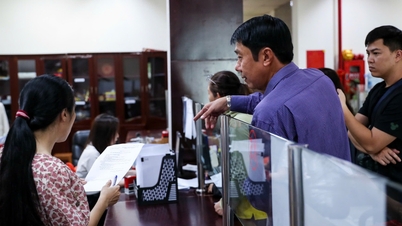
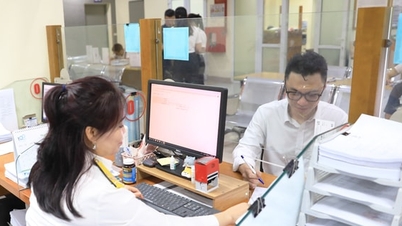
Individuals need assistance with tax refunds in cases where businesses still owe taxes.
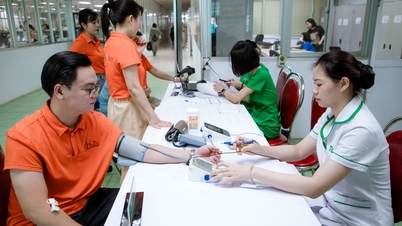
Photo: Dao Ngoc Thach
The reason is that according to Decision 108/2025 of the General Department of Taxation (now the Tax Department): "At the time of processing the personal income tax refund application, the income-paying organization must have fulfilled its obligation to pay the withheld tax or the total personal income tax already paid into the state budget...". Therefore, if the income-paying organization still owes tax, the tax authority will not process the refund application for the taxpayer.
According to this decision, many salaried workers are being negatively affected, similar to Mr. K's case. The list recently published by the Ho Chi Minh City Tax Department includes 2,872 businesses that owe personal income tax on their employees, totaling nearly 276 billion VND. This means that employees will have to wait for these businesses to pay their taxes before they can receive a refund.
Similarly, looking at the number of tax refund applications clearly illustrates this. From the beginning of the year to April 30th, the tax authorities received over 1.31 million electronic personal income tax return forms, of which 1.082 million were requests for refunds. The tax authorities determined that 1.026 million applications were eligible for automatic refunds, accounting for 95% of the total number of refund requests, totaling 4,882 billion VND. However, the number of applications that have not yet been refunded is also around 56,000. Certainly, many of these cases involve businesses failing to fulfill their personal income tax obligations, leading to salaried employees being negatively affected.
Workers must be avoided from being disadvantaged.
Explaining Decision 180, lawyer Tran Xoa, Director of Minh Dang Quang Law Firm, pointed out that, in principle, the budget only has money to refund taxes after the tax revenue has been collected. This regulation has been applied to businesses when refunding value-added tax, and to individuals when refunding personal income tax. However, Mr. Tran Xoa acknowledged that this regulation applied to individuals also has shortcomings because how can employees themselves demand that businesses pay outstanding taxes? "Currently, personal income tax for salaried employees is usually deducted at source by businesses; employees cannot declare and pay quarterly themselves. Only when businesses conduct annual tax settlements does the system show the income and the amount of tax payable, and only then can individuals see it on eTax. This means that when they are not entitled to a tax refund and receive the reason that the business still owes taxes, only then do individuals know. So how can they demand that the business pay this tax?", he questioned.
From that perspective, lawyer Tran Xoa suggested that when businesses submit monthly or quarterly personal income tax returns, they should include a list of each employee's tax payment amount and display the data on eTax so that businesses can track it, instead of waiting until the tax settlement period (which usually falls at the beginning of the following year). This would help resolve refunds for cases where taxes have already been paid. Furthermore, for some businesses with only a few dollars, a few tens of dollars, or generally very small debts, a solution could be to require the business to pay or to verify and correct any errors to avoid affecting the rights of employees.
From a different perspective, Mr. Nguyen Ngoc Tu, a lecturer at the Hanoi University of Business and Technology, explained that personal income tax (PIT) has accounted for a large percentage of total domestic revenue in recent years, ranging from 10-11%. Therefore, software improvements are needed so that salaried employees can monitor whether businesses are paying this tax into the state budget. In reality, businesses currently make quarterly tax payments, so they can update their quarterly PIT declarations on the eTax system. This is a technically feasible solution. Similarly, regarding social insurance, many businesses currently owe social insurance contributions, but there are still solutions to address employees' entitlements when businesses have collected money but failed to pay it.
"If a company deducts personal income tax from its employees but fails to pay it into the state budget, the employees cannot be held responsible. In this case, they have fulfilled their responsibilities as stipulated. Therefore, the responsibility cannot be entirely shifted to the employees when they are not entitled to a tax refund due to outstanding debts," Mr. Tú said.
"The law stipulates that businesses directly deduct personal income tax from employees' salaries, but it doesn't clearly specify whether employees are entitled to a refund if the business hasn't paid the personal income tax. This is left to the tax authority's guidance. Therefore, to support taxpayers in cases where businesses cease operations without going through dissolution procedures, abandoning their business address, and to prevent employees from being disadvantaged, the tax authorities need to urge and apply tax enforcement measures, inspect businesses... as soon as the debt arises to ensure timely recovery, thereby guaranteeing the tax refund rights for employees. The regulations should also clearly state the timeframe within which the tax authorities will carry out this process. If this timeframe is exceeded, the tax authorities can initially refund the taxpayer and then pursue the outstanding tax debt," Mr. Nguyen Ngoc Tu further suggested.
Several reasons why personal income tax returns are not automatically processed.
Besides the reason of businesses owing taxes, the tax authorities also stated several other reasons why automatic personal income tax refund applications are not processed. These include businesses submitting tax returns late, leading to increased income and reduced automatic refund amounts; businesses declaring discrepancies in the amount of personal income tax withheld between the amount claimed during the year and the amount claimed in the final personal income tax return. Furthermore, some reasons stem from taxpayers, such as refund applications submitted by taxpayers that do not originate from suggested tax returns, accounting for 26% of the total refund applications, leading to lengthy manual processing by the tax authorities. Taxpayers using non-existent personal bank accounts (virtual accounts) or accounts belonging to others to receive personal income tax refunds. Additionally, taxpayers adjusting dependent information, modifying family allowance deductions, or using incorrect personal income tax withholding certificates, or certificates belonging to others, etc., to attach to their final tax return and refund application.
Source: https://thanhnien.vn/nguoi-lam-cong-an-luong-bi-va-lay-185260528220625.htm



![[Photo] General Secretary and President To Lam and his wife begin their state visit to the Republic of Singapore.](https://vphoto.vietnam.vn/thumb/1200x675/vietnam/resource/IMAGE/2026/05/29/1780011284377_vna-potal-tong-bi-thu-chu-tich-nuoc-to-lam-va-phu-nhan-bat-dau-chuyen-tham-cap-nha-nuoc-toi-singapore-va-phat-bieu-dan-de-tai-doi-thoai-shangri-la-8791484-2-jpg.webp)




























![[Photo] Standing Committee member of the Party Central Committee Tran Cam Tu working with the Central Inspection Committee](https://vphoto.vietnam.vn/thumb/1200x675/vietnam/resource/IMAGE/2026/05/28/1779969579668_ndo_br_bnd-2495-jpg.webp)







































































Comment (0)