

According to experts, Vietnamese university students often choose English-speaking countries because of their reputation, quality of education, and opportunities for permanent residency.
According to the latest statistics from the Department of International Cooperation, Ministry of Education and Training , for the 2019-20 academic year, approximately 190,000 Vietnamese students are studying abroad. Popular destinations include Europe, Japan, South Korea, Australia, the United States, and Canada.
"We don't have statistics for this year yet, but the number of international students after the pandemic is estimated to have returned to pre-pandemic levels, or even be increasing," a leader of the Department said this week.
According to statistics from private organizations, such as Capstone Education Vietnam – an organization providing study abroad and career guidance services – in 2022, South Korea was the country receiving the largest number of Vietnamese students, with 66,000, followed by Japan with 37,000. This number includes interns and students in short-term or non-degree courses.
If we consider university studies specifically, the current trend is still towards English-speaking countries because of their quality education and good student support policies, said Ms. Lu Thi Hong Nham, Director of Duc Anh Study Abroad and Translation Consulting Company.
Vietnam ranks 5th among countries with the most students studying in Australia (as of September 2022), according to IDP Education. ICEF Monitor, a company specializing in international education research, lists Vietnam as the 6th largest market for the US, the 4th largest for New Zealand, and the 8th largest for Canada.
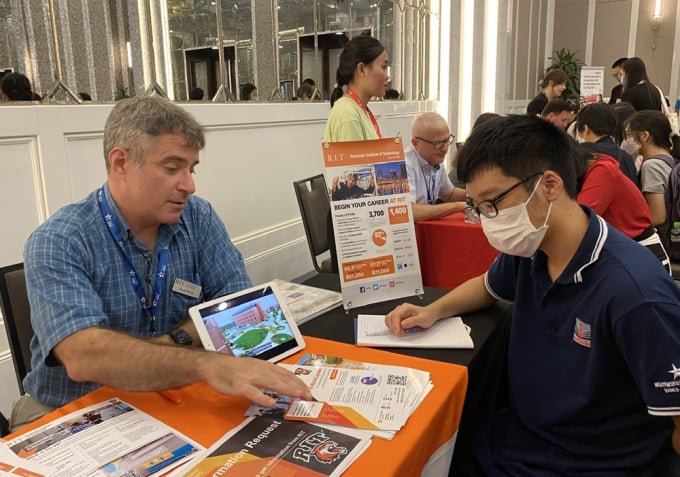
Representatives from Rochester Institute of Technology, USA, advise Vietnamese students at a study abroad event in Hanoi in October 2022. Photo: Binh Minh
Nguyen Minh Duc, a 12th-grade student in Hanoi, is considering studying Pharmacy or Biochemistry in Australia or Singapore. Duc wants to study abroad because he sees these fields as underdeveloped in Vietnam. Australia and Singapore are two popular study destinations with good job prospects, high income, and especially opportunities for permanent residency.
Tran Thanh Nam, a 10th-grade student at a specialized high school in Hanoi, has planned to study art and design abroad in the Netherlands, Canada, or the United States because he believes that universities there are strong in training in this field.
The market for studying abroad in English-speaking countries remains vibrant, according to Ms. Tran Phuong Hoa, Director of Summit Education Organization. For the past 10 years, the group studying in the US has consistently accounted for the highest percentage of the company's programs. Interest in the US hasn't surged dramatically but has remained stable and continues to recover and grow slightly after the Covid-19 period. Recently, the number of parents inquiring about studying abroad in other English-speaking countries such as Canada, Australia, and the UK through Summit has increased by approximately 15-20%.
At another service center, Duc Anh, 60% of customers chose to travel to Australia, and 20% to Canada and New Zealand.
The factors that students and their families are most concerned about when considering studying abroad at university are the reputation of the school and the country, the quality of education, employment opportunities, and finally, the chance of permanent residency. Therefore, besides the US and the UK, which are two countries with top-quality education globally, countries with favorable immigration policies such as Australia, New Zealand, and Canada are always of great interest.
Vietnam is a key growth market in Southeast Asia for overseas education, according to ICEF Monitor. A company like Ms. Nham's is directly representing over 2,000 high schools, colleges, and universities in 16 countries and territories; processing applications for thousands of students each year, she said.
There are many reasons why Vietnam is increasingly becoming a "hot spot" for student recruitment by global educational institutions.
First of all, Vietnam is a populous country with a high proportion of young people, leading to increased demand for educational services and studying abroad.
In addition, economic development has led to a rapid increase in average income.
An open mindset and positive awareness of education and opportunities abroad are leading more and more families to invest in their children's overseas education, hoping to access quality education. HSBC's 2018 statistics show that education spending accounts for 47% of each family's total expenditure.
Vietnamese students are highly regarded by universities for their academic abilities and proactive attitude. The movement to learn English is strong and has been widespread among students since an early age.
"The results of standardized tests for admission to universities in English-speaking countries are also being used by many Vietnamese universities, contributing to an increase in the number of students who are English-ready for studying abroad," Ms. Hoa said.
Minh Duc, a 12th-grade student, is striving to improve his GPA, preparing for the IELTS exam, and aiming for academic awards to win an ASEAN scholarship from Singapore or a 50% scholarship from universities in Australia.
Meanwhile, Nam, a 10th-grade student, is researching scholarship and financial aid policies to ease the financial burden. He's also starting on art projects and gradually preparing his portfolio, maintaining a GPA of 9.6 and studying to improve his IELTS score to 7.0.
"To go to the US, my application needs to show a strong record of extracurricular activities, so I'm aiming to try my luck in amateur drawing competitions both in Vietnam and internationally," Nam said.
Dawn
Source link


![[Photo] Prime Minister Pham Minh Chinh receives the Chinese Ambassador to Vietnam](https://vphoto.vietnam.vn/thumb/1200x675/vietnam/resource/IMAGE/2026/04/05/1775397481797_ndo_br_dsc-5512-jpg.webp)



































































































Comment (0)