

Vietnamese consumers' demand for gold decreased by 12% in the first quarter compared to the same period last year, according to the World Gold Council.
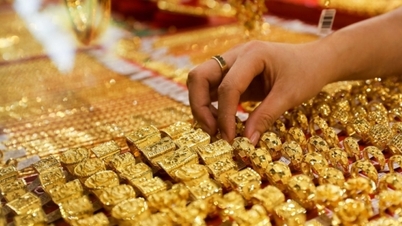
According to a recent report by the World Gold Council (WGC), gold consumption in Vietnam reached 17.2 tons in the last quarter, a decrease of 2.4 tons compared to the same period in 2022. Specifically, consumption of gold bars and coins decreased from 14 tons in the first quarter of last year to 12.6 tons. Consumption of gold jewelry decreased by 18%, from 5.6 tons to 4.6 tons.
Shaokai Fan, Managing Director for Asia Pacific (excluding China) and Global Head of Central Banking at the World Gold Council (WGC), said the decline was due to the base effect, with a high comparative base as the first quarter of 2022 was the quarter with the strongest demand for gold jewelry in Vietnam since 2007.
At that time, experts said rising inflation and the weakening of the Vietnamese dong increased the appeal of gold, reflected in high domestic premiums. Local festivals including Lunar New Year, Valentine's Day, and the God of Wealth festival supported a surge in demand for gold jewelry, along with a recovery in business activity to pre-Covid levels.
Furthermore, according to representatives of the Gold Business Association, the Vietnamese custom of hoarding gold has a long tradition. Besides being a savings asset for each family, gold is also a safe haven, an investment, and a good source of profit for many people.
However, this year's situation has changed, with Vietnamese consumers' purchasing of gold jewelry being particularly strong during the Lunar New Year period, then gradually declining in February and March due to the high price of the precious metal. The average world gold price in the first quarter was $1,890 per ounce.
The business results of companies in the industry this past quarter also reflect the trend recorded by the WGC. Phu Nhuan Jewelry Joint Stock Company (PNJ) had net revenue of VND 9,753 billion in the first three months of the year, a slight decrease compared to the record high of the same period last year. Specifically, revenue from wholesale jewelry and 24K gold decreased slightly compared to the same period in 2022.
At the annual general meeting at the end of April, Ms. Cao Thi Ngoc Dung, Chairwoman of the Board of Directors of PNJ, said that the first quarter of the year is always the foundation for the whole year because it includes the peak sales season before the Lunar New Year, the God of Wealth festival, and Valentine's Day, but this year the company is feeling difficulties right at this stage.
"The market is currently very uncertain, and we cannot rule out the possibility of it worsening," Ms. Dung said. However, the head of PNJ believes there is a 50% chance that purchasing power could recover in the last three months of the year.
According to financial expert Phan Dung Khanh, the decrease in gold consumption compared to the same period last year is reasonable because in the first half of last year, gold prices rose sharply and demand was very high. Vietnam's financial market was not doing well at that time, but the gold market was vibrant. Meanwhile, the first quarter of this year saw a slowdown in GDP growth, particularly in Ho Chi Minh City. "During difficult economic times, people are focused on saving and using money for daily expenses rather than prioritizing gold purchases," Mr. Khanh said.
Furthermore, Mr. Khanh believes that other investment channels are beginning to show signs of emerging from their bottom, for example, the stock market improved at the beginning of this year, attracting money back. This market only weakened at the end of the first quarter and the beginning of the second quarter.
According to Mr. Khanh's assessment, interest in gold has also decreased. "Last week, the world gold price peaked at $2,078 per ounce, but I see low interest from domestic investors," Mr. Khanh observed.
According to him, the decrease in people's gold purchases is a good sign for the economy. Because people's money tied up in gold is considered "dead money." Therefore, if this money is not invested in gold but instead deposited in savings accounts, it will help banks mobilize capital for lending, not to mention investing in production and business," this expert analyzed.
Meanwhile, global gold demand in the first quarter reached 1,174 tonnes , a slight increase of 1% compared to the same period in 2022, according to the WGC. Consumption of gold jewelry remained stable at 478 tonnes, driven by increased purchases by Chinese consumers following lockdowns, offsetting weak demand from India.
Demand for gold bullion and coins also increased by 5%, reaching 302 tonnes. Central banks contributed to this surge by adding 228 tonnes to their reserves, a record high in first-quarter statistics.
Louise Street, Senior Market Research Specialist at WGC, commented that the global gold market experienced complex developments in the first three months of the year. Due to various economic factors and differing demands, growth in some regions offset declines in others. "The common thread across major markets is investors' interest in gold as a way to protect asset value during times of financial uncertainty," she said.
This expert predicts that investment demand for gold will increase this year, especially as the barriers from the USD and rising interest rates gradually ease. Along with that, central banks are likely to continue their strong buying activity, becoming one of the main drivers of gold demand in 2023.
"As some economies teeter on the brink of recession, the role of gold as a long-term strategic asset can become incredibly important, as this asset class has demonstrated the ability to deliver positive returns in five of the last seven recessions," said Louise Street.
Dỹ Tùng
Source link

![[Image] Pleasant weather helps students enter the 10th grade entrance exam with confidence.](https://vphoto.vietnam.vn/thumb/1200x675/vietnam/resource/IMAGE/2026/05/29/1780034401612_ngay-1-thi-lop-10-minh-duy-8-5009-jpg.webp)
![[Photo] Ba Lang An Lighthouse - the "eye of the sea" amidst the "rock museum" of Quang Ngai province.](https://vphoto.vietnam.vn/thumb/1200x675/vietnam/resource/IMAGE/2026/05/29/1780038698840_anh-man-hinh-2026-05-29-luc-14-10-42.png)


































































Comment (0)