

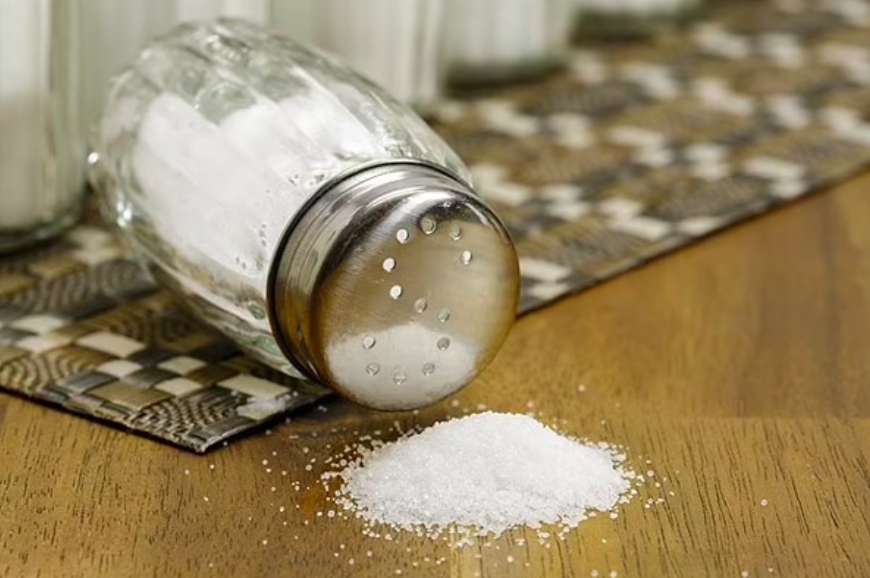
 |
| A habit of eating salty foods leads to high blood pressure, which in turn puts pressure on the kidneys, forcing them to work harder. (Source: Daily Mail) |
According to the World Health Organization (WHO), an adult should consume less than 5g of salt per day, equivalent to about one teaspoon. However, the results of the 2021 National Survey on Risk Factors for Noncommunicable Diseases (STEPS) conducted by the Ministry of Health show that the average salt consumption of Vietnamese people remains high, at approximately 8.1g/day.
Although this figure has decreased from 9.4g/day in 2015, the amount of salt in the daily diet of Vietnamese people is still significantly higher than recommended. In addition, 8.7% of the population regularly consumes processed foods with high salt content.
Salt is hidden in our daily meals.
Salt is not only found in ordinary table salt but also in many familiar seasonings such as bouillon powder, seasoning granules, fish sauce, soy sauce, and MSG. In many Vietnamese families' meals, the habit of marinating, soaking, and seasoning food before cooking, adding seasoning during cooking, and using dipping sauces when eating is still very common.
From bowls of fish sauce, plates of seasoning powder, and fermented fish paste to the habit of dipping fruit in salt, the amount of salt consumed daily is often much higher than consumers realize. According to surveys, approximately 70% of daily salt consumption comes from seasonings used in food preparation, cooking, and dipping sauces.
Along with that, the trend of using ultra-processed foods and pre-packaged meals is becoming increasingly popular, especially among young people and busy groups. These products often contain high amounts of salt to enhance flavor and extend shelf life.
According to the Ministry of Health , approximately 20% of the salt in our diet comes from processed foods such as sausages, canned goods, snacks, instant noodles, frozen foods, and fast food. This is a "hidden" source of salt that is easily overlooked, because consumers do not directly season their food but still absorb a significant amount of sodium.
Eating salty foods increases the risk of high blood pressure.
According to Master's degree holder and doctor Ngo Thi Ha Phuong from the National Institute of Nutrition, excess sodium, the main component in salt, can increase vascular permeability and tone, causing water retention in cells, increasing peripheral resistance, and leading to hypertension.
High blood pressure often develops silently but can cause many dangerous complications such as cerebrovascular accidents, strokes, and heart attacks. Besides affecting the cardiovascular system, consuming too much salt also overloads the kidneys, which over time can impair kidney function, increase the risk of kidney stones, and cause osteoporosis.
For children, developing a habit of eating salty foods from a young age can lead to taste dependence, easily forming an unhealthy "salty mouth" eating pattern. When this habit persists into adulthood, the risk of developing chronic non-communicable diseases increases.
Dr. Truong Hong Son, Director of the Institute of Applied Medicine, stated that scientific evidence shows that reducing salt intake to less than 5g per day can lower blood pressure in adults by up to 20%. This is particularly significant given that over 25% of Vietnamese people aged 18-69 suffer from hypertension.
Reduce salt intake through small changes.
Experts recommend that consumers develop the habit of reading nutrition labels before buying food. This is considered key to controlling the amount of salt, sugar, and saturated fat in their daily diet.
Product packaging usually includes information about sodium or salt content. Consumers should prioritize products with low salt content, limit processed foods and fast food, and reduce the use of salty seasonings in cooking.
In family meals, reducing salt intake can begin with simple changes such as using less salt in seasoning, limiting the amount of dipping sauces on the table, avoiding soaking food in fish sauce or seasoning powder, and reducing consumption of pickled vegetables, salty stews, and processed foods.
In addition, people need to increase their intake of green vegetables, fresh fruits, and natural foods to build a healthier diet. Adjusting taste should be done gradually to allow the body to adapt, avoiding the misconception that reducing salt means eating completely bland food.
Reducing salt intake doesn't mean eliminating saltiness from meals, but rather using just enough salt to protect long-term health. On World Hypertension Day, May 17th, experts continue to advise people to follow the message "use less salt, season lightly, and reduce salty foods" to prevent hypertension, protect cardiovascular health, and improve quality of life.
Source: https://baoquocte.vn/nguoi-viet-ruoc-benh-tu-thoi-quen-an-man-395025.html
![[Image] Hanoi's urban life under the challenge of a "scorching hot" environment](https://vphoto.vietnam.vn/thumb/1200x675/vietnam/resource/IMAGE/2026/05/25/1779706979265_nang-nong-t5-2026-minh-duy-7-4636-jpg.webp)
































































































Comment (0)