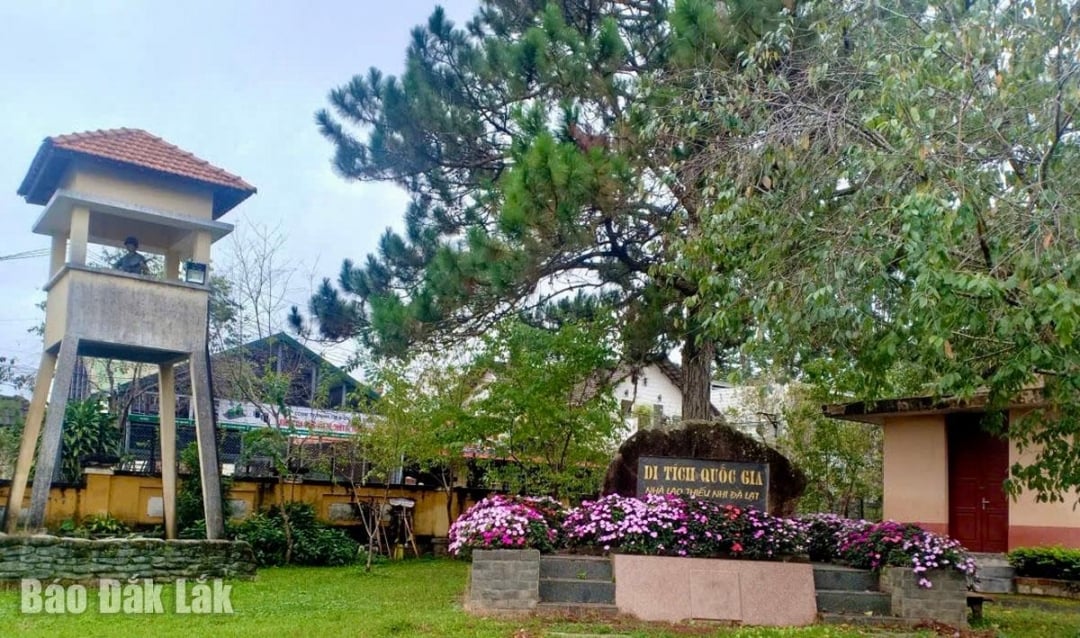
This was the detention center for over 600 young prisoners (aged 12 to 17) with revolutionary spirit, gathered from various prisons in the South.
This prison was designed as a self-contained rectangular structure with thick stone walls surrounding it. The front was a block shaped like an A, flanked on either side by prison cells and solitary confinement cells. Two rows of buildings formed two courtyards in the middle, serving as spaces for prisoners to use outside their cells.
The prison administration was tightly organized, with personnel carefully selected from those trained in prisons of the time. At the top was the warden's office; the security department specialized in repression and beatings; the reform department planned propaganda campaigns to eradicate revolutionary ideology among child prisoners; the vocational guidance department organized vocational training classes, essentially a form of deception; the supervisory board assigned personnel to constantly monitor the cells; and the warden directed the guards and recruited some prisoners to act as security guards, aiming to create internal divisions among the child prisoners, isolate patriotic children from the influence of their elders, and cleanse them of revolutionary ideology and spirit.
|
Today, the Da Lat Children's Prison historical site has become a "red address," educating future generations about patriotism. |
In particular, the stone cellar was a little-known area, reserved for prisoners whom the enemy considered "stubborn." Here, they tortured young revolutionary fighters with "dew baths." This room, about 10 square meters in size, was built on all four sides with cut stone, and the roof was covered with barbed wire. Prisoners held here wore only shorts, their hands were handcuffed, and their bodies were covered with whip marks. In the biting cold, the wounds were even more excruciatingly painful.
The prison was also designed with 3 rows of cells, each row consisting of 4 cells with an area of 2 m2, holding 4-5 young soldiers. There was also a women's detention area, with 2 rooms (H, G) each about 50 m2, holding 50-70 people at its peak. Each room had a cell door with iron bars and two layers of sturdy main doors. The men's detention area had 6 rooms (A, B, C, D, E, F) holding over 400 people.
In this prison, child prisoners were subjected to brutal torture and abuse in various ways, such as being handcuffed, beaten with whips made from electrical wires, barbed wire, scout batons, or having hot, high-voltage light bulbs pressed against their faces, and having cold water poured on them…
Within the prison, the young revolutionary fighters gathered a core force, established a unified command structure, and formulated specific demands to carry out continuous and persistent struggle throughout the prison's existence.
The anti-flag-saluting movement: Every Monday morning, all prisoners had to gather in the courtyard to salute the flag and sing the national anthem of the Republic of Vietnam. In this context, many child prisoners refused to salute the flag or sing the national anthem; instead, they discussed plans to commit suicide by disembowelment to pressure the enemy into making concessions.
Prison Break Movement: Following a series of struggles to uphold the communist spirit and refuse to surrender to the enemy, the idea of escaping from prison began to take shape among newly admitted prisoners. Seven escape attempts were carried out sporadically in various forms and at different times; however, most were individual escapes involving small numbers of prisoners, lacking a well-organized plan, and without contact or coordination with local liaisons.

|
Cell E - The male juvenile prisoner section in the prison. |
The anti-fingerprinting movement and uprising: From 1972-1973, the revolutionary movement in South Vietnam intensified, impacting the prison struggle. At this time, the enemy planned to fingerprint and photograph all child prisoners to falsify records and avoid condemnation from domestic and international public opinion. Faced with this situation, the child prisoners discussed among themselves how to resist fingerprinting and revolt to take control of the prison.
On February 22, 1973, upon learning that all prisoners would be taken to the courtyard for fingerprinting and photography, the prisoners sent representatives to demand that the prison guards release the young prisoners and force them to comply with their demands. However, the guards refused and began to repress them. The young fighters rose up, vandalizing the prison to seize sticks, knives, machetes, hoes, and shovels; shouting "Down with repression!", "Down with the policy of forcing child prisoners to fingerprint!", "Forced photography for defection!" The struggle reached its peak when the fighters pulled the enemy's flagpole, lowering the enemy's flag; and used the enemy's loudspeakers to call on the surrounding people to support the struggle. The uprising was victorious, the prison community gained the upper hand, forcing the enemy to concede and fulfill the prisoners' demands.
By June 1973, due to strong public condemnation and the victories of the revolutionary battlefield in the South, the enemy was forced to abolish the prison and release prisoners who had completed their sentences, transferring those with remaining sentences to local prisons.
The dismantling of the Da Lat Children's Prison was the result of significant victories on the Southern battlefield, combined with the creative, persistent, heroic, and courageous struggle of the patriotic child prisoners within the prison itself, thereby demonstrating the courageous and indomitable revolutionary spirit of Vietnamese youth.
Source: https://baodaklak.vn/van-hoa-du-lich-van-hoc-nghe-thuat/202512/nha-lao-dac-biet-o-xu-ngan-hoa-8b6058c/



















![[Photo] Reception to welcome General Secretary and President To Lam and his wife on their State visit to the Philippines](https://vphoto.vietnam.vn/thumb/1200x675/vietnam/resource/IMAGE/2026/06/01/1780295488620_vna-potal-chieu-dai-chao-mung-tong-bi-thu-chu-tich-nuoc-to-lam-va-phu-nhan-tham-cap-nha-nuoc-toi-philippines-8798060-7855-jpg.webp)









































Comment (0)