

For many years, a 4.5°C increase above pre-industrial levels was predicted as one of the worst-case scenarios for global climate by 2100.
However, new climate models suggest a more optimistic scenario as the world becomes less dependent on fossil fuels.
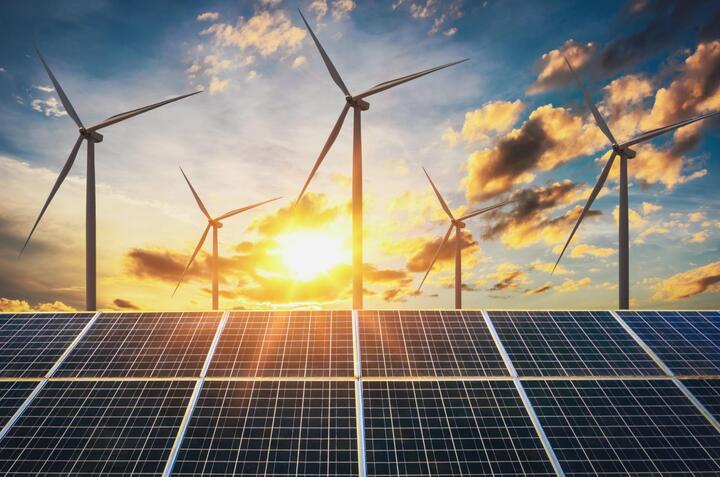
The global warming scenario is changing for the better thanks to renewable energy. (Illustrative image)
According to researchers, the sharp decline in the cost of solar and wind power over the past decade has significantly impacted the world's consumption of coal, oil, and natural gas. Meanwhile, climate policies are also contributing to a reduction in global emissions.
Some leading climate scientists now believe that the maximum temperature increase under extreme scenarios could be revised down to around 3.5°C by 2100.
The new forecasts were developed within the framework of the Scenario Model Comparison Project (ScenarioMIP), an international research program that develops climate models based on multiple scenarios of future emissions and land-use change.
The research findings will be used for subsequent assessment reports by the United Nations Intergovernmental Panel on Climate Change (IPCC).
Nevertheless, a 3.5°C increase is still far higher than the 2°C global temperature increase target set in the 2015 Paris Agreement and could have serious consequences for the planet.
In an extreme scenario
Scientists modeled various factors such as population, energy demand, energy sources, climate policies, the level of international cooperation, and investment in adaptation and emission reduction.
In worst-case scenarios, climate policies weaken or reverse, while the use of fossil fuels continues to increase along with energy-intensive technologies and lifestyles.
According to these models, fossil fuel consumption could exceed existing reserves, forcing the world to exploit undiscovered deposits using future technologies.
Scientists also assume that the cost of renewable energy will no longer continue to fall as it is now, possibly due to the scarcity of minerals needed for electric vehicle batteries, solar panels, and wind turbines, or due to the impact of trade tensions.
An accompanying study warns that rising nationalism, regional competition, geopolitical conflict, and concerns about economic security could lead many countries to prioritize domestic interests over cooperation in reducing greenhouse gas emissions.
This risks undermining or disrupting global climate policies.
According to extreme models, a sharp increase in emissions could cause irreversible changes to the slow-moving components of the Earth's system, such as the deep oceans, ice sheets, and glaciers—all of which play a role in regulating global climate.
Although considered less likely than before, scientists believe the consequences of this scenario would still be catastrophic.
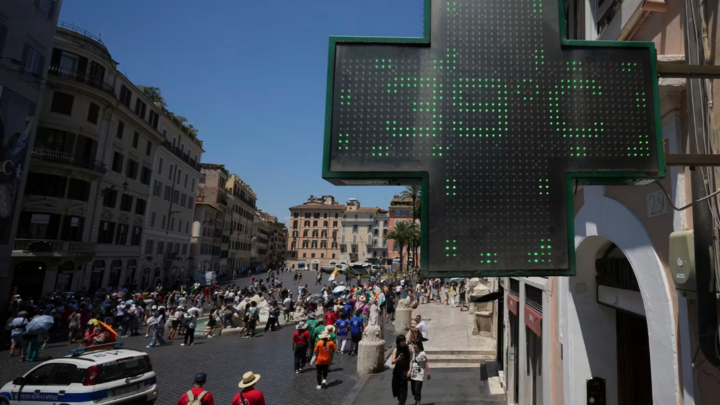
A thermometer in a building in Rome, Italy, shows 39°C on July 1, 2025. (Photo: CNN)
The Earth will still warm up even in the best-case scenario.
The report also outlines "milder" scenarios, ranging from high emissions sustained until mid-century before a sharp decline, to drastic climate policies that help the world achieve net-zero emissions as soon as possible.
According to research, even in the best-case scenario, the world is now unlikely to avoid a temporary increase in temperature exceeding 1.5°C above pre-industrial levels. This is also the most ambitious target of the Paris Agreement.
If current climate policies remain unchanged, preliminary estimates suggest that global temperatures could rise by around 2.5°C by the end of the century.
Even if emissions reduction measures are delayed, if the world still achieves net-zero emissions by the end of the century, the temperature increase could be around 2°C.
However, even low-emission scenarios could cause sea level rise and ice sheet melting that is irreversible within the lifetime of humankind.
Scientists also warn that temperatures exceeding 1.5°C (even for a short period) could still cause long-term damage to vital ecosystems such as coral reefs and tropical rainforests.
Compared to models developed in the mid-2010s, the new forecast updates actual emissions data up to 2023 and better reflects how oceans, forests, and natural systems absorb CO2 as the Earth warms.
Source: https://vtcnews.vn/nhiet-do-trai-dat-nong-len-bao-nhieu-vao-nam-2100-ar1018898.html


![[Image] Pleasant weather helps students enter the 10th grade entrance exam with confidence.](https://vphoto.vietnam.vn/thumb/1200x675/vietnam/resource/IMAGE/2026/05/29/1780034401612_ngay-1-thi-lop-10-minh-duy-8-5009-jpg.webp)
![[Photo] Ba Lang An Lighthouse - the "eye of the sea" amidst the "rock museum" of Quang Ngai province.](https://vphoto.vietnam.vn/thumb/1200x675/vietnam/resource/IMAGE/2026/05/29/1780038698840_anh-man-hinh-2026-05-29-luc-14-10-42.png)





























































































Comment (0)