

Create your own space to practice foreign languages and learn about different cultures.
Having personally guided international friends on tours of Hanoi , Mr. Le Van Tai - President of the Club - frequently receives informal questions from people wanting to learn more about Vietnamese culture.
"When I go to the Ho Chi Minh Museum, I have to talk about Uncle Ho's life and the historical periods. When I go to the Temple of Literature, foreigners ask about his scholarly achievements and Confucianism, and I have to research thoroughly before I can answer," Tài shared.
From those real-life situations, Mr. Tai realized that foreign languages only truly demonstrate their value when linked to knowledge and a cultural and historical context. Therefore, in 2015, he decided to establish a club operating as a volunteer tour guide providing free services to foreigners.
Each tour, lasting from 3 to 8 hours, is not just a sightseeing trip, but a field learning experience where students can use their foreign language while simultaneously honing their communication skills, reflexes, and problem-solving abilities in a real-world environment.
In the early stages, the club faced numerous obstacles. According to Mr. Tai, the biggest barrier was trust, as many young people were skeptical about the effectiveness of the learning method and hesitant to interact directly with foreigners for extended periods. Furthermore, tourism businesses were also cautious because the model was still new.
"Only when the first groups of trainees show clear progress and receive positive feedback from tourists will the model gradually be accepted and spread," Tài said.
Despite initial difficulties, the effectiveness of the model has gradually been confirmed. After learning and actively participating in tour guiding, many young people who were previously shy and lacked confidence have become more proactive in communication, significantly improving their foreign language skills and practical problem-solving abilities.
"Zero-cost" tours not only help young people improve their foreign language skills but also open up opportunities for deeper access to culture and history. In this way, English is no longer just a goal, but becomes a tool for exploring knowledge and conveying Hanoi's cultural values to international tourists.
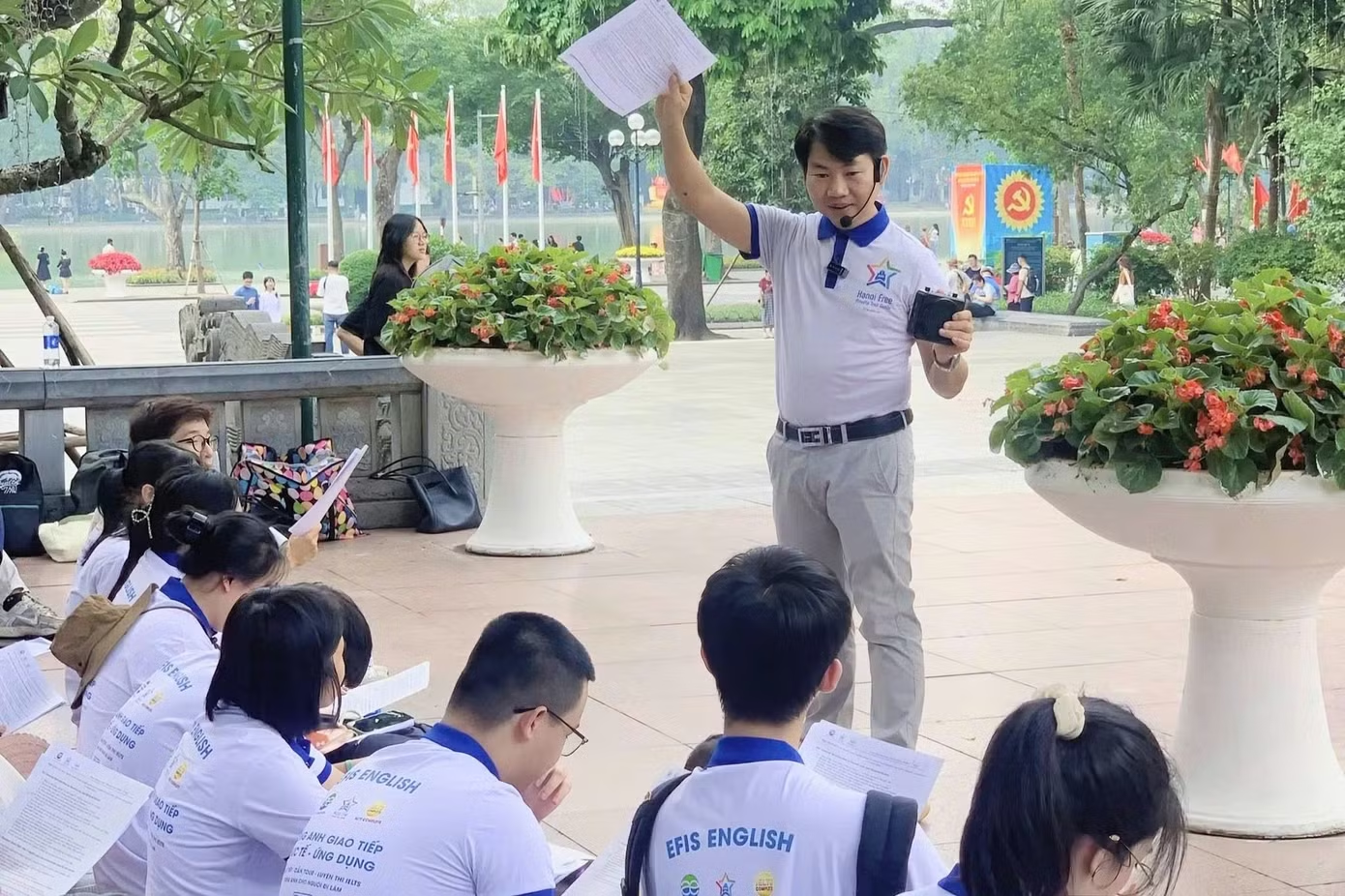
To enable every young person to become a "cultural ambassador"
Sharing her practical experience, Thuong Huyen (a 4th-year student at the Water Resources University) said: “In the beginning, I mostly just stood and listened, not daring to speak much, and had to follow the older students to learn how to tell stories. After participating for a while, I gradually got used to conversing in English and no longer feared making mistakes. Now, I can proactively introduce and exchange information with tourists naturally and much more confidently.”
Thuong Huyen said that previously, she mainly just observed and didn't deeply understand the cultural and historical stories. When she started leading tours, the student not only improved her foreign language skills but also learned and proactively sought out more cultural knowledge. From there, Huyen understood and loved the traditional values of the capital even more.
To ensure the quality of each tour, the club develops a training program that combines foreign languages with in-depth knowledge of culture, history, and cuisine. At the same time, members are guided towards the standards of global citizenship, emphasizing respect, proactiveness, and responsibility in cross-cultural communication.
According to Mr. Tai, when young people interact with foreigners, they not only express themselves but also represent the image of Vietnamese people. Their communication and behavior directly influence how tourists perceive the country. This also motivates young people to continuously improve themselves, enhance their knowledge, and develop a sense of responsibility in communication.
"I still remember the tour where tourists called me a 'cultural ambassador.' That made me very happy and proud, and it motivated me to continue spreading more beautiful images of Vietnamese people and the culture of Hanoi and the country," Thuong Huyen further shared.
During their visit to Hanoi in mid-April, two Australian tourists, Dominique Pepper-Rose and Matthew Pepper, expressed their admiration for the people and the beauty of the city. In particular, during their tour of Ho Guom Lake, the Temple of Literature, and Hoa Lo Prison, despite having researched the trip online beforehand, they said that thanks to their travel companion, Huyen, the experience was clearer and more profound. Both tourists considered the trip very rewarding and enjoyable.
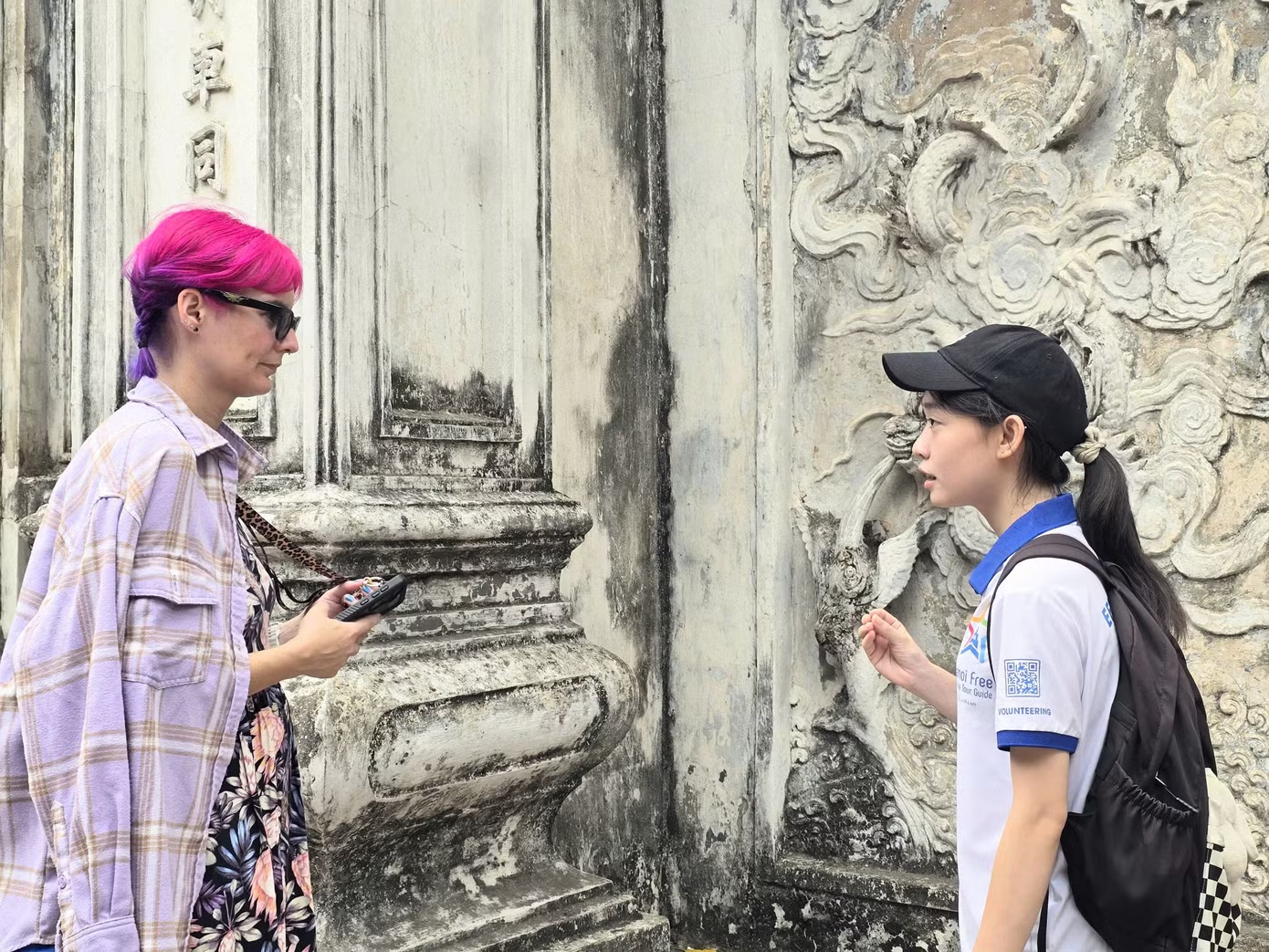
Aiming to spread the image of Hanoi and Vietnam more widely, the club is not only focused on tourism activities but also on improving the quality of training in the future. The focus is on deepening knowledge, equipping young people with a comprehensive cultural foundation, and improving and updating experiential content at destinations to enhance tour quality. Through this, the club is gradually expanding its scale, aiming to replicate the model in localities with rich tourism potential such as Ho Chi Minh City, Hue, etc.
To date, the club has organized over 100,000 tours, serving approximately 200,000 tourists, with over 10,000 members, of which about 2,000 are regular participants.
Source: https://tienphong.vn/nhung-dai-su-tre-lan-toa-net-dep-van-hoa-thu-do-post1846526.tpo


















![[Photo] Reception to welcome General Secretary and President To Lam and his wife on their State visit to the Philippines](https://vphoto.vietnam.vn/thumb/1200x675/vietnam/resource/IMAGE/2026/06/01/1780295488620_vna-potal-chieu-dai-chao-mung-tong-bi-thu-chu-tich-nuoc-to-lam-va-phu-nhan-tham-cap-nha-nuoc-toi-philippines-8798060-7855-jpg.webp)







































Comment (0)