

In many rural areas of Phu Tho today, it's not difficult to find small grocery stores, eateries, carpentry workshops, and mechanical workshops. Without large signs or elaborate strategies, these businesses create jobs, generate income, and maintain the economic rhythm of each residential area.
Mr. Nguyen Van Son, owner of Son Thuy grocery store in Veo village, Vinh Phuc ward, shared that he is originally from Thanh Ba commune but married a woman from this ward, so more than 10 years ago, he decided to move his whole family here for convenience. The couple decided to pool their money to buy a house on the village road to open a grocery store.

Mr. Nguyen Van Son's grocery store in Vinh Phuc ward provides a stable source of income for his family.
Thanks to their reputable business and extensive network, Mr. and Mrs. Son's shop is popular, providing stable employment for three employees with decent incomes and contributing taxes to the local budget. In addition, their family life is comfortable, and all four children are well-cared for and receive a good education, all thanks to their grocery store.
In reality, the private sector plays a crucial role in the economy. Looking deeper, the household economy, prevalent in rural areas, forms the direct and sustainable foundation. In Phu Tho , this is no longer just an observation but has been demonstrated by concrete figures.
The province currently has over 126,000 households of skilled farmers and business owners, with hundreds of thousands of households participating in economic development movements annually. This large force directly operates production, service, and trade activities in rural areas, creating a soft economic network that permeates every residential area.
Significantly, the rural private economy is no longer limited to small-scale, spontaneous operations, but is gradually forming linkages and production organizations. Currently, the province has nearly 1,700 cooperatives and 1,425 cooperative groups in operation, attracting tens of thousands of workers. The cooperative sector alone has created jobs for over 73,300 workers, with an average income of approximately 5.2 million VND per person per month. This is not just a figure for employment, but also demonstrates the shift from individual production to linkages and cooperation, gradually improving economic efficiency.
In addition, financial resources for household economies are also receiving attention. More than 4,000 farming households have accessed loan capital, with a total outstanding debt of over 191 billion VND, contributing to expanding production scale, investing in equipment, and increasing income.
Another highlight is the One Commune One Product (OCOP) program, which is creating a significant shift. The province currently has nearly 600 OCOP products rated 3 stars or higher, many of which meet high standards and are gradually establishing their brands in the market. This shows that the rural economy is no longer limited to raw material production but is shifting towards commodity production and participating more deeply in the value chain.
In the overall picture, agriculture remains fundamental, with growth projected at around 3.29% in 2025, continuing to be the backbone of the economy. However, it is noteworthy that rural areas are transforming, no longer solely dependent on agricultural production but expanding into services, small-scale industries, and business.
Mr. Duong Van Truong from Yen Lac commune shared that his family used to be farmers, working the land year-round, yet life remained difficult. More than a decade ago, his family decided to pursue the traditional carpentry trade of the village, despite having little capital and limited experience.
However, thanks to the diligence, hard work, skillful hands of the villagers, and their constant pursuit of innovation, the family's products have been well-received and strongly consumed by the market. As a result, the revenue from Mr. Truong's family's carpentry workshop has steadily increased, providing stable employment for dozens of workers with an average income of over 10 million VND per person per month.
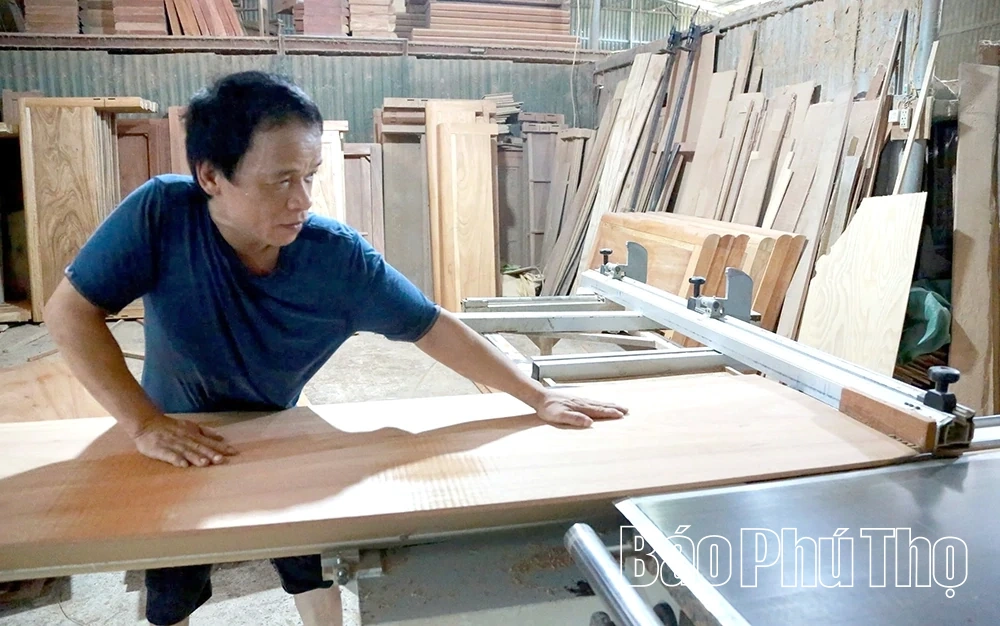
The carpentry workshop of Mr. Duong Van Truong in Yen Lac commune provides a considerable income for his family and offers stable employment for many local workers.
It can be said that the flexibility of the household economy is its outstanding advantage. When the market fluctuates, people can quickly adapt, transforming their production models from crop farming to livestock breeding, from agriculture to services, and from traditional businesses to online sales. This is a crucial factor in helping the rural economy maintain stability amidst many changes. From being a pillar, this sector is gradually becoming a local growth engine, contributing to retaining labor, limiting migration, and creating balanced development between regions.
However, the rural private economy still faces many limitations. The majority of household businesses are small-scale, lacking capital, production space, and especially limited in management skills and technology application. The transition from household businesses to enterprises remains slow, linkages between households are weak, and sustainable value chains have not yet been formed. This is the "bottleneck" that prevents the great potential of this sector from being fully exploited.
Overall, the rural private sector is no longer a "secondary occupation" but is becoming the foundation of sustainable development. The challenge is not just to encourage it, but to create mechanisms for its more systematic development. This includes supporting access to capital, skills training, promoting digital transformation, and building production-consumption linkage models.
For Phu Tho, this is not just an economic story, but also a story about preserving the people, the villages, and maintaining the pace of development in rural areas. When these "small shops" are supported and family-based economic models are upgraded, these underlying currents will combine to form a larger flow, creating a solid foundation for the local development.
Quang Nam
Source: https://baophutho.vn/nhung-mach-ngam-kinh-te-phu-tho-252079.htm
![[Photo] Secretary of the National Assembly Party Committee, Chairman of the National Assembly presides over the meeting of the Standing Committee and Executive Committee of the National Assembly Party Committee.](https://vphoto.vietnam.vn/thumb/1200x675/vietnam/resource/IMAGE/2026/06/03/1780480353201_ndo_br_bnd-2585-jpg.webp)
![[Photo] General Secretary and President To Lam presides over a meeting with the Central Organizing Committee.](https://vphoto.vietnam.vn/thumb/1200x675/vietnam/resource/IMAGE/2026/06/03/1780482764658_a1-bnd-4741-3342-jpg.webp)

![[Photo] First session of the 14th Congress of the Vietnam Trade Union](https://vphoto.vietnam.vn/thumb/1200x675/vietnam/resource/IMAGE/2026/06/03/1780465947883_ndo_br_img-3852-jpg.webp)















































![[Video] Sunset at Lap An Lagoon – Where the sun sets over the fishing nets](https://vphoto.vietnam.vn/thumb/1200x675/vietnam/resource/IMAGE/2026/05/31/1780192137701_beach-landscape-sea-water-nature-grass-745871-pxhere-com.jpeg)


























Comment (0)