

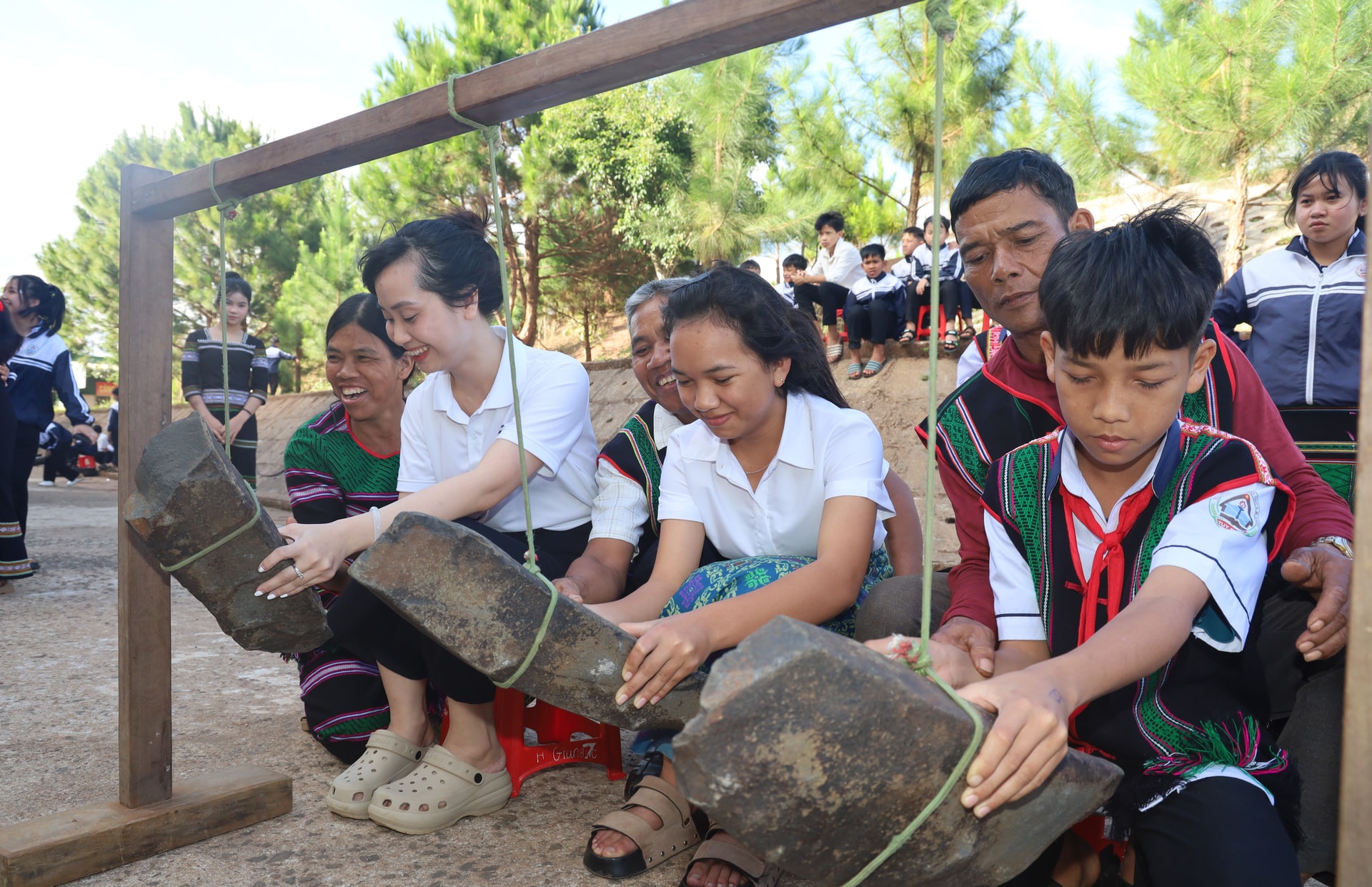
Silently keeping the rhythm of the stone's sound.
As evening falls over the Dien Du village, when the farmers have finally finished their work in the fields, the clear, rustic sounds of the stone xylophones can be heard. The sounds are not loud, but they are enough to captivate the listener, like the heartbeat of the mountains and forests echoing back.
Among those preserving this musical instrument, Mr. Dieu Gie (born in 1970) is a prime example. Not born into a family with a tradition, nor receiving formal training from a young age, he came to the stone xylophone relatively late, in 2022. His journey began simply by watching others perform, sparking a love for it, and from there he taught himself. “I learned because I thought it was interesting. It was difficult at first, but after listening repeatedly, I got used to it, remembered the rhythm and the sounds,” Mr. Dieu Gie recounted. For him, the stone xylophone is not just a musical instrument, but a part of his people's cultural memory.
According to Mr. Dieu Gie, getting acquainted with the stone xylophone isn't too difficult; it can be learned in a day. However, to play with a steady rhythm and accurate pitch, learners must practice persistently for a long time. "Concentration is key. When playing, only listen to your own voice. If you hear the voices of others nearby, you'll easily lose the rhythm and play the wrong notes," he shared his experience.
In the entire Dien Du village, there are more than 10 people who know how to play the stone xylophone, but only about 3 are truly proficient. With limited resources, the village only has one set of stone xylophones for shared use. Therefore, practice sessions are all the more precious. Adults teach the younger generation, those with more knowledge guide those with less, and in this way, the sound of the instrument is preserved through perseverance and a love for the craft.
Transmit the sound so it doesn't fade away.
For Mr. Dieu Gie, preserving the tradition of playing the instrument is difficult, but ensuring that the younger generation continues the tradition is even more challenging. Therefore, his greatest concern is not performance or technique, but teaching.
His daughter, Thi San, is currently an 11th-grade student. Since elementary school, her father introduced her to the stone xylophone. Initially, it was just trying it out, gradually developing into a passion without her even realizing it. “When I was little, I found it strange, but it sounded nice, so I liked it. Later, when I learned more, I found the sound of the instrument very special, like the sound of our mountains and forests,” Thi San shared. Thanks to early exposure and natural talent, she can now skillfully play all three bars of the stone xylophone.
Mr. Dieu Gie's joy wasn't just that his son knew how to play the instrument, but that he understood and loved the cultural values of his people. "I'm old now, and in the future, there must be young people to carry on the tradition. Since my son knows how to play, I feel somewhat relieved," he said, his eyes shining with confidence.
The teaching of the instrument is not limited to families; it has spread throughout the community. Ms. Gờ Rếch (born in 1972), Ms. Điểu Xoong (born in 1974)... are members of the artisan team and are passionately dedicated to the stone xylophone. Ms. Gờ Rếch shared: "I learn to know and to preserve it. I'm very happy to see the children starting to show interest. I only hope that in the future, more people will know how to play, so that the sound of the instrument will not be lost."
Currently, the Dien Du village's stone xylophone artisans not only perform at festivals but also collaborate with schools to teach students. These classes, without blackboards or lesson plans, using only stone slabs and patience, offer lasting value. Lessons are usually held during free time, after farming work is finished. Despite the hardships, more and more young people are participating, learning each rhythm and note as a way to understand their roots.
Amidst the modern era, when many traditional values face the risk of disappearing, the sound of the stone xylophone in Dien Du village still resonates thanks to people like Mr. Dieu Gie, Ms. Go Rech, and young people like Thi San.
Source: https://baolamdong.vn/nhung-nguoi-giu-hon-dan-da-o-bon-ieng-u-435062.html

![[Image] Nearly 125,000 Hanoi students completed the Literature exam for the 10th grade entrance exam.](https://vphoto.vietnam.vn/thumb/1200x675/vietnam/resource/IMAGE/2026/05/30/1780117233041_ndo_br_thiet-ke-chua-co-ten-2-png.webp)






























































































Comment (0)