

2024 will continue to see efforts to explore the Moon, test flights of new vehicles, and the emergence of new records.
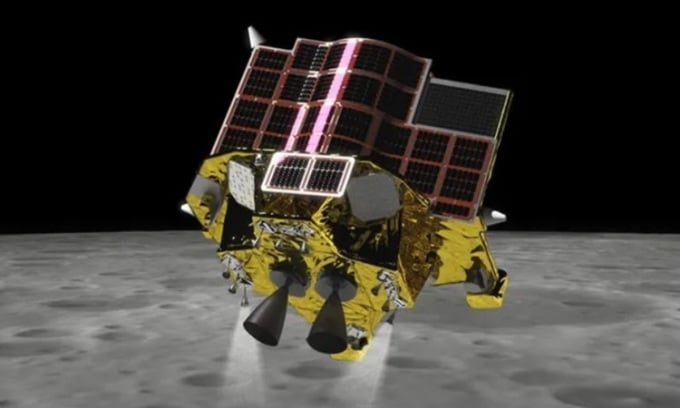
Simulation of the SLIM spacecraft preparing to land. Photo: JAXA
Japanese lunar lander attempts to land on the Moon.
The Japan Aerospace Exploration Agency (JAXA) launched the Smart Lunar Research Lander (SLIM) in September 2023. The spacecraft entered lunar orbit in December and is scheduled to land inside the Shioli crater on the Moon on January 19th. The SLIM mission aims to demonstrate the ability to land with extremely high precision, within 100 meters of the target. If successful, this would be the first time Japan has successfully landed a spacecraft on the Moon, becoming the fifth country to do so after the Soviet Union, the United States, China, and India.
Starship launch system makes its third liftoff.
SpaceX's Starship launch system is preparing for its third flight, IFT-3, in the first quarter of 2024. IFT-3 is being undertaken to validate key technologies for future lunar and interplanetary missions. Starship has already had two test flights in 2023, but neither reached orbit. SpaceX has a contract with NASA to develop a version of the Starship lunar lander in 2025. Therefore, it's possible the vehicle will launch several more times this year. Starship could also be developed into a vehicle to carry people to Mars in the future.
Boeing's spacecraft launched with a crew.
The first crewed test flight of Boeing's Starliner spacecraft is scheduled for mid-April. The mission will last eight days, during which astronauts will fly to the International Space Station (ISS). Starliner includes a reusable crew module and a disposable equipment module. The spacecraft is designed to transport crews to low Earth orbit and will serve NASA's Commercial Crew Program. For its first test flight, Starliner will launch into space using a ULA Atlas V rocket.
First private spacewalk mission
The Polaris Dawn mission is part of the Polaris Program, a series of launches chartered by billionaire Jared Isaacman, scheduled to begin as early as April 2024. In this mission, SpaceX's Crew Dragon spacecraft will carry Isaacman and three others to low Earth orbit for several days. If successful, the mission will set several records, including the first private spacewalk and the highest altitude spacewalk ever recorded.
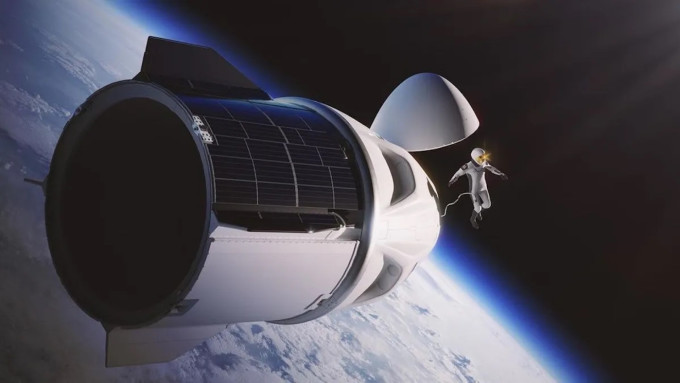
The Polaris Dawn mission could conduct the first private spacewalk. Photo: Polaris Program
China launches spacecraft to collect lunar samples.
The Chang'e 6 mission, scheduled for launch in May 2024, aims to bring samples from the Moon back to Earth. The mission is particularly noteworthy because the spacecraft will collect soil and rock samples from the far side of the Moon, specifically in the Aitkin Basin. This area is believed to have abundant ice reserves, and scientists have never before collected samples there. While the ice may have disappeared by the time Chang'e 6 returns to Earth, studying the samples will still provide valuable information about the Aitkin Basin and its potential as a water source for future astronauts.
US spacecraft ready for takeoff.
NASA and the American company Sierra Space plan to launch the Dream Chaser spacecraft in 2024 using a ULA Vulcan Centaur rocket. Dream Chaser is a reusable private spacecraft designed to deliver cargo and astronauts to low Earth orbit. The first uncrewed flight will be directed to the International Space Station (ISS). Dream Chaser is expected to carry more than 3,500 tons of cargo for this mission. It can also transport experimental samples, debris, and other supplies from the ISS back to Earth. If successful, Dream Chaser will be a crucial part of NASA's commercial resupply program.
Launching a spacecraft to search for life on Jupiter's moon.
NASA plans to launch the Europa Clipper spacecraft to explore Jupiter's icy moon Europa, one of the largest potential candidates for harboring life in the solar system, in 2024. Europa Clipper is scheduled to launch in October 2024 aboard SpaceX's Falcon Heavy rocket and arrive at Jupiter in April 2030. Upon arrival, this large spacecraft, roughly the size of a car, will use radar to map Europa's ice and study the area beneath its outer crust, where vast subsurface oceans may exist.
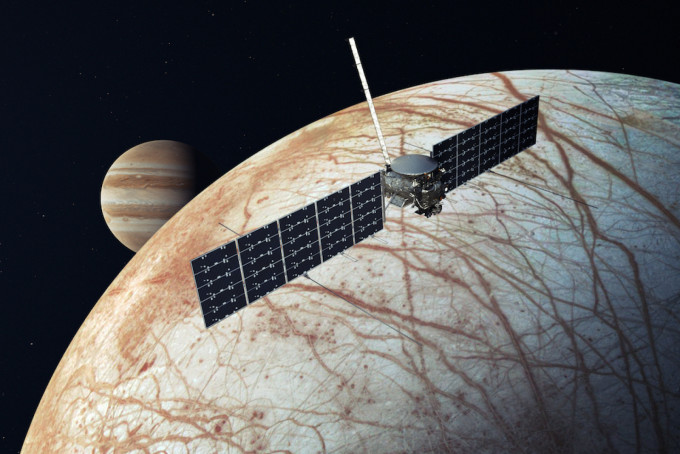
Simulation of the Europa Clipper spacecraft. Image: NASA/JPL-Caltech
The Artemis 2 mission aims to return humans to the Moon.
NASA's Artemis 2 mission, expected to last eight days, aims to return astronauts to the Moon in nearly 50 years. The mission uses a Space Launch System (SLS) rocket and the Orion spacecraft, scheduled for launch as early as November 2024. The spacecraft will carry four astronauts to orbit the Moon. Flying at an altitude of approximately 10,300 km on the far side of the Moon, Artemis 2 will be the first crewed mission to venture beyond low Earth orbit since the Apollo 17 mission in 1972.
Thu Thao (According to Space )
Source link

![[Photo] First session of the 14th Congress of the Vietnam Trade Union](https://vphoto.vietnam.vn/thumb/1200x675/vietnam/resource/IMAGE/2026/06/03/1780465947883_ndo_br_img-3852-jpg.webp)
![[Photo] General Secretary and President To Lam presides over a meeting with the Central Organizing Committee.](https://vphoto.vietnam.vn/thumb/1200x675/vietnam/resource/IMAGE/2026/06/03/1780482764658_a1-bnd-4741-3342-jpg.webp)


![[Photo] Secretary of the National Assembly Party Committee, Chairman of the National Assembly presides over the meeting of the Standing Committee and Executive Committee of the National Assembly Party Committee.](https://vphoto.vietnam.vn/thumb/1200x675/vietnam/resource/IMAGE/2026/06/03/1780480353201_ndo_br_bnd-2585-jpg.webp)
























































![[Video] Sunset at Lap An Lagoon – Where the sun sets over the fishing nets](https://vphoto.vietnam.vn/thumb/1200x675/vietnam/resource/IMAGE/2026/05/31/1780192137701_beach-landscape-sea-water-nature-grass-745871-pxhere-com.jpeg)












































Comment (0)