

Sacred "oases"
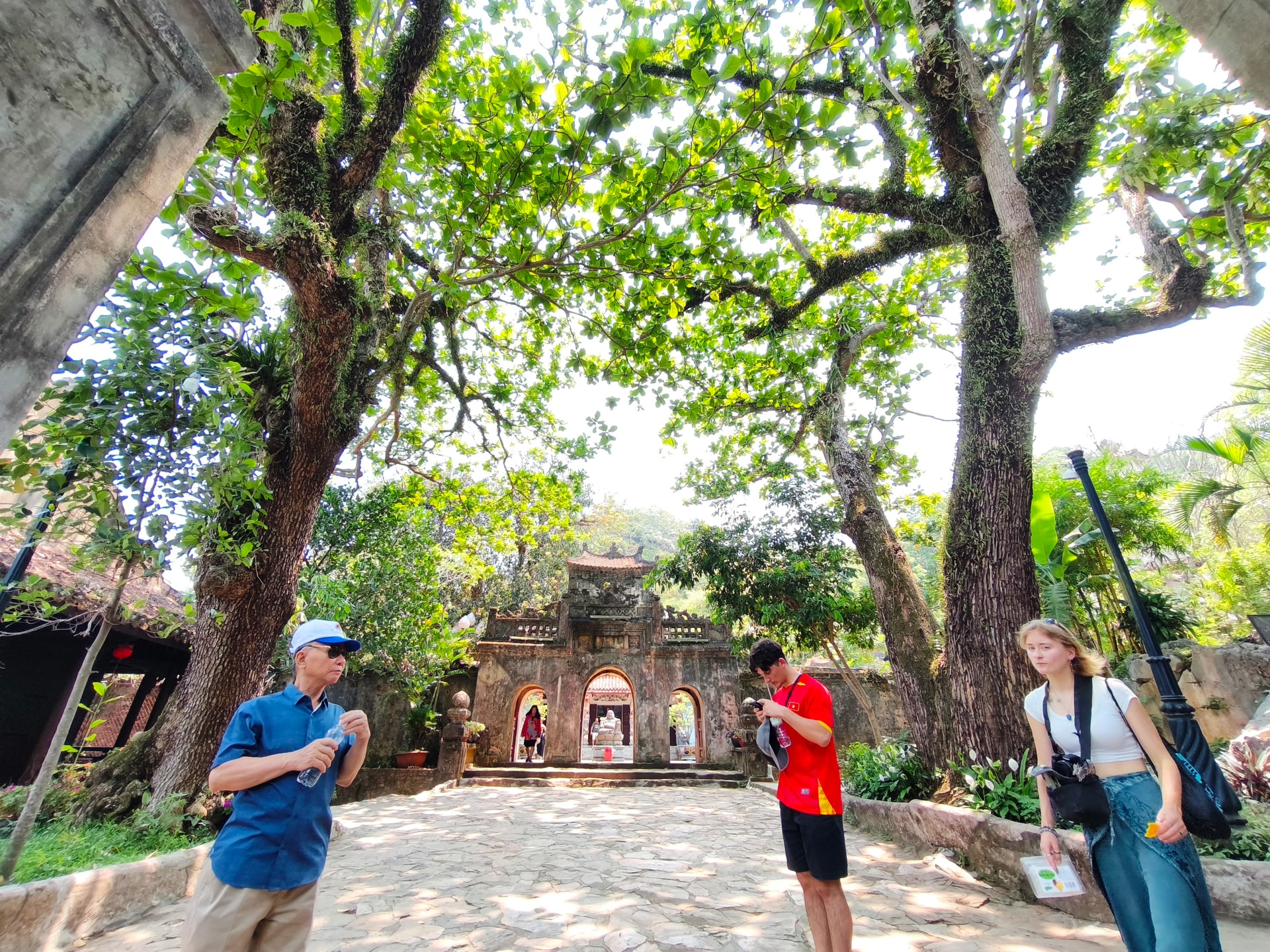
On a scorching early summer afternoon, the sun blazed down on the Lien Chieu area. Along the extended Nguyen Tat Thanh road, trucks and containers rumbled past in a continuous stream. However, as soon as one stepped onto the steps, past the banyan tree at the entrance to Trung Son communal house, the atmosphere instantly changed. The smell of damp, decaying leaves mingled with the earth, and the chirping of birds echoed through the cool air. High above, the dense canopies of ancient trees covered the sky, separating the forest from the hustle and bustle of the streets.
Sitting and fanning herself under a tree, 85-year-old Mrs. Le Thi Nhan slowly recounted the "history" of the forest. "This forest is a forbidden forest. It was like that in the past, and it's like that now. No one dares to come in and cut down trees," she said. More than three centuries ago, when the first settlers came to cultivate this land, they themselves established prohibitions for the forest located in the middle of the village. These included: no cutting down trees, no taking white sand for building houses, and no burying the dead in the forest. As residents of Trung Son, everyone must uphold these rules; no one has ever dared to break them.
The people of Trung Son have always believed that disturbing the forest is like disturbing the sacred part of the village. This belief has helped the forest survive through war, periods of scarcity, and the pressures of urbanization. In particular, in 2016, when the Trung Son historical site planning project proposed leveling the hills, the villagers reacted fiercely. They refused to accept the destruction of the forest, which they considered the soul of their ancestors. After numerous dialogues, the project was forced to be adjusted to preserve the existing state.
Not far from Trung Son, at the foot of Hai Van Pass, the Mom Hac forest still nestles between the sea waves and the bustling residential area of Nam O village. The villagers call it the "forbidden forest." For generations, the people of Nam O have passed down two prohibitions: no cutting down trees, and no picking up stones. No one remembers when these rules began, only that their descendants have been taught them since birth.
Researcher Dang Dung, who has spent many years collecting documents about Nam O, said that since the time of the Nguyen lords, this area has been considered a forbidden mountain. Only when building temples or shrines were villagers allowed to enter and take wood. These deeply spiritual prohibitions have become an invisible thread holding together a nearly pristine coastal forest in the heart of the city.
South of the city, the forest on Thuy Son mountain, part of the Ngu Hanh Son scenic area, presents a different appearance. Unlike the wildness of Mom Hac or the gloominess of Trung Son village forest, this forest on the limestone mountain resembles a "green roof" covering ancient temples that have stood for hundreds of years.
Behind Linh Ung Pagoda in Ngu Hanh Son, a more than 600-year-old banyan tree still casts its lush shade amidst the barren mountain rocks. In front of Tam Thai Pagoda, two ancient Terminalia trees stand symmetrically like old witnesses, silently watching the daily stream of people coming and going. Mr. Nguyen Van Hien, Head of the Ngu Hanh Son Scenic Area Management Board, said that although the forest here is not large, it plays the role of an "ecological core" supporting the entire historical site. "As long as the forest remains, the scenic area will remain," Mr. Hien said.
Transforming forests into green assets.
Previously, forests like Trung Son, Mom Hac, or the forest ecosystem in Ngu Hanh Son were preserved primarily through village customs and spiritual beliefs. However, in the context of urbanization and tourism development, the story is no longer about "preserving them," but about how to promote the value of these unique green spaces as a living heritage of the city.
In Trung Son, the forest is still in the process of having its documentation completed to be classified as a city-level historical site. According to Da Nang's Department of Culture, this place brings together many rare historical, cultural, and religious values, from village communal houses and ancient Cham wells to hundreds of tombs of martyrs and layers of memory formed over more than 350 years.
The city's decision to maintain the status quo instead of clearing the area, as previously proposed, shows a significant shift in approach. Forests are no longer seen as mere reserve land within the urban area, but are beginning to be recognized as a form of cultural and ecological heritage that needs preservation.
Meanwhile, in Nam O, the dossier proposing the ranking of the Nam O Cliff and Cliff area as a scenic site has been largely completed. This is considered an important step to both protect the unique coastal forest and open up possibilities for developing cultural and ecological tourism.
Mr. Huynh Dinh Quoc Thien, Director of the Da Nang Museum, believes that the value of Hac Point lies both in its landscape and its connection to the historical and cultural depth and the system of folk tales of the Nam O area. According to Mr. Thien, stories such as the legend of Princess Huyen Tran, the memories of the fishing village, or the remnants of ancient temples have created a unique appeal for this area.
"If properly preserved, the Mỏm Hạc forest and the cultural relics around Nam Ô will become a 'green asset' that both preserves the soul of the coastal village and creates long-term value for the community," Mr. Thiện said.
According to many researchers, if properly classified as a scenic spot and planned systematically, the Nam O - Mom Hac reef area could completely become a distinctive eco-cultural tourism model for Da Nang. More importantly, establishing this "official status" would create important legal grounds in the face of increasing urbanization pressure in the northwestern coastal area of the city.
Meanwhile, the green spaces at the Marble Mountains are being developed in a way that preserves the ecosystem in conjunction with spiritual spaces and heritage tourism. According to Mr. Nguyen Van Hien, Head of the Marble Mountains Management Board, protecting ancient trees and landscape forests not only has ecological significance but also directly determines the value of the site. Therefore, for many years, in addition to caring for and protecting the Vietnamese Heritage Trees, the management board has also identified forest conservation as a key task to maintain the natural landscape and habitat, because the forest is also an integral part of the complex.
Source: https://baodanang.vn/nhung-rung-tram-nam-giua-pho-3337824.html
![[Photo] Standing Committee member of the Party Central Committee Tran Cam Tu working with the Central Inspection Committee](https://vphoto.vietnam.vn/thumb/1200x675/vietnam/resource/IMAGE/2026/05/28/1779969579668_ndo_br_bnd-2495-jpg.webp)



































































































Comment (0)