


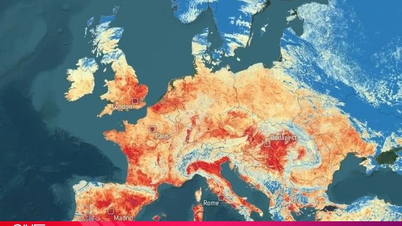
According to CNN, record temperatures are being broken repeatedly across Europe, as many areas of the temperate continent grapple with an extreme heatwave that arrived a month early.
On May 25th, England experienced its hottest May on record, with London reaching 34.8 degrees Celsius, breaking the previous record by 2 degrees Celsius. The following day, temperatures rose further to 35 degrees Celsius, while the average temperature in London at the end of May is usually only around 20 degrees Celsius.
Across the English Channel, France is also experiencing an "unprecedented" heatwave for this time of year, according to the national meteorological agency Météo France, and May 25, 2026, will be the hottest May day ever recorded in France.
“We know for sure that heatwaves like this are becoming more frequent and severe due to climate change,” said Peter Thorne, Director of the ICARUS Climate Research Centre at Maynooth University (Ireland). “However, the number of records being broken, particularly in the UK and France, is still incredibly crazy.”
Extreme heatwaves in Europe are no longer just an environmental or public health issue, but are becoming a major economic shock, costing tens of billions of euros annually due to reduced labor productivity, production stoppages, and increased public spending – according to La Tribune, May 26.
A study conducted by Germany's University of Mannheim and the European Central Bank, published in September 2025, shows that heatwaves, droughts, and floods in the summer of 2025 caused approximately €43 billion ($49 billion) in damage to the European economy. Researchers warn that this impact could last for years, with total losses potentially rising to €126 billion ($144 billion) by 2029.
Alongside these macro-level losses are the sufferings of vulnerable communities at the heart of society. As experts have noted, across South and Southeast Asia, cities are increasingly becoming places where informal workers – the most vulnerable group – are no longer able to recover from the intense heat.
According to a new report by People's Courage International (PCI), based on research in Delhi, Dhaka, Kathmandu, Jakarta, and Quezon City, stifling hot nights, combined with the urban heat island effect, are exhausting millions of informal workers before the start of a new workday. The International Labour Organization estimates that more than 70% of the workforce across Asia is exposed to excessively high temperatures at some point in their work.
On May 20, the United Nations General Assembly adopted a resolution reaffirming the obligation of states to fulfill their commitments to address climate change under international law, with 141 votes in favor, while the United States, Russia, Iran, and five other countries voted against.
On May 25, according to the French newspaper Le Figaro, European climate experts expressed concern about the potential weakening of the global climate observation system, following the Trump administration's cuts to many climate science and Earth observation programs.
The United States currently plays a key role in the global climate observation network, through the National Aeronautics and Space Administration (NASA) and the National Oceanic and Atmospheric Administration (NOAA). Therefore, the reduction and scaling back of some satellite programs (especially those directly related to climate change, such as monitoring sea level, ocean levels, or CO₂ levels) could create serious gaps in long-term climate data.
If a prolonged disruption occurs, much historical data could lose its scientific value. And without the support of a scientific foundation, all efforts to save the Blue Planet will become nothing more than fanciful stories, wild dreams...
( According to nhandan.vn )
Source: https://baodongthap.vn/nhung-vet-ran-duoi-vom-nang-lua-a241502.html

![[Image] Nearly 125,000 Hanoi students completed the Literature exam for the 10th grade entrance exam.](https://vphoto.vietnam.vn/thumb/1200x675/vietnam/resource/IMAGE/2026/05/30/1780117233041_ndo_br_thiet-ke-chua-co-ten-2-png.webp)








































































































Comment (0)