

National Hero Nguyen Huu Huan, born in 1830 in Tinh Ha village, Kien Hung district, Dinh Tuong province, was renowned for his intelligence and academic excellence. He topped the 1852 examination, hence he is often called "Valedictorian Huan".
THREE UPRISINGS AGAINST FRENCH COLONIALISM
In 1859, the French colonialists attacked Gia Dinh citadel. At that time, Nguyen Huu Huan, the top scholar, was in charge of education and examinations in Kien Hung, holding the position of Professor.
At this time, the "Southern Vietnam Anti-French Resistance" movement was gaining momentum. In Dinh Tuong – his hometown – the most prominent activities were those of the district chief Tran Xuan Hoa (also known as Phu Cau).
In April 1861, the French advanced on Dinh Tuong. Phu Cau bravely led the resistance fighters in a fierce battle. Unfortunately, he was captured by the enemy and committed suicide.
During this period, Nguyen Huu Huan, the top scholar, resigned from his position as a professor and joined forces with patriots in the region. Determined to fight the enemy and defend the land, he recruited insurgents, raised the banner of rebellion in the My Quy - Thuoc Nhieu area, won many battles, and caused many difficulties for the enemy.
But it was at that very moment that the Hue court weakly signed the "1862 Treaty," ceding three eastern provinces (Gia Dinh, Dinh Tuong, and Bien Hoa) to France. Simultaneously, the Hue court ordered the suspension of all resistance against the French in the area.
In that situation, the top-ranking student, Nguyen Huu Huan, led his entire force under the banner of Generalissimo Truong Dinh at Tan Hoa base (Go Cong), continued fighting the enemy, and was appointed Deputy Commander.
Deputy Commander Nguyen Huu Huan was assigned to lead the attack against the French on the front line from Tan An to My Tho, inflicting heavy losses on the invading army.
In early 1863, during a surprise French attack, Deputy District Chief Nguyen Huu Huan was captured and imprisoned in Saigon. The enemy tried every means to entice and bribe him, but he resolutely refused. Taking advantage of a moment of carelessness, he escaped from prison.
At that time, the Tan Hoa base of National Hero Truong Dinh had also been fiercely attacked and fell by the French. After returning to the resistance army, he was assigned to the Cho Gao area to build the Binh Cach base (formerly Cho Gao district).
In this second uprising, from the Binh Cach base, the top scholar Nguyen Huu Huan commanded the rebel army to spread out and attack the French in Cho Gao, My Quy (Cai Lay), Thuoc Nhieu (Chau Thanh), My Tho, etc., continuing to inflict heavy losses on them.
In mid-1863, the French forces concentrated their attack on Binh Cach. Nguyen Huu Huan, the top scholar in the army, bravely led the resistance fighters, making it very difficult for the enemy to capture this base.
At the end of 1863, the French concentrated their forces and attacked the Thuoc Nhieu base. The resistance fighters had to abandon Thuoc Nhieu and retreat to Dong Thap Muoi. There, Thu Khoa Huan met Thien Ho Duong (also known as Vo Duy Duong).
The two men agreed on a course of action: Vo Duy Duong went to Dong Thap Muoi; Nguyen Huu Huan went to An Giang , leading the mobilization of the people there to raise funds and support the Dong Thap Muoi resistance forces.
Huân's activities in An Giang greatly worried the French. They pressured the Governor of An Giang, Phan Khắc Thuận, demanding that Huân be arrested and handed over.
Seeing Phan Khac Thuan still hesitating, they immediately dispatched 500 troops along with many cannons from Oudong (Cambodia), threatening to attack An Giang.
Therefore, Governor-General Phan Khắc Thuận had to quickly arrest Nguyễn Hữu Huân and hand him over to the French.
During this second arrest, Scholar Huân was taken back to Saigon by the enemy. They tried every means to entice and bribe him, but without success. On August 22, 1864, the enemy brought him to trial, sentencing him to 10 years of hard labor and exile to Cayenne (a French colony in Central America).
Fifty-one years ago, in the latter half of the 19th century, the French colonialists gradually invaded our country. At that time, many patriotic scholars and intellectuals refused to be subdued, rising up to lead the people in raising the banner of rebellion and fighting to protect their homeland and country. In that patriotic movement, the patriotic intellectual and national hero Nguyen Huu Huan, the top scholar, left a special historical mark with three uprisings and rebellions against French colonialism. |
After serving five years in the Cayenne barracks, valedictorian Nguyen Huu Huan received a "pardon" and was sent back to Saigon under "house arrest" (that is, to the home of Governor-General Do Huu Phuong - his "schoolmate" from their youth), reinstating him as a professor, teaching students in the Cholon area.
At this time, his comrades-in-arms – the illustrious rebel leaders: Truong Dinh, Vo Duy Duong… – had all perished. However, he remained steadfast and determined to fight the enemy and defend his land, preparing for a third uprising.
While the work was underway, the French found out, mobilized forces to suppress it, and even seized the boat carrying his weapons. He quickly fled from Governor Do Huu Phuong's house and made his way back to My Tho.
Here, he met the leader Ouyang Lin and received enthusiastic support from the people, launching the third uprising, with Pingge as its central base.
Many insurgents from all over rallied to him, helping to expand the area of operation for his third campaign against the French, stretching from My Tho to My Quy - Cai Lay.
But at that time, the French – using both political pressure and military force, and taking advantage of the confusion and weakness of the Hue court – advanced to seize the remaining three western provinces (Vinh Long, An Giang, and Ha Tien).
At the end of 1874, the enemy launched a fierce attack on the Binh Cach base. Nguyen Huu Huan, the top scholar, had to abandon the base and escape to Cho Gao.
After operating there for a while, in March 1875 he found his way back to the Tan An area, still being relentlessly pursued by the French and their collaborators. Due to betrayal and infiltration, Nguyen Huu Huan, the top scholar, fell into the hands of the enemy for the third time.
"Loyalty and integrity endure throughout the universe."
Despite attempts to capture him and bribe him as before, he consistently and unequivocally refused. Realizing they could not sway him, the French decided to kill him and organize his execution. On the 15th day of the fourth lunar month of the year of the Pig (May 19, 1875), the French transported him by ship along the Bao Dinh Giang River to My Tinh An for execution at noon.
Before being executed, he managed to compose a farewell poem to send home, demonstrating his unwavering integrity. Later, Phan Bội Châu translated this poem as follows:
The flies chased the horses, seeking collective revenge.
Soldiers are in disarray, so their lives must be intertwined.
Loyalty and integrity endure throughout the universe.
Winning or losing is irrelevant to a hero.
Enraged, the barbarian soldiers lost their nerve.
Determined not to surrender, the waterfall shines brightly through the mountains and rivers.
Tho Thuy today is stained with red blood.
Dragon Island is desolate in the autumn breeze.
Although his mission to save the country was not accomplished, and his aspirations were not fulfilled, the valedictorian Nguyen Huu Huan left behind an example of patriotism and love for the people; of unwavering loyalty and indomitable spirit; of qualities of humility in victory and resilience in defeat; and of a man whose noble ideals for national independence and the happiness of the people could not be subdued by wealth, fame, or power.
Out of respect for the national hero Nguyen Huu Huan, the Party Committee and people of Tien Giang province, now Dong Thap province, have always paid attention to restoring and preserving the relics that were once associated with his life and anti-French resistance activities.
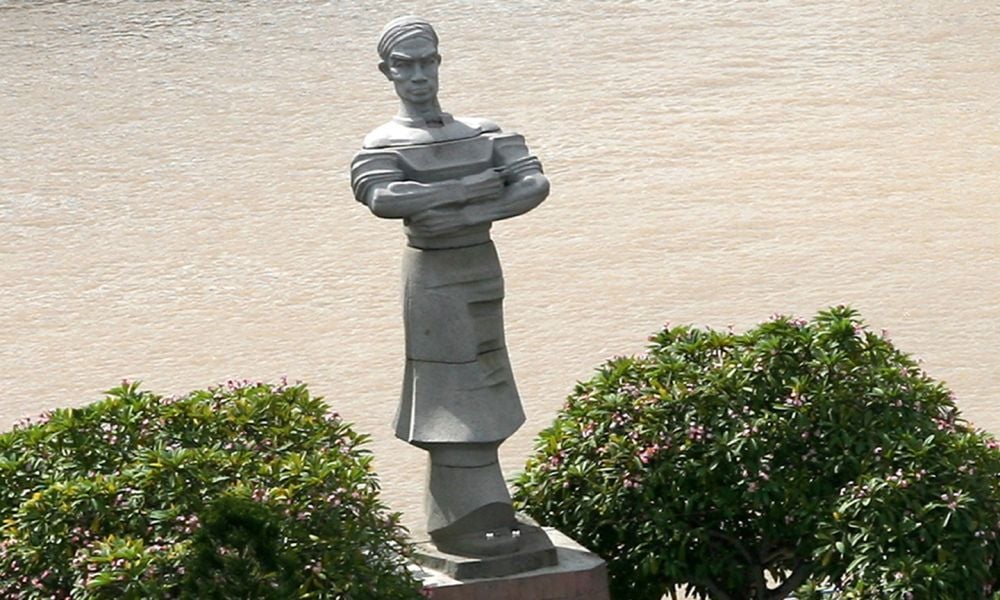
The temple dedicated to Nguyen Huu Huan in Hoa Tinh commune, Cho Gao district (now My Tinh An commune, Dong Thap province), and especially the majestic statue of Valedictorian Nguyen Huu Huan in the center of My Tho ward, on the banks of the peaceful and poetic Tien River, stands as a symbol of the heroic spirit and indomitable resistance of the people of the province.
The temple and tomb of the national hero and top scholar Nguyen Huu Huan were classified as a National Historical and Cultural Monument by the Ministry of Culture and Information in June 1987.
Every year, the commemoration ceremony for the national hero and valedictorian Nguyen Huu Huan is held very solemnly on the 14th and 15th of the 4th lunar month, and a large number of people come to offer incense and pay their respects.
HONG LE
(synthetic)
Source: https://baodongthap.vn/nguoi-anh-hung-mot-long-yeu-nuoc-thuong-dan-a241442.html

![[Photo] The General Secretary, President and his wife begin their state visit to the Philippines.](https://vphoto.vietnam.vn/thumb/1200x675/vietnam/resource/IMAGE/2026/05/31/1780230559452_anh-man-hinh-2026-05-31-luc-19-28-11.png)
![[Photo] Admire the coral "masterpiece" amidst the million-year-old heritage of Dak Lak province.](https://vphoto.vietnam.vn/thumb/1200x675/vietnam/resource/IMAGE/2026/05/31/1780221235105_anh-man-hinh-2026-05-31-luc-16-53-27.png)
![[Photo] Solemn bathing ceremony and Buddha procession in Hue](https://vphoto.vietnam.vn/thumb/1200x675/vietnam/resource/IMAGE/2026/05/31/1780228263543_1-jpg.webp)











![[Video] Sunset at Lap An Lagoon – Where the sun sets over the fishing nets](https://vphoto.vietnam.vn/thumb/340x192/vietnam/resource/IMAGE/2026/05/31/1780192137701_beach-landscape-sea-water-nature-grass-745871-pxhere-com.jpeg)


































![[Photo] Admire the coral "masterpiece" amidst the million-year-old heritage of Dak Lak province.](https://vphoto.vietnam.vn/thumb/402x226/vietnam/resource/IMAGE/2026/05/31/1780221235105_anh-man-hinh-2026-05-31-luc-16-53-27.png)




























Comment (0)