


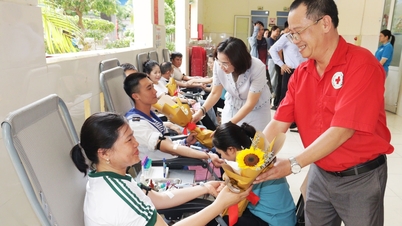
People in Hanoi donate blood following a call from the National Institute of Hematology and Blood Transfusion - Photo: Provided by the Institute
Ms. Ngoc said she felt "indebted" to the volunteer blood donors, people she had never met but who silently gave their blood, saving the lives of her and her son. Ms. Ngoc and her son are just two of thousands of patients who have been and are being saved thanks to donated blood.
Prime Minister Pham Minh Chinh once shared at a meeting with outstanding blood donors nationwide that while science and technology today are not yet capable of producing blood, human compassion can help those in need.
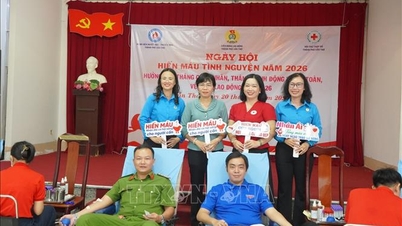
Looking back over 30 years since the first blood donation campaign was launched, voluntary blood donation in our country has become a persistent and widespread humanitarian activity. Each year, Vietnam receives approximately 1.4-1.5 million units of blood; tens of thousands of people have donated blood 30, 50, or even over 100 times.
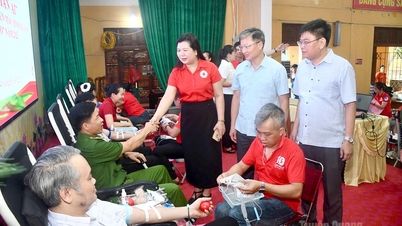
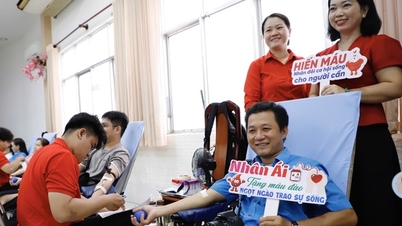
To ensure a consistent supply of blood for saving lives, many localities have maintained a force of repeat blood donors and organized large-scale campaigns such as "Spring Blood Donation Festival," "Red Journey," and "Gratitude Blood Donation"... These campaigns not only replenish the national blood bank in a timely manner but also foster the habit of blood donation as a regular act of kindness within the community.
Nevertheless, the voluntary blood donation movement still faces many challenges. The amount of blood received is not stable, and shortages, which often occur during Tet (Lunar New Year) or summer, continue to recur.
In just the first two months of this summer, the entire country experienced a blood shortage. The reason cited was that the annual blood drive was not organized as planned.
This means that thousands of patients in need of blood and those requiring emergency care will not receive timely treatment, and some may even die.
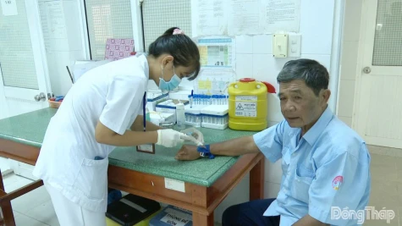
In Hanoi, starting in early May, the National Institute of Hematology and Blood Transfusion planned to organize mobile blood donation drives throughout the city. Invitations to donate blood were sent out.
The institute's fan page constantly uses "mentioning you" to reach potential blood donors. When organizing blood donation drives, some locations initially only have a few dozen registrations, but hundreds of people end up participating. To achieve these numbers, the blood donation drives must be organized as close to the people as possible.
A person living far away may not be able to travel hundreds of kilometers to the National Institute of Hematology and Blood Transfusion to donate blood. However, if the blood donation point is right in their neighborhood, residential area, or hospital near their home, the number of people participating in blood donation will certainly increase significantly.
Therefore, to ensure the sustainability of the voluntary blood donation movement, a comprehensive solution is needed to maintain peak campaigns while simultaneously building a network of regular blood donors at the local level.
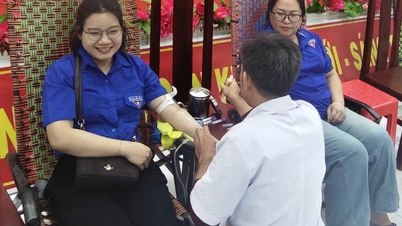
At the same time, it encourages the participation of businesses, hospitals, schools, and religious organizations as "regular blood donation points".
Blood donation centers should be organized regularly, from the commune/ward level to hospitals, so that blood donation volunteers can easily access and donate blood right in their local area. This is something that many localities have not yet achieved.
Our country will reach the milestone of 100 million people in 2025, and among them, tens of millions are eligible to donate blood voluntarily.
Each year, each person can donate whole blood 4 times and platelets 10-12 times. Therefore, if everyone donated blood regularly, the number of blood units received annually would not only be 1.4 to 1.5 million but could be much higher.
Only when each person considers blood donation as an essential part of a humane lifestyle will we no longer worry about a shortage of blood to save lives, so that stories like that of Ms. Ngoc and her child are not just a matter of luck, but a given in a society that knows how to share.
Source: https://tuoitre.vn/noi-dai-giot-mau-cuu-nguoi-20250813111130561.htm

![[Image] Hanoi's urban life under the challenge of a "scorching hot" environment](https://vphoto.vietnam.vn/thumb/1200x675/vietnam/resource/IMAGE/2026/05/25/1779706979265_nang-nong-t5-2026-minh-duy-7-4636-jpg.webp)



![[Image] Close-up view of the interchange connecting the two expressways and Long Thanh Airport.](https://vphoto.vietnam.vn/thumb/1200x675/vietnam/resource/IMAGE/2026/05/25/1779703378210_ndo_br_z7863716673926-224453a31600126cce10622af6290afd-4549-jpg.webp)











































































Comment (0)