

 |
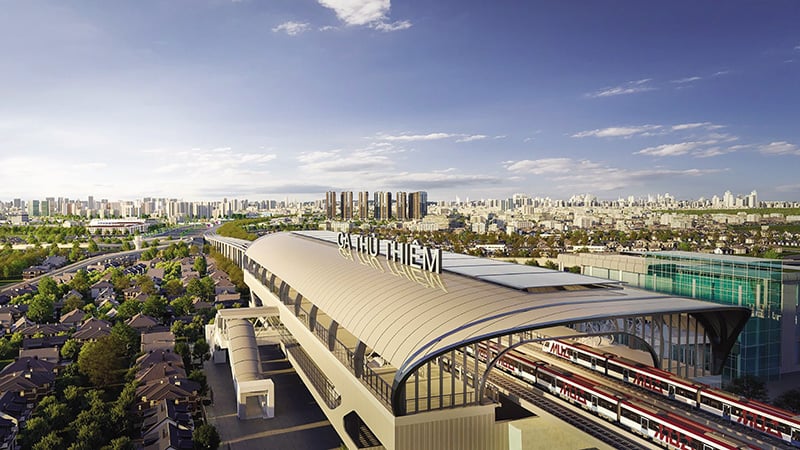
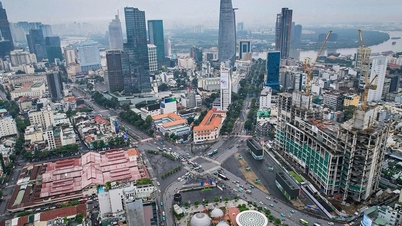
| Adjusting the Railway Network Master Plan for the period 2021-2030, with a vision to 2050, will open up opportunities for many investors to participate. In the photo: Thu Thiem Station. |
second high-speed rail line
To date, the Hanoi-Quang Ninh railway line is the second high-speed railway project in Vietnam with a speed of 350 km/h, currently being considered for investment under the PPP (Public-Private Partnership) model by the Ministry of Construction .
Previously, the Vietnam Railway Authority received an investment plan for the Hanoi - Quang Ninh railway line under the PPP (Public-Private Partnership) model from Vingroup Corporation. According to Vingroup's proposal, the Hanoi - Quang Ninh railway line is proposed to be a high-speed railway within the national railway network; with a design speed of 350 km/h, operating exclusively for passenger trains; a track gauge of 1,435 mm, and electrified.
The route starts at the Vietnam Exhibition Center (Co Loa, Hanoi ) and ends at the Forest Park area, Dai Yen ward (Ha Long, Quang Ninh province, opposite Vinhomes Ha Long Green urban area), with a total length of approximately 120.9 km.
The Hanoi-Quang Ninh railway line is expected to have four stations: Co Loa, Gia Binh, Yen Tu, and Ha Long. The estimated land acquisition for the line is approximately 308.98 hectares; the investment capital required is about 5.4 billion USD (equivalent to 133,175 billion VND); and the implementation period is within the planning period up to 2030.
“Because the Hanoi-Quang Ninh high-speed railway line is not included in the Railway Network Planning for the period 2021-2030, with a vision to 2050, in order for this project to have a legal basis for implementation, the competent state agency needs to approve the planning content of the Hanoi-Quang Ninh railway line and add this railway line to the adjusted Railway Network Planning for the period 2021-2030 and a vision to 2050,” said Mr. Tran Thien Canh, Director of the Vietnam Railway Department.
It is understood that the inclusion of the Hanoi-Quang Ninh railway line in the planning, with an investment roadmap before 2030, is also one of the contents of the Railway Network Planning for the period 2021-2030 and vision to 2050, which the Vietnam Railway Authority is proposing to the Ministry of Construction for consideration and approval.
Specifically, in Report No. 2078/TTr-CĐSVN on the approval of adjustments to the Railway Network Planning for the period 2021-2030, with a vision to 2050, submitted to the Ministry of Construction last week, the Hanoi - Quang Ninh railway line was proposed by the Vietnam Railway Authority to be added to the plan with investment progress before 2030.
According to the Vietnam Railway Authority, the existing railway lines on the Hanoi-Quang Ninh corridor are old lines with many limitations, carrying both passenger and freight trains, with low technical standards, failing to attract and satisfy passenger demands. Meanwhile, the demand for high-quality passenger transport on this transport corridor is constantly increasing, along with the socio-economic development of the provinces in the project study area.
The high-speed railway connecting Hanoi (the political and economic capital) with the provinces of Bac Ninh (a center of tourism, culture, and industry), Hai Phong (a center of industry and agriculture), and Quang Ninh (a center of tourism, industry, and seaport) is expected to create momentum for inter-regional economic development.
"In particular, the Hanoi-Quang Ninh railway line also connects with Gia Binh airport, helping to form a multimodal system (air - rail - road), reducing transportation costs and promoting international trade," a leader of the Vietnam Railway Authority stated.
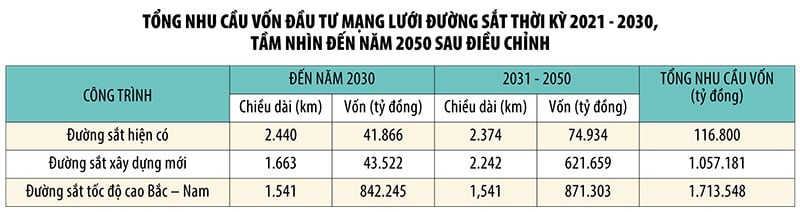 |
Several notable adjustments have been made.
It should be added that the emergence of the Hanoi - Quang Ninh railway line is not the only proposed adjustment to the Railway Network Planning for the period 2021 - 2030 and vision to 2050.
Specifically, for the North-South high-speed railway line, the specialized state management agency proposes adding 5 high-speed freight stations in areas with potential to generate and attract freight transport demand, including: Thuong Tin (Hanoi), Vung Ang (Ha Tinh), Chu Lai (Quang Nam), Ninh Hoa (Khanh Hoa), and Trang Bom (Dong Nai); adding a connecting freight station; and adjusting the high-speed railway depot from Thuong Tin to the Ngoc Hoi area.
Regarding the functional distinction between the high-speed railway line and the existing conventional railway line, the Vietnam Railway Authority proposes that the high-speed railway line will transport passengers, meet dual-use requirements serving national defense and security, and may transport goods when necessary.
For existing railway lines, including the Thong Nhat railway line, they will handle freight and passenger transport over appropriate distances.
Another noteworthy adjustment in Report No. 2078 is that the implementation schedule for many proposed railway lines has been moved forward compared to the Railway Network Planning for the period 2021-2030 and vision to 2050 approved by Decision No. 1579/QD-TTg dated September 22, 2021 of the Prime Minister (Plan No. 1579).
Specifically, the investment schedule for the following railway lines has been adjusted to the period 2021-2030, instead of after 2030: Lao Cai - Hanoi - Hai Phong; Hanoi - Dong Dang, 1,435 mm gauge, 156 km long; Ha Long - Mong Cai, 1,435 mm gauge, 150 km long; Thap Cham - Da Lat railway…
In addition, some railway lines included in Plan No. 1579 are also proposed to be extended in scope and scale, including: the Bien Hoa - Vung Tau railway line (with a length of 132 km instead of 84 km); and the Ho Chi Minh City - Can Tho railway line, which is planned to be extended to Ca Mau when there is sufficient transportation demand.
Conversely, the proposed adjustment to the scope and scale of the Lim - Pha Lai - Ha Long - Cai Lan railway line is from "Yen Vien - Pha Lai - Ha Long - Cai Lan railway line from Yen Vien Bac station to Cai Lan station: single track, gauge 1,000 mm and 1,435 mm, length 129 km" to "upgrading and renovating the Kep - Chi Linh - Ha Long - Cai Lan section, single track, gauge 1,435 mm, length approximately 126 km, and converting the section from Lim to Pha Lai into a service road for the Noi Bai - Ha Long expressway".
Specifically, the Vietnam Railway Authority has recommended that the Thu Thiem - Long Thanh line not be included in the National Railway Network Plan, but instead be transformed into an urban railway.
This change is significant because the latest research shows that the demand for travel on the Thu Thiem - Long Thanh railway line mainly consists of passengers traveling between areas along the route (from Thu Thiem to Long Thanh) and passengers traveling between the central area of Ho Chi Minh City and the areas along the route (including passengers traveling between Tan Son Nhat Airport and Long Thanh Airport).
Thus, the line's target passengers are primarily from both the inner and outer suburbs (estimated to account for approximately 85-90% of the line's travel demand by 2050), indicating that the main function of the Thu Thiem - Long Thanh railway line is urban passenger transport.
"Therefore, adjusting the plan to exclude it from the national railway network plan is necessary to ensure it aligns with the Party and State's direction and the approved national master plan, as well as the transportation needs on the route," said Mr. Tran Thien Canh.
According to our information, the Ministry of Construction has proposed to the Prime Minister that the principle of assigning the Ho Chi Minh City People's Committee as the managing agency for the Thu Thiem - Long Thanh urban railway project be approved, and that the Ho Chi Minh City People's Committee be tasked with working and reaching an agreement with the Dong Nai Provincial People's Committee on assigning the Ho Chi Minh City People's Committee as the managing agency for the project, in order to report to the Prime Minister for a decision in accordance with Article 30 of the Law on Public Investment.
The Ministry of Construction has proposed that the Head of Government allow the People's Committee of Ho Chi Minh City to study the addition of the Thu Thiem - Long Thanh railway line to the Ho Chi Minh City urban railway plan and propose that the Government consider and approve the addition of the Thu Thiem - Long Thanh railway line to the list of projects attached to Resolution No. 188/2025/QH15 dated February 19, 2025, of the National Assembly on piloting some specific and special mechanisms and policies to develop the urban railway network system in Hanoi and Ho Chi Minh City.
The Ministry of Construction stated that this plan will help expedite the implementation of the railway line connecting Tan Son Nhat International Airport with Long Thanh International Airport, ensuring uniformity and synchronization in construction, operation, and maximizing the utilization of land around the project area; and increasing the local authorities' proactive role in project implementation.
"It is estimated that, if the special policy mechanism mentioned above is applied to the connecting route, the investment preparation for the Thu Thiem - Long Thanh urban railway project will take about one year," said Deputy Minister of Construction Nguyen Danh Huy.
Adjustments to the railway network plan are carried out according to the following principles:
Building upon the approved models, spatial allocation guidelines, infrastructure framework, and regional and inter-regional connections, the plan will review and update its content to align with the current state of investment research for railway projects, forecast transportation demand, and the ability to balance resources to ensure its feasibility.
Only update content that aligns with the national master plan regarding the identification of economic corridors, development zones, growth poles, solutions, resources for plan implementation, and progress of nationally important projects.
Updating the Party and State's policies and development orientations related to the development goals of high-speed rail lines, railways connecting border gates, seaports, and international airports, in order to promote the development of transport infrastructure, regional connectivity, inter-regional connectivity, and international intermodal transport.
Source: https://baodautu.vn/noi-quy-hoach-don-cac-dai-du-an-ha-tang-duong-sat-d386545.html
![[Photo] Secretary of the National Assembly Party Committee, Chairman of the National Assembly presides over the meeting of the Standing Committee and Executive Committee of the National Assembly Party Committee.](https://vphoto.vietnam.vn/thumb/1200x675/vietnam/resource/IMAGE/2026/06/03/1780480353201_ndo_br_bnd-2585-jpg.webp)

![[Photo] General Secretary and President To Lam presides over a meeting with the Central Organizing Committee.](https://vphoto.vietnam.vn/thumb/1200x675/vietnam/resource/IMAGE/2026/06/03/1780482764658_a1-bnd-4741-3342-jpg.webp)



























![[Photo] First session of the 14th Congress of the Vietnam Trade Union](https://vphoto.vietnam.vn/thumb/1200x675/vietnam/resource/IMAGE/2026/06/03/1780465947883_ndo_br_img-3852-jpg.webp)


























![[Video] Sunset at Lap An Lagoon – Where the sun sets over the fishing nets](https://vphoto.vietnam.vn/thumb/1200x675/vietnam/resource/IMAGE/2026/05/31/1780192137701_beach-landscape-sea-water-nature-grass-745871-pxhere-com.jpeg)






























Comment (0)