

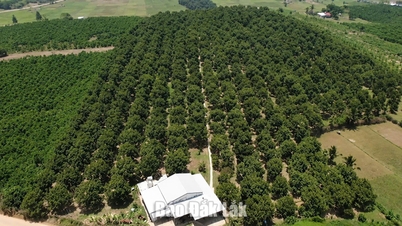
This is the first production season in which the Ea Súp Poverty Reduction Cooperative has implemented the large-scale model of a model field on 20 hectares of leased and jointly owned land from member households in Ia Lốp commune.
During the production process, households receive technical support from the cooperative, including management of seed quantities, fertilizers, pesticides, irrigation water sources, and guidance on measures to reduce post-harvest losses.
Mr. Vi Van Thiet, from Chieng village, said that previously, his family and many other households in the area mainly cultivated using traditional methods. Small-scale production and a lack of linkages resulted in low productivity, and the output depended on traders, thus limiting economic efficiency. “Since joining the cooperative, my family has 1 hectare of rice paddies cultivated under a linked production chain. We receive technical training, support with seeds and production materials, and the company guarantees the purchase of our products. Mechanization has been introduced to the fields, significantly reducing labor costs, saving expenses, and eliminating concerns about market access,” Mr. Thiet shared.
 |
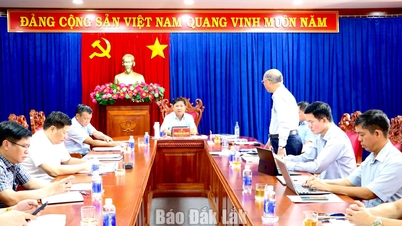
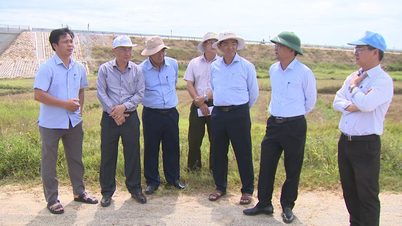
| Local leaders, cooperatives, and experts evaluated the results of the Ia Lốp rice production and consumption linkage model. |
According to Mr. Nguyen Viet Duc, Director of the Ea Sup Poverty Reduction Cooperative, established 7 years ago with the goal of supporting livelihoods and creating economic development opportunities for people, especially disadvantaged households in the area, the cooperative currently has 81 members with a total cultivated area of 92 hectares. In this year's Winter-Spring crop season, the cooperative focused on building a large-scale model field to address production costs and organize the supply chain. The use of 100% Dai Thom 8 rice variety combined with closed-loop mechanization helped achieve yields of 7.5-8 tons/ha. The cooperative also strictly controls input materials right from the field, reducing waste and bringing post-harvest losses down to below 5%.
In particular, the entire rice yield after harvest is purchased directly from the fields by the affiliated enterprise and transported to the processing plant on the same day. This not only helps ensure product quality but also limits price manipulation, helping farmers feel secure in their production.
Not only do the people benefit, but the linkage model also creates conditions for businesses to build stable raw material areas. Mr. Vu Dinh Muoi, Chairman of the Board of Directors of Phan Gia Trading and Service Co., Ltd., said that after more than 5 years of surveying and working with the locality, the company realized that the locality has great potential to develop a high-quality commercial rice production area.
According to Mr. Mười, investing in a factory right in the raw material area helps businesses proactively procure raw materials, reduce transportation costs, and ensure product quality. With the cooperation of cooperatives and local authorities, the business is gradually expanding its raw material area to thousands of hectares to meet future processing and consumption needs.
Evaluating the effectiveness of the model, Mr. Le Anh Ung, Vice Chairman of the People's Committee of Ia Lop commune, said that this is a breakthrough in agricultural production in the locality. Previously, people mainly produced on a small scale, so the economic value was not high. When the cooperative linked households, organized concentrated production, and connected with businesses to guarantee product consumption, it created a more sustainable value chain. In the future, the locality will continue to encourage people to participate in linkage models, support human resource development, and improve the irrigation system in the fields. In particular, phase 2 of the irrigation project with 45 canals is being implemented to ensure water supply for production.
| Based on initial results, the rice production linkage model in Ia Lop commune is opening up a new direction for agriculture in the border region. The close cooperation between farmers, cooperatives, businesses, and the government not only helps increase the value of rice but also contributes to changing production mindsets, moving towards a sustainable and modern commodity-based agriculture. |
Van Anh
Source: https://baodaklak.vn/kinh-te/202606/nong-dan-vung-bien-xay-dung-chuoi-lien-ket-lua-gao-f481baa/
![[Photo] First session of the 14th Congress of the Vietnam Trade Union](https://vphoto.vietnam.vn/thumb/1200x675/vietnam/resource/IMAGE/2026/06/03/1780465947883_ndo_br_img-3852-jpg.webp)


![[Photo] Secretary of the National Assembly Party Committee, Chairman of the National Assembly presides over the meeting of the Standing Committee and Executive Committee of the National Assembly Party Committee.](https://vphoto.vietnam.vn/thumb/1200x675/vietnam/resource/IMAGE/2026/06/03/1780480353201_ndo_br_bnd-2585-jpg.webp)

![[Photo] General Secretary and President To Lam presides over a meeting with the Central Organizing Committee.](https://vphoto.vietnam.vn/thumb/1200x675/vietnam/resource/IMAGE/2026/06/03/1780482764658_a1-bnd-4741-3342-jpg.webp)
































![[Video] Sunset at Lap An Lagoon – Where the sun sets over the fishing nets](https://vphoto.vietnam.vn/thumb/1200x675/vietnam/resource/IMAGE/2026/05/31/1780192137701_beach-landscape-sea-water-nature-grass-745871-pxhere-com.jpeg)































Comment (0)