

During the years 1973-1974, the resistance war against the US for national liberation waged by our army and people in the South was intense. In January 1973, the Paris Agreement was signed. Despite suffering heavy defeats, the US imperialists and their henchmen stubbornly pursued their plot to impose neo-colonialism on the entire South of our country. They brazenly trampled on most of the main provisions of the Agreement, continuing to wage a large-scale neo-colonial war with plans of "territorial inundation" and "pacification" campaigns to seize liberated areas, accumulating countless crimes against our people.
Having correctly assessed the enemy's plot, our Party concluded that, under any circumstances, the path to victory for the revolution in the South had to be the path of violence, resolutely using revolutionary warfare to defeat the new form of colonial war waged by the US and its puppet regime.
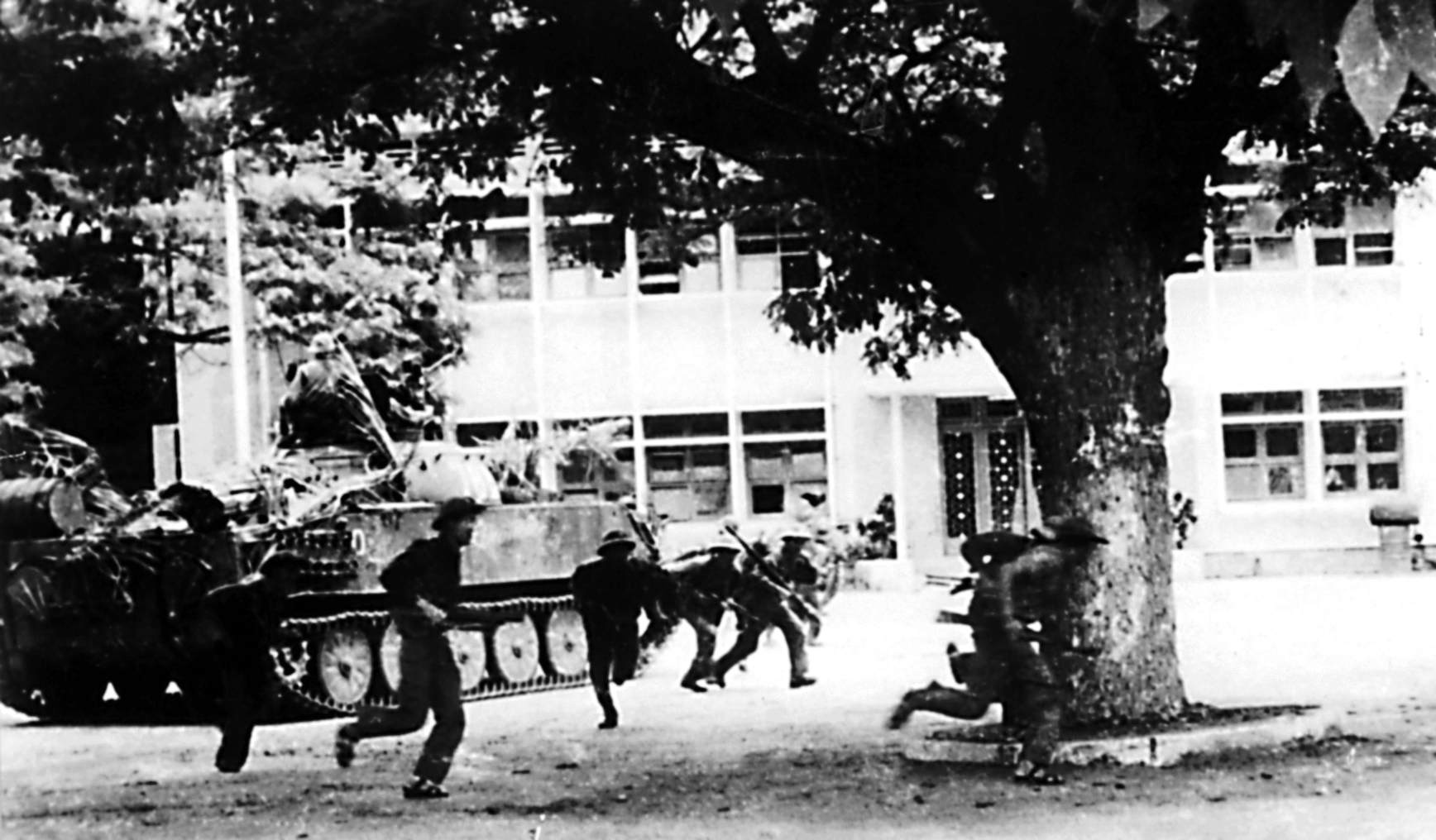
Soldiers captured the administrative building at 9:30 AM on April 16, 1975. (Archival photo)
After the two years of 1973-1974, and especially after the victory in liberating Phuoc Long (January 6, 1975), the battlefield situation in the South changed fundamentally in our favor. The Politburo meetings of the Central Committee of the Party in October 1974 and early 1975 promptly assessed the balance of forces between us and the enemy, clearly identifying the emergence of a historical opportunity: "The whole year of 1975 is an opportunity... if the opportunity comes at the beginning or end of the year, we will immediately liberate South Vietnam in 1975," and decided on a general offensive and uprising to liberate the South, culminating in the historic Ho Chi Minh Campaign in the spring of 1975.
Following successive defeats in the Central Highlands and the coastal provinces of Central Vietnam, the Saigon regime was in extreme disarray. They ordered a troop withdrawal, establishing a forward command post and building a "remote defense line" to protect Saigon. They designated Du Long, 30km north of Phan Rang, as their main stronghold, determined to fight to the death in Ninh Thuan and Binh Thuan provinces. Here, the enemy concentrated their forces, including the 6th Air Force Division, two infantry regiments and battalions, one commando brigade, two tank squadrons, and a fleet offshore ready to provide support. With this "remote defense line," they hoped to restore the morale of their soldiers after a series of disastrous defeats on other battlefields, halt the rapid advance of our forces, and protect the Saigon regime's headquarters from complete collapse.
Faced with a once-in-a-lifetime opportunity, on March 31, 1975, the Politburo met and decided: “The revolutionary war in the South has entered a leapfrog stage of development; the strategic opportunity to launch a general offensive and uprising against the enemy's stronghold has matured. From this moment, the final strategic decisive battle of our army and people begins.” The Politburo resolved: “With the guiding principle of speed, boldness, surprise, and certain victory, with the great determination to carry out the general offensive and uprising as soon as possible, ideally in April 1975, there can be no delay.” Implementing the Politburo's directive, the Regional Party Committee and Military Region 6 instructed the Ninh Thuan Provincial Party Committee: “The opportunity has arrived; the Ninh Thuan Provincial Party Committee must mobilize all forces in the delta and base areas, immediately advance to attack the enemy, support the masses in rising up to destroy enemy strongholds and liberate the homeland.”
After the liberation of Khanh Hoa and Lam Dong provinces, from April 1st to 3rd, 1975, remnants of enemy forces in Da Lat fled along Highway 11 towards Phan Rang. Seizing the opportunity, our troops launched attacks against the enemy, capturing hamlets in Song My; then successively capturing hamlets along Highway 11 from Krong Pha to Deo Cau, liberating Krong Pha district. Although the enemy used numerous aircraft combined with tanks, artillery, and infantry to fiercely attack the base areas and newly liberated zones, the army and people of Ninh Thuan remained steadfast, repelling all enemy counterattacks. Under the direction of Military Region 6, the Ninh Thuan Provincial Party Committee directed the withdrawal of local troops from Bac Ai and Anh Dung districts, along with several other provincial units, to reinforce Battalion 610. Their mission was to hold Deo Cau Pass, intercept enemy counterattacks from Thanh Son airfield, protect Krong Pha district, and be ready to coordinate with the main forces to liberate Phan Rang.
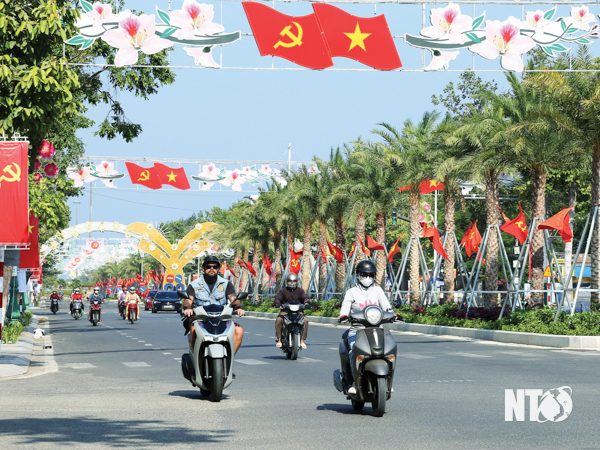
April 16th Street (Phan Rang - Thap Cham City). Photo: Van Ny
On the afternoon of April 7, 1975, at Thap Cham, while the enemy was in disarray and confusion, our forces launched an offensive to control the collaborators, thugs, and militia. At 7 PM that same day, the town's armed forces and secret guerrillas attacked Nguyen Hoang Camp, Thap Cham train station, Cau Mong bridge, Thap Cham intersection, and Buu Son district headquarters. The enemy at Thanh Son airfield launched a fierce counterattack. Company 311, with the support of militia, guerrillas, and the people of Xom Dua, fought bravely for two days and nights deep within enemy territory, repelling 16 counterattacks. To break through the enemy's distant defense line, General Le Trong Tan, Commander of the Coastal Army, decided to use the 3rd Division of Military Region 5, the 25th Regiment of the Central Highlands, and Military Region 6, reinforced with two special forces and engineering companies, along with forces from Ninh Thuan, to prepare for an attack on the "Distant Defense Line." The Ninh Thuan Provincial Party Committee made the highest resolution, leading the local troops, militia, and people of the province to coordinate with the main forces of the Central Government and the Military Region to launch an attack and uprising to overthrow the US-puppet regime and liberate the province.
On the morning of April 14, 1975, our main army began shelling enemy strongholds at Ba Rau, Suoi Da, Kien Kien, Ba Thap, Nui Dat, and Thanh Son airfield. By 7:00 AM on April 14, 1975, our 3rd Infantry Division attacked and captured Du Long district town and the positions at Ba Rau, Suoi Vang, and Suoi Da, eliminating a significant portion of the enemy forces there; simultaneously, we repelled numerous counterattacks aimed at maintaining the "Distant Defense Line." On the morning of April 16, 1975, the order to attack was given, and our forces were divided into three main prongs: The first prong, led by tanks, advanced along National Highway 1, and after capturing Phan Rang, would advance towards Thanh Son airfield from the south; the second prong attacked Thanh Son airfield directly from the northwest; and the third prong captured Ninh Chu port, preventing the enemy from escaping to the sea. In coordination with the main forces, the 311th Regiment at Ca Du Mountain launched an attack, flanking the retreating enemy. In the Northwest, two special forces and engineering companies of Military Region 6, in coordination with local forces, advanced directly into Phuoc Thien and Ninh Quy, crossing the Iron Bridge into the Bao An - Thap Cham area. At 9:30 AM on April 16, 1975, the Liberation Front flag flew atop the Ninh Thuan Administrative Building – the headquarters of the puppet regime – marking the complete liberation of Ninh Thuan province. The shattered distant defense line protecting Saigon paved the way for our main army to advance and liberate Saigon, successfully concluding the historic Ho Chi Minh Campaign.
PhD
Source


![[Photo] The courage of new recruits of Brigade 144 on the training ground.](https://vphoto.vietnam.vn/thumb/1200x675/vietnam/resource/IMAGE/2026/05/27/1779881651341_anh-man-hinh-2026-05-27-luc-18-32-52.png)
![[Photo] General Secretary and President To Lam and his wife begin their official visit to Thailand.](https://vphoto.vietnam.vn/thumb/1200x675/vietnam/resource/IMAGE/2026/05/27/1779881249412_anh-man-hinh-2026-05-27-luc-18-10-51.png)











































![[Photo] The courage of new recruits of Brigade 144 on the training ground.](https://vphoto.vietnam.vn/thumb/402x226/vietnam/resource/IMAGE/2026/05/27/1779881651341_anh-man-hinh-2026-05-27-luc-18-32-52.png)






















Comment (0)