

Hero of the People's Armed Forces Le Thi Thu Hanh |
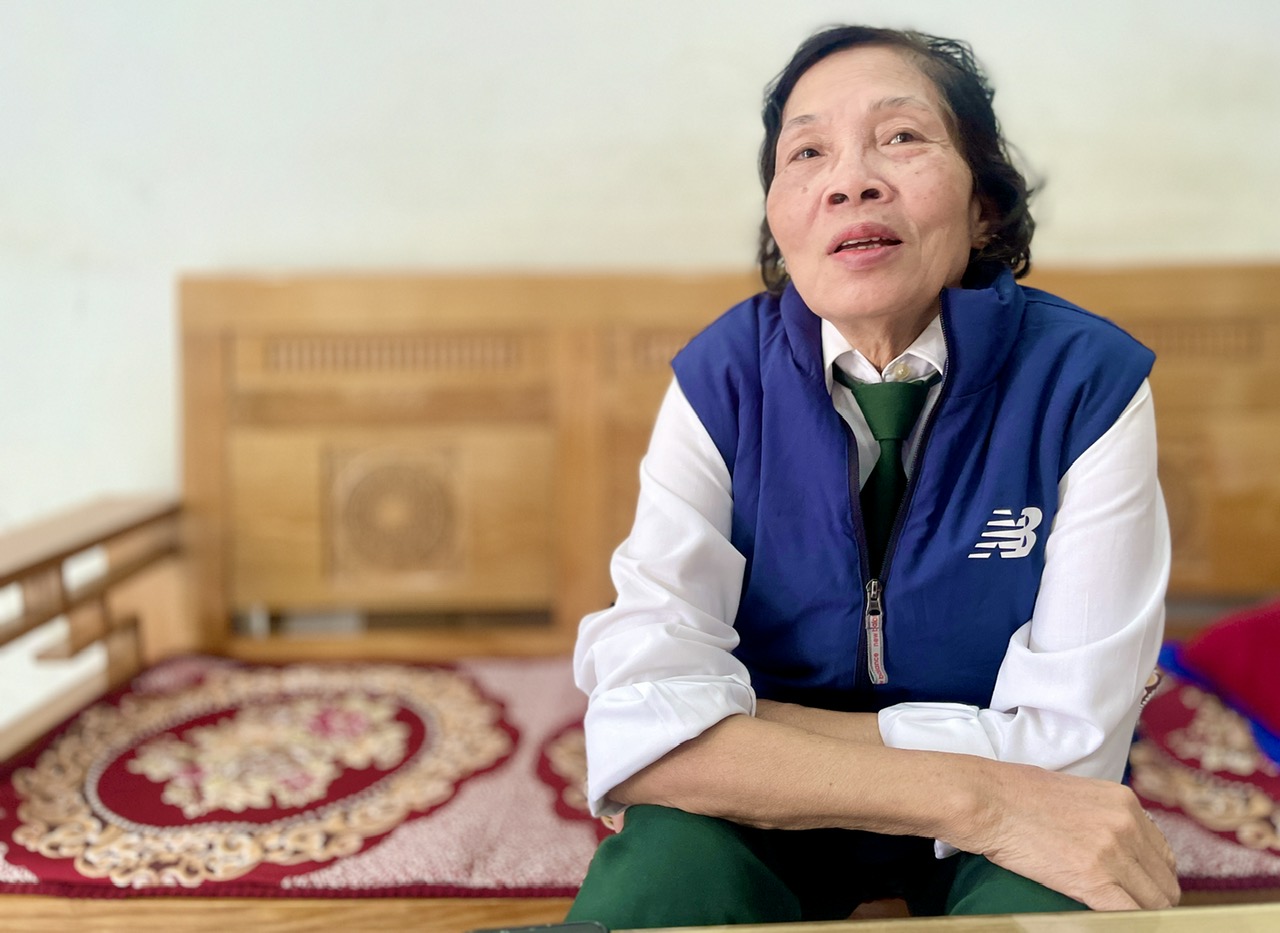
The young messenger girl lived amidst gunfire.
In Hue during the 1950s, war permeated every alleyway and every moss-covered roof; beneath the shady green trees along the Perfume River, the sounds of gunfire and bombs occasionally echoed from afar...
Ms. Le Thi Thu Hanh was born in 1951 into a family with a revolutionary tradition in Phong Chuong commune, Phong Dien district, Thua Thien Hue province (now Phong Chuong commune, Phong Dien town, Hue city).
Her childhood wasn't filled with carefree days of running and playing in the fields or frolicking with friends, but rather with afternoons spent hiding in bomb shelters and nights huddled together listening to the distant roar of cannons.
"I've known about war since I was born. Every day, I would ask my relatives: 'Will the enemy launch an attack tonight?'" Mrs. Le Thi Thu Hanh began her story.
Her parents were revolutionary cadres, operating secretly in enemy-occupied territory. In 1954, they relocated to the North, and young Thu Hạnh lived with her grandfather.
"I don't have many memories of my parents from my childhood, except for the rare letters they sent from the North…," Mrs. Hanh said thoughtfully.
Phong Chuong commune, where she lived, was one of the important revolutionary base areas. Sweeps were commonplace. Children in the village grew up not listening to fairy tales, but to stories about how to evade conscription, how to identify and report enemy soldiers.
Like other children, as soon as dusk fell, Thu Hanh's relatives would urge her to run down to the cellar and huddle there to avoid the bullets. "Once, American soldiers suddenly raided the village, searching every house. My grandfather hid me in a large earthenware jar, sealing the lid tightly. My heart was pounding. I could clearly hear the sound of rifle butts hitting tables and chairs, along with shouts," Mrs. Hanh recalled.
During the brutal years of war, from a young age, she was taught by her grandfather how to observe, how to listen, and how to keep secrets. At 13, she began her first assignments: working as a courier, delivering news between revolutionary bases.
Ms. Le Thi Thu Hanh in 1975. Photo: Provided by the interviewee. |
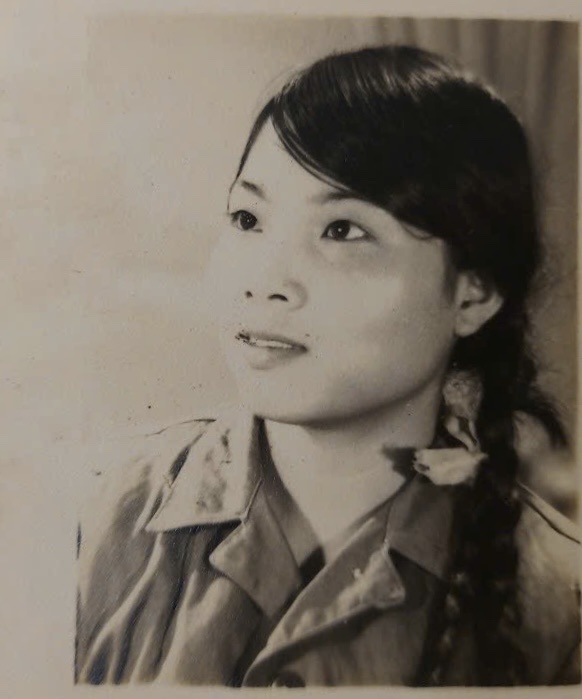
The job seemed simple, but it was extremely dangerous. She disguised herself as a street vendor, wearing a conical hat, covering her face, and carrying a few cakes or a bunch of vegetables along with small, rolled-up pieces of paper hidden inside.
Once, while delivering a message, she was stopped by American soldiers. A tall soldier bent down, staring intently and asking, "Where are you going in such a hurry, little girl?" - "I'm going to sell vegetables for my mother!" The soldier sneered, reaching up to lift the conical hat from her head as if searching for something.
Ms. Hanh said, "At that moment, all I could do was pray to God. If he found the pieces of paper hidden under the bunch of vegetables, she certainly wouldn't have had a chance of survival."
During her time as a courier, the 13-year-old girl witnessed many heartbreaking scenes. She once saw American soldiers execute a civilian suspected of being a revolutionary operative.
From a distance, Thu Hanh saw the old man kneeling, his eyes closed, his lips moving as if praying. When the gunshot rang out, she turned away, but in her heart she vowed that if it were her, she would never surrender…
Standing side by side with wounded soldiers
It was the painful memories of her childhood that forged in Ms. Le Thi Thu Hanh an iron will.
"I used to think that if I didn't carry a gun, I had to do something to contribute to this war," Ms. Hanh confided.
Ms. Hanh still vividly remembers the day she was assigned her new duty: becoming a battlefield nurse, belonging to Treatment Team 82 stationed along the Ta Luong pass on the way to A Luoi district. At that time, she was only 17 years old. A petite girl with bright eyes and clumsy hands, she never imagined she would one day hold a scalpel and bandage bleeding wounds on the battlefield. Before that, at the age of 15, Ms. Le Thi Thu Hanh participated in the youth volunteer movement, carrying ammunition...
"I didn't receive formal medical training; I only got basic instruction on how to stop bleeding and bandage wounds. But when I witnessed my teammates' pain, I understood that I needed not only strong hands but also a strong heart to overcome fear," Ms. Hanh shared.
The "field hospital" where she worked was deep in the jungle of the war zone. It wasn't a proper hospital, but just makeshift shelters built from bamboo and palm leaves. To ensure safety, she and the other nurses had to dig deep underground bunkers to protect themselves from enemy aircraft. During heavy rains, water would flood into the bunkers…
Ms. Hanh's main duties were bandaging wounds, supplying medicine, and caring for the wounded. But on numerous occasions, she had to rush into emergency surgeries when doctors lacked support staff.
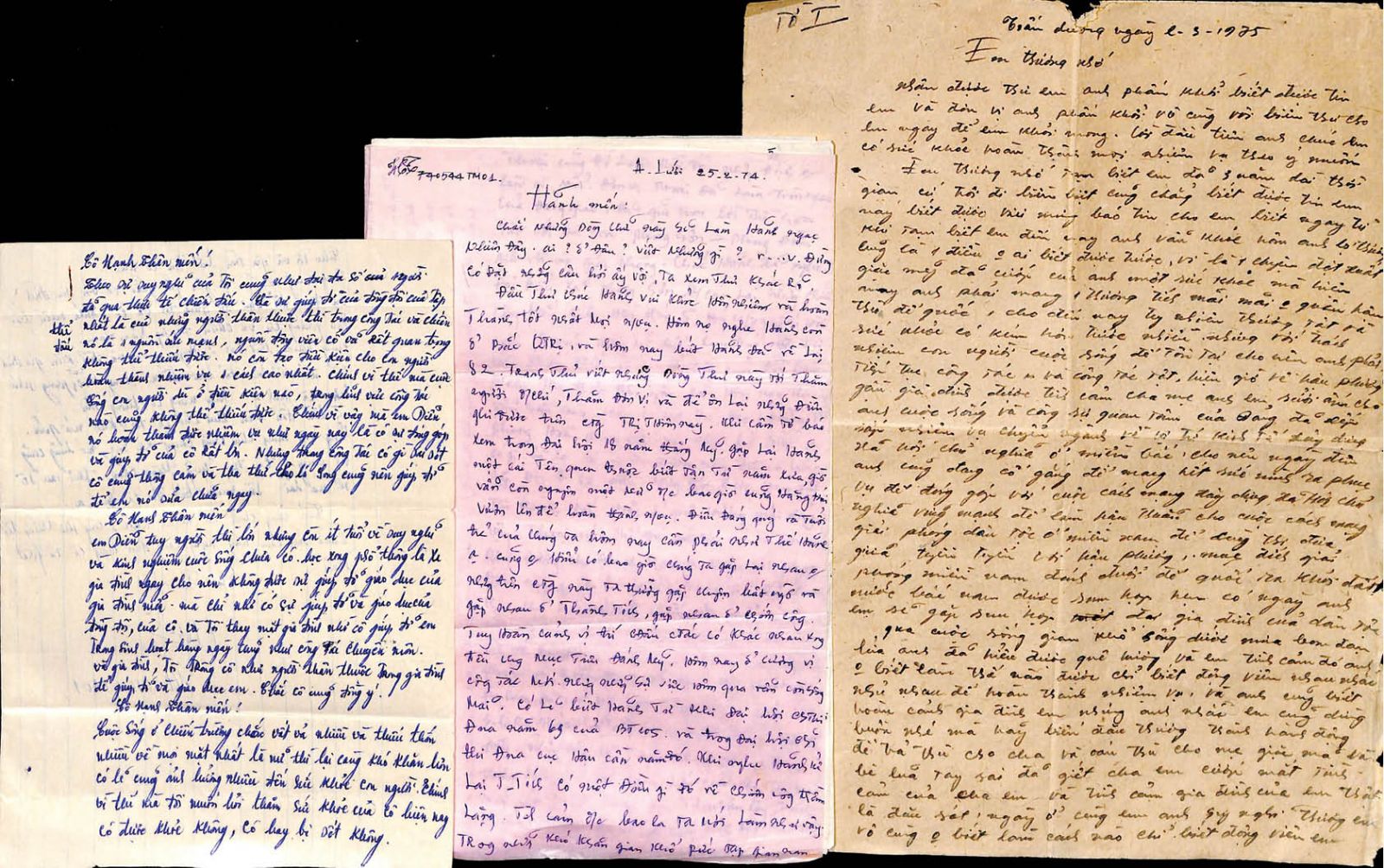
These letters from comrades to Ms. Hanh express gratitude and share thoughts and aspirations from the war years. (Photo: Provided by the interviewee) |
Ms. Hanh recalled that on a rainy night in 1969, a soldier was hit by artillery fire, shrapnel lodged deep in his abdomen, and blood flowed incessantly. The doctor called on her to assist in the surgery. At first, her hands trembled, but when she heard him groan in pain, she knew she couldn't be afraid. "I held the wound tightly, wiped the doctor's sweat, and worked like that for three hours," Ms. Hanh recounted.
The surgery was successful, but the wounded soldier still had a high fever. For the next week, she barely slept, constantly by his side, feeding him spoonfuls of water and porridge.
"The day he woke up, I was so happy I cried. He held my hand and said, 'I'm sure I'm still alive thanks to you.' I smiled, but my heart ached, knowing he wouldn't be able to go to the battlefield again," Mrs. Hanh said.


![[Video] Sunset at Lap An Lagoon – Where the sun sets over the fishing nets](https://vphoto.vietnam.vn/thumb/1200x675/vietnam/resource/IMAGE/2026/05/31/1780187239592_2222.jpeg)














































































Comment (0)