

Although humans have never set foot on Mars, man-made debris from landers and rovers still piles up on the red planet.
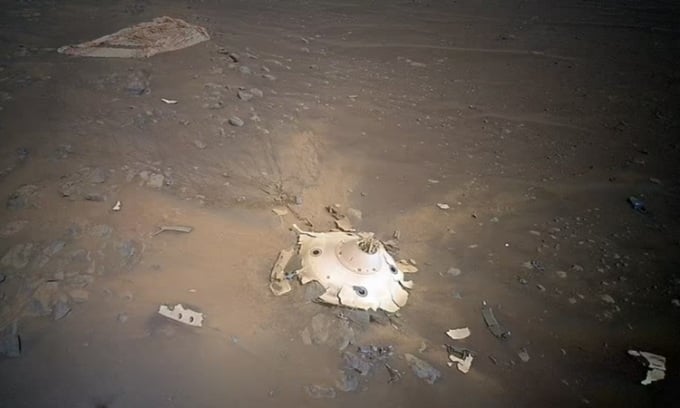
The parachute and conical shield protect the Perseverance rover during landing. Photo: NASA
A new map reveals the locations of debris from Mars landing vehicles over the past 53 years, including NASA's decommissioned Ingenuity helicopter, the Mail reported on January 31. This debris includes metal landing gear, heat shields, used parachutes, broken rotor blades, nose cones, and even fabric netting. Cagri Kilic, a professor of aerospace engineering at West Virginia University, estimates the amount of human-made debris on Mars to be as high as 7,119 kilograms, equivalent to the weight of a fully grown African elephant.
Examples of human-made debris on the red planet include Russia's Mars 2 lander, the first man-made object to touch the Martian surface when it crashed in May 1971. Beagle 2, another Russian spacecraft, landed on the red planet in December 2023 but was subsequently lost. Now, the latest object to join this group is NASA's Ingenuity helicopter, which was unable to continue flying after a rotor broke off on January 18th. Due to the damaged rotor and lack of wheels, the helicopter is stuck and unable to move, although it maintains contact with ground control.
These vehicles demonstrated remarkable achievements by flying to a planet 225 million kilometers from Earth, and many of the machines performed valuable scientific experiments upon landing. Professor Alice Gorman, an astroarchist at Flinders University in Australia, likened the decommissioned landers to historical records of humanity's connection with Mars. "Ingenuity shows how far the technology we need to adapt to another planetary environment can go," Gorman said.
But when the machines stop working, they turn Mars into a garbage dump. Dr. James Blake, a space debris researcher at the University of Warwick, argues that future missions to Mars should be designed with sustainability in mind. That means designing spacecraft that don't discard parts upon landing on Mars, or bring them back to Earth when the mission ends. Manned missions to Mars in a few decades could land on the planet and collect space debris.
Including Ingenuity, nearly 20 landers have reached the Martian surface via successful gentle landings or dramatic crashes. Many landers that crashed now exist as debris or even burn marks, evidence that they successfully reached Mars before crashing on the final leg of their journey. One example is NASA's Mars Polar lander, which crashed while attempting to land at the south pole in December 1999. A 2005 photograph of the crash site shows the parachute and Martian dust burned by rocket engines. Another similar example is the Italian lander Schiaparelli, which crashed into the Martian surface at 306 km/h in October 2016. Schiaparelli left behind a black dot surrounded by the lander's heat shield and parachute.
Other spacecraft that landed and completed their missions also left a trail of debris during their operation. NASA's Opportunity rover, which operated from 2004 to mid-2008, created a trail of debris as it traveled across the red planet. The rover, weighing approximately 157 kg, is now stuck in the Martian soil. It transmitted a 2004 image of its heat shield along with debris scattered across the ground for several kilometers. According to Kilic, much of the rover remains intact, and space agencies consider it a historical monument rather than junk.
An Khang (According to Mail )
Source link

![[Photo] Standing Committee member of the Party Central Committee Tran Cam Tu working with the Central Inspection Committee](https://vphoto.vietnam.vn/thumb/1200x675/vietnam/resource/IMAGE/2026/05/28/1779969579668_ndo_br_bnd-2495-jpg.webp)



















![[GALLERY] A "billion-dollar" game that hasn't even been released yet is already driving gamers crazy.](https://vphoto.vietnam.vn/thumb/402x226/vietnam/resource/IMAGE/2026/05/28/1779977371733_goi-3-png.webp)






















































































Comment (0)